DEF 14A: Definitive proxy statements
Published on March 27, 2026
UNITED STATES
SECURITIES AND EXCHANGE COMMISSION
Washington, D.C. 20549
SCHEDULE
(Rule 14a-101)
SCHEDULE 14A INFORMATION
Proxy Statement Pursuant to Section 14(a) of the
Securities Exchange Act of 1934
(Amendment No.)
Filed by the Registrant ☒ |
Filed by a Party other than the Registrant ☐ |
Check the appropriate box:
☐ |
Preliminary Proxy Statement |
|
|
☐ |
Confidential, for Use of the Commission Only (as permitted by Rule 14a-6(e)(2)) |
|
|
☒ |
Definitive Proxy Statement |
|
|
☐ |
Definitive Additional Materials |
|
|
☐ |
Soliciting Material under §240.14a-12 |
(Name of Registrant as Specified In Its Charter)
(Name of Person(s) Filing Proxy Statement, if other than the Registrant)
Payment of Filing Fee (Check all boxes that apply):
☒ |
No fee required. |
|
|
☐ |
Fee paid previously with preliminary materials |
|
|
☐ |
Fee computed on table in exhibit required by Item 25(b) per Exchange Act Rules 14a-6(i)(1) and 0-11 |

Notice of 2026 Annual Meeting of Shareholders and Proxy Statement
Teradyne, Inc.
May 8, 2026 10:00 A.M. Eastern Time
600 Riverpark Drive North Reading, Massachusetts 01864
|

NOTICE OF 2026 ANNUAL MEETING OF SHAREHOLDERS
|
Date and Time May 8, 2026 |
|
Location 600 Riverpark Drive, |
|
Who Can Vote Shareholders of record as of March 13, 2026 are entitled to vote |



To the Shareholders:
The Annual Meeting of Shareholders of Teradyne, Inc., a Massachusetts corporation (“Teradyne,” the “Company,” “we,” “it”, “our” or “us”), will be held on Friday, May 8, 2026 at 10:00 A.M. Eastern Time, at the offices of Teradyne, Inc. at 600 Riverpark Drive, North Reading, Massachusetts 01864 (the “Annual Meeting”), for the following purposes:
Voting Items |
Board Voting Recommendations |
Page Reference |
1. To elect the nine nominees named in the accompanying proxy statement to the Board of Directors |
FOR each nominated Director |
24 |
2. To approve, on a non-binding, advisory basis, the 2025 compensation of the Company’s named executive officers |
FOR |
36 |
3. To ratify the appointment of PricewaterhouseCoopers LLP as the Company’s independent registered public accounting firm for the fiscal year ending December 31, 2026 |
FOR |
83 |
Shareholders will also transact such other business as may properly come before the meeting and any postponements or adjournments thereof. For additional information on how you may attend or vote at the Annual Meeting, please see page 87 of the proxy statement.
On or about March 27, 2026, we mailed to our shareholders of record as of March 13, 2026, a notice containing instructions on how to access this proxy statement and Teradyne’s annual report online and to vote, and printed copies of these proxy materials to shareholders that requested printed copies.
By Order of the Board of Directors, |
Proxy Voting Please promptly sign, date, and return your proxy card or voting instruction form, or submit your proxy and/or voting instructions by telephone or through the Internet so that a quorum may be represented at the meeting. Any person giving a proxy has the power to revoke it at any time, and shareholders who attend the meeting may withdraw their proxies and vote at the meeting. |
Ryan E. Driscoll, Secretary |
Important Notice Regarding the Availability of Proxy Materials for the Annual Meeting to be Held on May 8, 2026. The proxy statement and the accompanying Annual Report on Form 10-K, Letter to Shareholders, and Notice, are available at www.proxyvote.com.
Teradyne, Inc. | 2026 Notice of Annual Meeting & Proxy Statement | Page i
Table of Contents
|
|
Page |
|
1 |
|
|
2 |
|
|
9 |
|
|
9 |
|
|
19 |
|
|
20 |
|
|
24 |
|
|
25 |
|
|
30 |
|
|
32 |
|
|
33 |
|
|
35 |
|
Proposal No. 2: Advisory Vote on Compensation of Named Executive Officers |
|
36 |
|
37 |
|
|
37 |
|
|
37 |
|
|
38 |
|
|
42 |
|
|
58 |
|
|
59 |
|
|
48 |
|
|
60 |
|
|
63 |
|
|
Page |
|
64 |
|
|
64 |
|
|
64 |
|
|
66 |
|
|
68 |
|
|
70 |
|
|
70 |
|
|
71 |
|
|
75 |
|
|
77 |
|
Proposal No. 3: Ratification of Appointment of Independent Registered Public Accounting Firm |
|
83 |
|
83 |
|
|
84 |
|
|
84 |
|
|
85 |
|
|
87 |
|
|
90 |
|
|
91 |
|
|
92 |
|
|
A-1 |
Teradyne, Inc. | 2026 Notice of Annual Meeting & Proxy Statement | Page ii
ABOUT TERADYNE
Teradyne, Inc. (“Teradyne,” the “Company,” “we,” “our” or “us”) was founded in 1960 and is a leading global provider of automated test equipment and robotics solutions. Teradyne's automated test systems are used to test semiconductors, wireless products, data storage, silicon photonics, and complex electronics systems in many industries including consumer electronics, wireless, automotive, industrial, computing, communications, and aerospace and defense. Teradyne's robotics product offerings consist primarily of collaborative robotic arms and autonomous mobile robots used by global manufacturing, logistics and industrial customers to improve quality, increase manufacturing and material handling efficiency while reducing costs. In the first quarter of 2025, Teradyne identified opportunities for operational synergies amongst our production board test, defense and aerospace, and wireless test businesses leading to the creation of the Product Test division as a new segment effective March 2025. Teradyne’s automated test equipment and robotics products and services include:
In 2025, Teradyne had revenue of $3.19 billion and today employs approximately 6,600 people worldwide.
In 2025, our Semiconductor Test segment achieved significant growth driven by robust demand from Artificial Intelligence ("AI") applications in networking and with vertically integrated producer ("VIP") compute solutions. Memory test revenue remained stable despite a smaller overall market, supported by share gains in high bandwidth memory and dynamic random access memory ("DRAM") final test applications. The Semiconductor Test segment’s strategic shift toward AI-driven semiconductor testing resulted in AI demand driving the majority of our revenue in the second half of 2025. Our 2025 results reflect our continued investments in AI applications and VIP customers, with benefits from these initiatives materializing throughout 2025. In the Product Test segment, we also achieved revenue growth in 2025, bolstered primarily by strength in defense and aerospace applications.
In our Robotics segment, the fourth quarter of 2025 represented the third consecutive quarter of sequential revenue growth. During the year, we focused on strategic partnerships with original equipment manufacturers, systems integrators, and large enterprise accounts, concentrating on high-growth verticals such as ecommerce, logistics, semiconductor, and electronics. At the same time, we also reduced costs through restructuring activities designed to better support the Robotics organization for future success.
Teradyne, Inc. | 2026 Notice of Annual Meeting & Proxy Statement | Page 1
PROXY STATEMENT SUMMARY
This summary highlights certain information in the proxy statement, but it does not contain all of the information that you should consider before voting. Please review the entire proxy statement and our Annual Report on Form 10-K for the year ended December 31, 2025 (the “2025 Form 10-K”) carefully. The items to be voted on at the 2026 Annual Meeting of Shareholders (the “Annual Meeting”) along with the recommendations of our Board of Directors’ (the “Board”) are listed below.
Proposals |
Board Vote Recommendation |
Reasons for Recommendation |
For Further Details |
||
|
Management Proposals |
||||
1. |
ELECTION OF DIRECTORS |
|
“FOR” each director nominee |
The Board believes that each of the nine director nominees possesses the necessary qualifications, skills and experiences to provide quality advice and counsel to management and to effectively oversee key business and strategy matters, while carefully considering the long-term success of Teradyne and our shareholders. |
Page 24 |
2. |
ADVISORY VOTE ON COMPENSATION OF NAMED EXECUTIVE OFFICERS |
|
“FOR” |
The Compensation Committee believes that the compensation of the Company’s named executive officers for 2025 is reasonable and appropriate and is aligned to, and justified by, the performance of Teradyne and its results against its strategic goals and is aligned with the interests of its shareholders. |
Page 36 |
3. |
RATIFICATION OF APPOINTMENT OF INDEPENDENT REGISTERED PUBLIC ACCOUNTING FIRM |
|
“FOR” |
Based on the Audit Committee’s assessment of PricewaterhouseCoopers LLP’s qualifications and performance, the Board believes that retention of PricewaterhouseCoopers LLP for the fiscal year 2026 is in the shareholders’ best interests. |
Page 83 |



Teradyne, Inc. | 2026 Notice of Annual Meeting & Proxy Statement | Page 2
Proxy Statement Summary
Proposal No. 1 |
Election of Directors
|
See page 24 for further information. |

Director Nominees
|
|
Committee Membership |
||
Name, Age and Primary Occupation |
Director Since |
AC |
CC |
NCGC |
Andrew "Drew" C. Henry, 64 Executive VP, Physical AI Business Unit, Strategy and Ecosystems, Arm Holdings |
2025 |
|
|
|
Peter Herweck, 59 Former CEO, Schneider Electric SE |
2020 |
|
|
|
Mercedes Johnson, 72 Former CFO, Avago Technologies |
2014 |
|
|
|
Ernest E. Maddock, 67 Former CFO, Micron Technology |
2022 |
|
|
|
Marilyn Matz, 72 CEO & Board Chair, Paradigm4, Inc. |
2017 |
|
|
|
Dr. Necip Sayiner, 60 Former EVP and General Manager, Renesas Electronics |
2025 |
|
|
|
Gregory S. Smith, 63 President, CEO and a director of Teradyne |
2023 |
|
|
|
Paul J. Tufano, 72 |
2005 |
|
|
|
Bridget van Kralingen, 62 Partner, Motive Partners |
2024 |
|
|
|



















|
|
|
|
||



Teradyne, Inc. | 2026 Notice of Annual Meeting & Proxy Statement | Page 3
Proxy Statement Summary
Proposal No. 2 |
Advisory Vote on Compensation of Named Executive Officers
|
See page 36 for further information. |

Compensation Governance and Our Compensation Philosophy
Our Compensation Philosophy
The objective of our executive compensation program is to provide a competitive level of compensation that achieves the following objectives:
Shareholder Alignment |
Pay for Performance |
Risk Management |
Competitive Excellence |
Attract and Retain |
2025 Executive Compensation Summary
Chief Executive Officer |
|
Average of the Other Named Executive Officers |
|
|
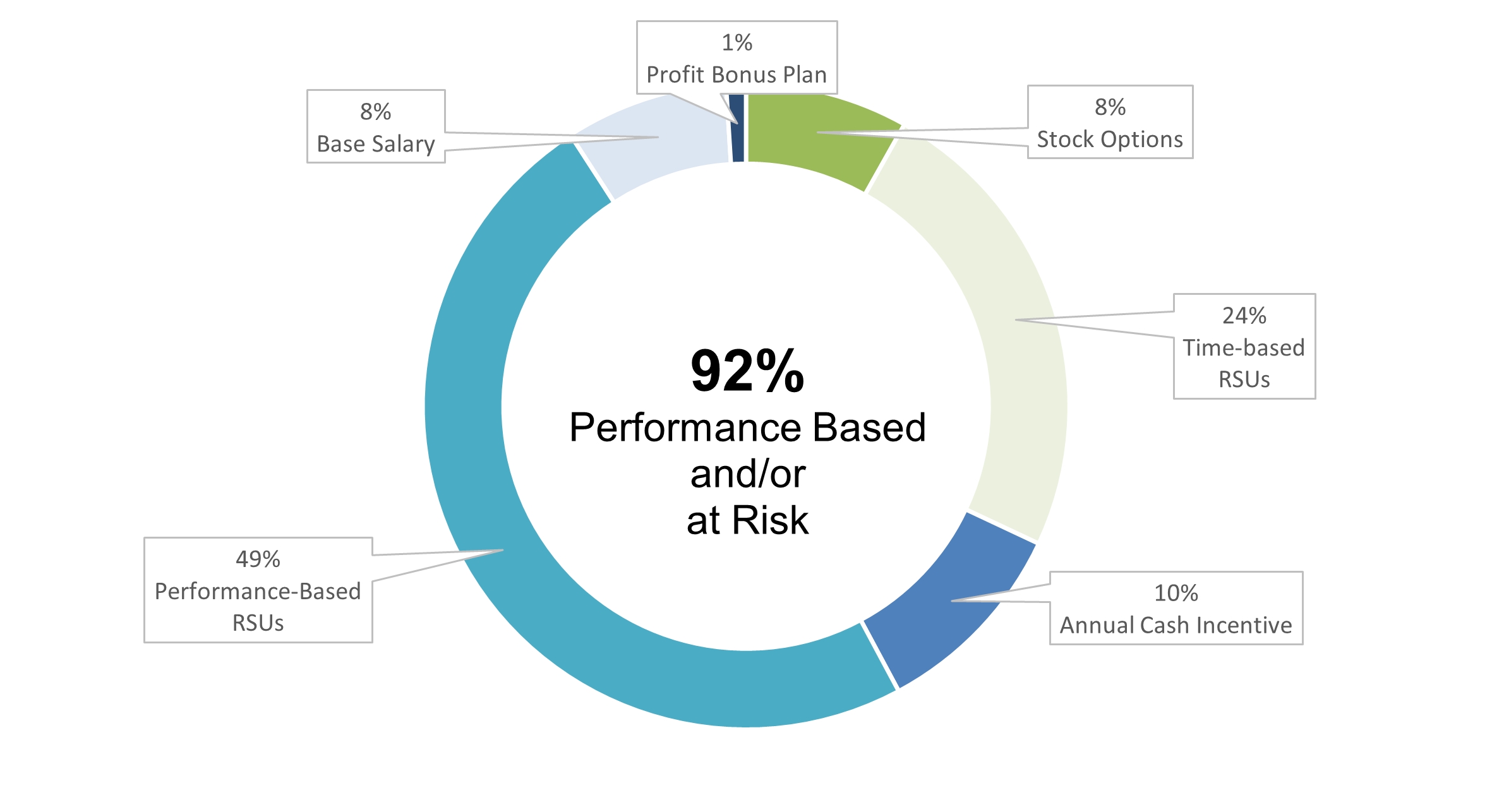
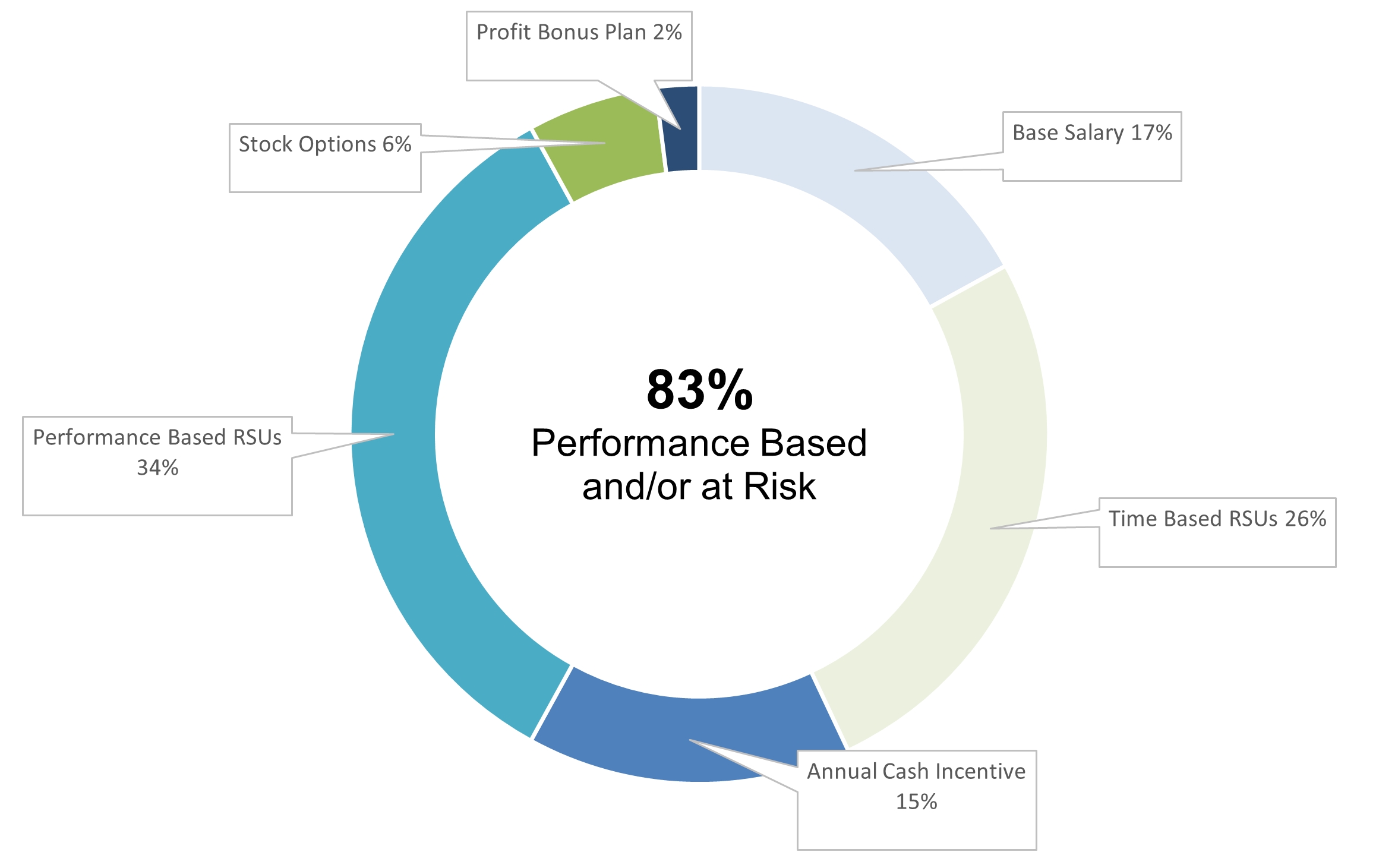
We have implemented an executive compensation program that fosters a performance-oriented environment by tying a significant portion of each executive officer’s cash and equity compensation to the achievement of short-term and long-term performance targets that are important to Teradyne and its shareholders. This approach is designed to focus the executive officers on creating shareholder value over the long term and on delivering exceptional performance throughout fluctuations in business cycles.
2025 Executive Officer Transitions
In the first quarter of 2025, the Company identified opportunities for operational synergies amongst our production board test, defense and aerospace, and wireless test business leading to the creation of the Product Test division effective March 2025. Mr. Mills was promoted to the newly created executive position President, Product Test effective March 24, 2025 (the "PTG Transition").
On March 6, 2025, we announced that Shannon Poulin joined Teradyne to succeed Rick Burns as President, Semiconductor Test effective April 9, 2025. Mr. Burns retired effective July 2, 2025 (the "SemiTest Transition").
On October 28, 2025, we announced that Michelle Turner was appointed as Vice President, Chief Financial Officer, and Treasurer effective November 3, 2025 succeeding Sanjay Mehta (the "CFO Transition" and, collectively with the PTG Transition and the SemiTest Transition, the "Executive Transitions"). Mr. Mehta remained with the Company through 2025 as a senior advisor and plans to retire in 2026.
Teradyne, Inc. | 2026 Notice of Annual Meeting & Proxy Statement | Page 4
Proxy Statement Summary
In setting Ms. Turner's and Mr. Poulin's 2025 annualized target compensation and Mr. Mills's increased annualized compensation upon his promotion to President, Product Test, the Compensation Committee applied our existing compensation philosophy to set their compensation at appropriate levels and to ensure that their compensation is tied to the creation of shareholder value.
Our Compensation Practices
|
|
|
What We Do |
|
What We Don’t Do |
|
|
|
|
|
|
|
|
|
|
|
|


Fiscal 2025 Variable Cash Compensation and Performance-Based RSU Funding Outcomes
The Compensation Committee believes that the compensation of Teradyne’s named executive officers for 2025 is reasonable and appropriate and is aligned with, and justified by, the performance of Teradyne and its results against its strategic goals and is aligned with the interests of shareholders.
Variable Cash Compensation Performance (Ms. Turner, Messrs. Smith, Mehta, and Driscoll)
For 2025, the variable cash compensation program for Ms. Turner and Messrs. Smith, Mehta, and Driscoll was based on three important performance components: (i) the Company’s two‑year rolling revenue growth rate, (ii) the Company’s non‑GAAP profit rate before interest and taxes (“PBIT”), and (iii) the weighted‑average achievement of the Vital Goals established for each of our operating divisions.
The Vital Goals are a set of predetermined, objective, measurable, and auditable operating metrics that reflect the Compensation Committee’s pay‑for‑performance philosophy. See Compensation Discussion & Analysis section below for further details.
The Company performed strongly against our Company-wide financial metrics, achieving above-target performance. The Company also achieved at-or-above target performance on 31 of the 59 Vital Goals. This resulted in a Vital Goal achievement level of 124% of target, which, together with Company-wide performance outcomes, produced a total variable cash compensation payout equal to 136% of target for Ms. Turner and Messrs. Smith, Mehta, and Driscoll.
|
|
|
|
|
|
|
|
|
|
|
|
|
Company-wide |
||||||||||||
|
|
|
|
|
|
|
|
|
|
|
|
|
Goal |
|
Threshold |
|
Target |
|
Maximum |
|
Actual |
|
Weighting |
|
Result |
|
|
|
|
|
|
|
|
|
|
|
|
|
|
|
|
|
|
|
|
|
|
|
|
|
|
Revenue Growth |
|
(12)% |
|
2% |
|
12% |
|
9.35% |
|
30.00% |
|
174% |
|
|
|
|
|
|
|
|
|
|
|
|
|
PBIT(1) |
|
10% |
|
21% |
|
36% |
|
22.2% |
|
20.00% |
|
108% |
|
|
|
|
|
|
|
|
|
|
|
|
|
Vital Goals |
|
N/A |
|
N/A |
|
N/A |
|
N/A |
|
50.00% |
|
124% |
|
|
|
|
|
|
|
|
|
|
|
|
|
|
|
|
|
|
|
|
|
|
|
|
|
|
|
|
|
|
|
|
|
|
|
|
|
|
|
Total Payout |
|
136% |
||||||||||
|
|
|
|
|
|
|
|
|
|
|
|
|
Teradyne, Inc. | 2026 Notice of Annual Meeting & Proxy Statement | Page 5
Proxy Statement Summary
Ms. Turner's 2025 variable cash compensation payout was pro-rated based on the number of months during 2025 that she was employed by Teradyne. Mr. Mehta was employed by the Company for the full year so his 2025 variable cash compensation payout was not pro-rated.
Variable Cash Compensation Performance (Mr. Poulin)
For Mr. Poulin, the 2025 variable cash compensation program incorporated both Company‑wide, as described above, and division‑specific performance components, each weighted at 50% of his total opportunity. Accordingly, his payout was based equally on total Company financial performance and Company‑wide Vital Goals, and on the financial performance and Vital Goal achievement of the Semiconductor Test division, which he leads. The division‑specific component reflected the Semiconductor Test division’s revenue growth rate, its non‑GAAP PBIT performance, and achievement of the division’s Vital Goals. Mr. Poulin's variable cash compensation payout was pro-rated based on the number of months during 2025 that he was employed by Teradyne.
For 2025, the Semiconductor Test division performed strongly against its financial metrics, achieving at‑or‑above‑target performance. The Semiconductor Test division also achieved at or above target performance on 14 of the 18 Vital Goals across its businesses. This resulted in a Semiconductor Test division achievement level of 153% of target, which, together with Company‑wide performance outcomes, produced a total variable cash compensation payout equal to 145% of target for Mr. Poulin.
|
|
|
|
|
Semiconductor Test Division |
||||
|
|
|
|
|
Goal |
|
Weighting |
|
Result |
|
|
|
|
|
|
|
|
|
|
Company Performance |
|
50.00% |
|
136% |
|
|
|
|
|
Semiconductor Test Group Performance |
|
50.00% |
|
153% |
|
|
|
|
|
|
|
|
|
|
|
|
|
|
|
Total Payout |
|
145% |
||
|
|
|
|
|
Variable Cash Compensation Performance (Mr. Mills)
For Mr. Mills, the 2025 variable cash compensation program incorporated both Company‑wide, as described above, and division‑specific performance components, each weighted at 50% of his total opportunity. Accordingly, his payout from the time of the PTG Transition was based equally on total Company financial performance and Company‑wide Vital Goals, and on the financial performance and Vital Goal achievement of the Product Test division, which he leads. The division‑specific component reflected the Product Test division’s revenue growth rate, its non‑GAAP PBIT performance, and achievement of the division’s Vital Goals. Mr. Mills variable compensation payout for 2025 was prorated to reflect (1) his bonus achievement applicable to his prior role in the Semiconductor Test division for service from January 1 to March 23 and (ii) his executive level bonus achievement for service as President, Product Test from March 24 through December 31, 2025.
|
|
|
|
|
Product Test Group |
||||
|
|
|
|
|
Goal |
|
Weighting |
|
Result |
|
|
|
|
|
|
|
|
|
|
Company Performance |
|
50.00% |
|
136% |
|
|
|
|
|
Product Test Group Performance |
|
50.00% |
|
110% |
|
|
|
|
|
|
|
|
|
|
|
|
|
|
|
Total Product Test Achievement |
|
123% |
||
|
|
|
|
|
Mr. Mills's actual variable compensation payout for 2025 was prorated to reflect (1) a bonus achievement level of 154% for our System-on-a-Chip (SOC) and memory test business units within the Semiconductor Test division in fiscal 2025 for the number of months in which he served in this prior role and (ii) the bonus achievement level of 123% for the number of months which he served as President, Product Test, leading to a total payout of 131% of target.
Teradyne, Inc. | 2026 Notice of Annual Meeting & Proxy Statement | Page 6
Proxy Statement Summary
Status of Performance-Based RSU Awards
|
2023 |
2024 |
2025 |
|
Goals |
Threshold |
Target |
Maximum |
Performance |
Result(1) |
|
|
|
|
|
|
|
|
|
|
|
|
|
Fiscal 2023 Relative TSR(2) Performance-Based RSUs (2023-2025 Performance Period) |
100% Completed |
|
TSR |
N/A |
N/A |
N/A |
64.09% |
200% |
|||
Fiscal 2023 PBIT(3) Performance-Based RSUs (2023-2025 Performance Period) |
100% Completed |
|
PBIT |
13% |
24% |
40% |
21.08% |
73.42% |
|||
Fiscal 2024 Relative TSR(2) Performance-Based RSUs (2024-2026 Performance Period) |
|
2/3 Completed |
|
TSR |
N/A |
N/A |
N/A |
In progress |
In progress |
||
Fiscal 2024 PBIT(3) Performance-Based RSUs (2024-2026 Performance Period) |
|
2/3 Completed |
|
PBIT |
11% |
21% |
39% |
In progress |
In progress |
||
Fiscal 2025 Relative TSR(2) Performance-Based RSUs (2025-2027 Performance Period) |
|
|
1/3 Completed |
|
TSR |
N/A |
N/A |
N/A |
In progress |
In progress |
|
Fiscal 2025 PBIT(3) Performance-Based RSUs (2025-2027 Performance Period) |
|
|
1/3 Completed |
|
PBIT |
10% |
21% |
36% |
In progress |
In progress |
|
Teradyne, Inc. | 2026 Notice of Annual Meeting & Proxy Statement | Page 7
Proxy Statement Summary
Proposal No. 3 |
Ratification of Appointment of Independent Registered Public Accounting Firm
|
See page 83 for further information. |

Fees for Services Provided by PricewaterhouseCoopers LLP
The following table sets forth the aggregate fees for services provided by PricewaterhouseCoopers (“PwC”), Teradyne’s independent registered public accounting firm, for the fiscal years ended December 31, 2025 and 2024, respectively.
|
|
2025 |
|
|
2024 |
|
||
Audit Fees(1) |
|
$ |
3,656,000 |
|
|
$ |
3,341,800 |
|
Audit-Related Fees(2) |
|
$ |
— |
|
|
$ |
500,801 |
|
Tax Fees(3) |
|
$ |
1,529,351 |
|
|
$ |
1,234,199 |
|
All Other Fees(4) |
|
$ |
4,994 |
|
|
$ |
302,000 |
|
Total: |
|
$ |
5,190,345 |
|
|
$ |
5,378,800 |
|
Teradyne, Inc. | 2026 Notice of Annual Meeting & Proxy Statement | Page 8
CORPORATE GOVERNANCE AND BOARD OF DIRECTORS
Corporate Governance and Board Policies
Teradyne is committed to corporate governance policies and practices that ensure that the Company is managed for the long-term benefit of its shareholders.
The Board reviews these practices on a regular basis. Teradyne’s current policies and practices include the following:
Sound Governance Practices |
|

 Executive sessions of independent directors at Board meetings
 Robust director and executive officer stock ownership guidelines
 Policy prohibiting employees and directors from hedging and pledging Teradyne stock
 Board access to management and independent advisors
 Independent registered public accounting firm and internal auditor meet regularly with Audit Committee without management
 Directors may be removed by a shareholder vote with or without cause
 Policy promoting equal opportunity for all employees
Independence and Board Composition |
|

 Independent Board Chair
 Independent directors constitute a majority of the Board and all members of the Board committees
 Annual Nominating and Corporate Governance Committee review of Board composition, skills, demographics and refreshment and succession plan
 Directors must be 74 years or younger as of the date of their election or appointment with no exceptions or conditions
Review and Oversight |
|

 Annual Board and committee self-assessments
 Annual Board evaluation of CEO performance
 Annual review of non-employee director compensation and cap on the aggregate value of total annual compensation to non-employee directors
 Nominating and Corporate Governance Committee review of director’s change in position or employment
 Board oversight of enterprise risk management, including cybersecurity and data protection, artificial intelligence, and sustainability risks
 Annual Board review of executive succession plan
Teradyne, Inc. | 2026 Notice of Annual Meeting & Proxy Statement | Page 9
Corporate Governance and Board of Directors
Shareholder Rights |
|
Single class of stock with equal voting rights
Directors elected annually for a one-year term
Directors are elected by majority vote for uncontested Board elections
Shareholder right to call a special meeting
Shareholder right to act by written consent
Our Bylaws provide for "proxy access" by shareholders
Board Leadership Structure
The Board has the flexibility to decide whether it is best for the Company, at any given point in time, for the roles of the Chief Executive Officer and the Chair of the Board to be separate or combined and, if separate, whether the Chair should be selected from the independent directors, non-management directors, or be an employee.
Since May 2021, Mr. Tufano has served as an independent Chair of the Board. The Board believes that having an independent Chair is currently the appropriate corporate governance structure for the Company because it strikes an effective balance between management and independent leadership participation in the Board process. Additionally, the Board believes that Mr. Tufano’s widespread knowledge of the issues confronting complex technology and manufacturing companies and extensive financial reporting and operational expertise provide the requisite experience needed to effectively serve as the independent Chair of the Board.
While the Chief Executive Officer is tasked with developing policy and strategic direction for the Company and providing management of its day-to-day operations, the duties and responsibilities of the independent Chair of the Board include:
Independent Chair of the Board |
• Coordinate the activities of the Board and ensure the review of both short- and long-term areas of interest to shareholders. • Work with the CEO to develop board agendas and set schedules for Board meetings. • Preside over Board meetings. • Develop agenda for executive sessions of the independent directors. • Moderate the executive sessions of the independent directors. • Discuss executive session subjects with the CEO. • As required, the Chair of the Board serves as a representative of the Board with management and the public. • Oversee, with the assistance of the independent members of the Board and the Compensation Committee, the evaluation of the CEO. |
Teradyne, Inc. | 2026 Notice of Annual Meeting & Proxy Statement | Page 10
Corporate Governance and Board of Directors
Director Independence
Teradyne’s Corporate Governance Guidelines require that at least a majority of the Board shall be independent and set out standards for determining director independence. Under our Corporate Governance Guidelines, to be considered independent, a director must satisfy applicable U.S. Securities and Exchange Commission ("SEC") and Nasdaq listing standard requirements, and, in the Board’s judgment, not have a material relationship with Teradyne.
The Board periodically reviews each director’s status as an independent director and whether any independent director has any relationship with the Company that, in the judgment of the Board, would interfere with the director’s exercise of independent judgment in carrying out his or her responsibilities as a director or would be deemed a material relationship with Teradyne.
The Board, in coordination with the Nominating and Corporate Governance Committee, has assessed the independence of each of the members of the Board who served for all or a portion of fiscal year 2025 and each of the director nominees and determined that the following directors are, and former directors were at the time of service, independent under SEC rules, Nasdaq listing standards and the independence standards in our Corporate Governance Guidelines:
In determining the independence of Teradyne’s directors, the Board reviewed and determined that the following relationships did not preclude a determination of independence under applicable standards:
The amounts paid to or received from each party under Teradyne’s business relationships with each of Analog Devices, Inc., Synopsys, Inc., Avnet, Inc., Lattice Semiconductor, Sandisk Technologies, Schneider Electric and Marvell Technology, Inc. during the last three fiscal years do not exceed the applicable threshold of Nasdaq listing standards, and the Board determined that each of these directors does not have a material relationship with Teradyne that would impair their independence. Teradyne will continue to monitor its business relationships and any significant competitive activity to ensure they have no impact on the independence of its directors.
All members of the Company’s three standing committees—Audit, Compensation, and Nominating and Corporate Governance—have been determined by the Board to be independent pursuant to applicable SEC rules and Nasdaq listing standards, including those applicable to such committees, as well as the independence standards in our Corporate Governance Guidelines.
Teradyne, Inc. | 2026 Notice of Annual Meeting & Proxy Statement | Page 11
Corporate Governance and Board of Directors
Director Selection and Nomination Process
1 Identify the Candidate |
The Nominating and Corporate Governance Committee identifies director candidates through numerous sources, including recommendations from existing Board members, executive officers, and shareholders and through engagements with executive search firms. As part of the identification and nomination process, the Committee regularly reviews Board composition to ensure that the Board reflects the knowledge, experience, skills and backgrounds required for the needs of the Board. |
|
2 Evaluate Candidate Qualifications |
Director candidates are evaluated by the Nominating and Corporate Governance Committee, with input from the Chair and the CEO, and all director candidates recommended to be nominees must meet, at a minimum, the Board membership criteria described below. • Nominees should have a reputation for integrity, honesty and adherence to high ethical standards. • Nominees should have demonstrated business acumen, experience and ability to exercise sound judgment and should be willing and able to contribute positively to the decision-making process of the Company. • Nominees should have a commitment to understand the Company and its industry and to attend and participate in Board and committee meetings. • Nominees should ensure that existing and future commitments would not materially interfere their obligations. • Nominees should not have, nor appear to have, any conflicts of interest. • Nominees must be 74 years or younger as of the date of their election or appointment. Additionally, the re-nomination of existing directors is not viewed as automatic but is based on continuing qualification under the criteria set forth above. |
|
3 Recommendation and Nomination |
The Nominating and Corporate Governance Committee recommends to the Board qualified candidates to be nominated by the Board for election or re-election at the annual meeting of shareholders or upon a majority vote of the Board. |
|
4 Shareholder Vote |
Nominees are elected by our shareholders at the annual meeting of shareholders. |
|
5 Implementation |
In the past five years, five of our nine current directors, which included four independent directors, were elected to the Board for the first time by our shareholders, each bringing fresh perspectives and unique skill sets to the Board. Drew Henry ǀ Ernest E. Maddock ǀ Necip Sayiner ǀ Gregory S. Smith ǀ Bridget van Kralingen |




Teradyne, Inc. | 2026 Notice of Annual Meeting & Proxy Statement | Page 12
Corporate Governance and Board of Directors
Shareholder Recommendations for Board Candidates
Shareholders wishing to suggest candidates to the Nominating and Corporate Governance Committee for consideration as potential director nominees may do so by submitting the candidate’s name, experience, and other relevant information to the Nominating and Corporate Governance Committee, 600 Riverpark Drive, North Reading, MA 01864. Shareholders wishing to nominate directors may do so by submitting a written notice to the Secretary at the same address in accordance with the nomination procedures set forth in Teradyne’s bylaws. Additional information regarding the director nomination procedure is provided in the section below captioned “Shareholder Proposals for 2027 Annual Meeting.”
Overboarding Policy
The Company maintains an overboarding policy in our Corporate Governance Guidelines to help ensure that directors are able to devote adequate time to their duties to the Company, including preparing for and attending meetings.
The Company’s overboarding policy limits the number of other public company boards on which a director serves to no more than four. Directors should notify the Chair of the Board and the Chair of the Nominating and Corporate Governance Committee in advance of accepting an invitation to serve on another public company board. Additionally, service on boards and/or committees of other organizations shall comply with the Company’s conflict of interest policies.
In renominating directors for election at our Annual Meeting, the Nominating and Corporate Governance Committee and Board have determined that each of our directors is currently in compliance with our Corporate Governance Guidelines and has sufficient time, energy, and attention to serve on the Board.
Director Refreshment and Succession Planning
The Nominating and Corporate Governance Committee is responsible for regularly reviewing Board composition, skills, and refreshment, including the review of director succession planning.
Additionally, directors elected at the annual meeting of shareholders serve until the next annual meeting of shareholders and until his or her successor shall have been duly elected and qualified. Directors who have been elected to fill a vacancy complete the remainder of the former director’s term. There are no limits on the number of terms that a director can serve. Term limits could result in loss of directors who have been able to develop, over a period of time, increasing insight into the Company and its operations and an institutional memory that benefits the entire membership of the Board, as well as management.
In June 2025, the Board appointed two new independent directors to the Board, Drew Henry, Executive Vice President, Physical AI Business Unit and Executive Vice President of Strategy & Ecosystem at Arm Holdings, and Dr. Necip Sayiner, former CEO of Intersil Corporation, as part of a multi-year board refreshment process. This process was led by the Board's Nominating and Corporate Governance Committee and aided by an independent search firm, to thoughtfully evolve the Board with directors that possess complementary skills aligned with Teradyne's strategic priorities to accelerate shareholder value creation.
Mr. Henry's extensive experience within the semiconductor industry, particularly in the Compute space, provides valuable insights to the Board as Teradyne pursues new opportunities in the Semiconductor Test and Product Test businesses. Dr. Sayiner's deep technical expertise and leadership across networking and analog mixed signal, driving targeted growth through end market diversification, provides a unique perspective to the Board across Teradyne's businesses.
Majority Vote Standard and Director Resignation Policy
Directors are elected by the majority of votes cast. Any director who fails to receive the requisite majority vote at any meeting for an uncontested election shall, promptly following certification of the shareholder vote, offer their resignation to the Board for consideration in accordance with the procedures established in our Corporate Governance Guidelines within 90 days following certification of the shareholder vote.
In addition, non-employee directors must notify the Nominating and Corporate Governance Committee if the director experiences a change of position from that held upon first becoming a member of the Board. Upon any such notification, the Nominating and Corporate Governance Committee will review the potential impact on the director’s independence and the appropriateness of the director’s continued membership on any Board committees under the circumstances.
Teradyne, Inc. | 2026 Notice of Annual Meeting & Proxy Statement | Page 13
Corporate Governance and Board of Directors
Board Size
The Company’s bylaws require the Board to consist of not less than three and no more than fifteen members. The number of directors on the Board is fixed each year by the Board and as of the Record Date, the size of the Board was fixed at nine directors. Additionally, the Nominating and Corporate Governance Committee is responsible for periodically reviewing and making recommendations to the Board as appropriate regarding the composition and size of the Board to help ensure that the Board is composed of members reflecting the proper expertise, skills, attributes and personal and professional backgrounds for service as a director of the Company, as determined by the Nominating and Corporate Governance Committee.
Board and Committee Self-Assessment
The Board and each of its committees annually undertake a self-assessment, including an evaluation of its composition, mandate and function, as well as soliciting feedback from senior management. The Chair of the Nominating and Corporate Governance Committee manages this annual process and implementation of any action items resulting from the process. For example, as a result of one of the Board’s self-assessments in which the directors expressed their interest in having a separate strategy discussion, an annual strategic session with management was implemented. Additionally, based on the result of another self-assessment, the Board undertook a multi-year refreshment and succession planning process, resulting in the recent addition of new directors with deep technical expertise and leadership.
CEO Evaluation and Management Succession Planning
The principal responsibility of directors is to oversee the management of the Company, and, in so doing, to serve the best interests of the Company and its shareholders. This includes a responsibility of directors to require and oversee succession plans for the Chief Executive Officer and the other named executive officers. The Board conducts a robust annual review of executive succession planning. Additionally, the Nominating and Corporate Governance Committee is responsible for periodically reviewing the Company’s succession plans with respect to the Chief Executive Officer and other senior executives.
The independent Chair of the Board, the independent members of the Board of Directors and the Compensation Committee are also responsible for overseeing the evaluation of the Company’s Chief Executive Officer.
Code of Conduct
Teradyne has adopted the Code of Conduct which outlines our ethics policy for directors, officers and all employees. The Audit Committee is responsible overseeing compliance with the Code of Conduct. The Audit Committee reviews the Code of Conduct and training materials and results annually and regularly reviews with management.
The Company conducts Code of Conduct training for all new full and part time employees and contractors as part of the on-boarding process and administers annual Code of Conduct refresher training to all employees and contractors at the end of each year, which includes a video presentation, quiz and compliance certification. The Code of Conduct training covers a variety of topics, including:
The Board has established channels for anyone to report violations of the ethics policy on a confidential or anonymous basis.
Teradyne shall disclose any substantive amendments to or waiver, including an implicit waiver, from the Code of Conduct granted to an executive officer or director within four business days of such determination by disclosing the required information on its website at www.teradyne.com under the “Governance” section of the “Investor Relations” link or in a Current Report on Form 8-K.
Insider Trading Policy
The Board has
Teradyne, Inc. | 2026 Notice of Annual Meeting & Proxy Statement | Page 14
Corporate Governance and Board of Directors
SEC as Exhibit 19.1 to our Annual Report on Form 10-K for the fiscal year ended December 31, 2025. We believe our Insider Trading Policy is reasonably designed to promote compliance with insider trading laws, rules and regulations, and applicable Nasdaq listing standards. Among other things, the Insider Trading Policy prohibits trading on material non-public information and prohibits directors, executive officers and certain other employees from buying or selling Teradyne securities during the Company’s non-trading periods, also called “blackout periods”, except pursuant to an approved trading plan under Rule 10b5-1 (“Rule 10b5-1”) of the Securities Exchange Act of 1934, as amended (the “Exchange Act”). The Board has also adopted a Rule 10b5-1 Trading Plan Policy which requires all executive officers and directors of Teradyne to adopt Rule 10b5-1 plans for trading in Teradyne’s securities.
Hedging and Pledging Policy
The Board recognizes there may be an appearance of improper or inappropriate conduct if Teradyne’s employees, executives and directors engage in certain types of transactions, even in circumstances where they may not be aware of any material, nonpublic information. Therefore, the Board has adopted, through the Insider Trading Policy, a policy prohibiting employees, executives and directors from hedging Teradyne stock through short sales, prepaid variable forward contracts, equity swaps, collars and exchange funds. In addition, transactions in put options, call options or other derivative securities, on an exchange or in any other organized market, are prohibited by this policy. The policy also prohibits holding Teradyne securities in a margin account or pledging Teradyne securities as collateral for loans.
Board Oversight of Risk
The Board, as a whole and through its committees, has responsibility for the oversight of risk management. While the full Board has ultimate responsibility for risk oversight, the Board has delegated oversight responsibility for certain risks to the Audit Committee, the Compensation Committee and the Nominating and Corporate Governance Committee. This approach allows the Board to draw upon the experience and judgment of specific directors comprising each committee who have experience overseeing and managing particular risks that Teradyne faces in various areas of its business.
The Board |
||
The Board oversees management’s processes for identifying and mitigating risks, including operational, cybersecurity and information security, legal, geopolitical, market and competitive risks as well as the risks to the Company, its business and its employees due to climate change and trade regulations, directly and through its committees to help align the Company’s risk exposure with its strategic objectives. While each committee is responsible for evaluating certain risks and overseeing the management of such risks, the entire Board is regularly informed through committee reports about such risks and participates in regularly scheduled Board discussions with management and outside advisors covering such risks. |
||
|
||
Committee Responsibilities |
||
|
|
|
Audit Committee |
Compensation Committee |
Nominating and |
The Audit Committee is responsible for oversight of enterprise risk management review, including financial risk assessment and management, related parties transaction policy compliance, and cybersecurity and technology security risks--including artificial intelligence. The Audit Committee receives regular reports from management including from our Chief Financial Officer, Corporate Controller, Internal Audit, in-house legal counsel, and Chief Information Security Officer on such risks at regularly scheduled meetings and as requested. |
The Compensation Committee is responsible for reviewing and assessing, on an annual basis, the impact of the Company’s compensation programs on Company risk and considering appropriate risk management policies and practices as applied to the Company’s compensation programs. The Compensation Committee receives reports from management including from our human resources and compensation teams and in-house legal counsel on such matters. |
The Nominating and Corporate Governance Committee oversees risks related to corporate governance, including Board and director performance, director recruitment and succession, director education, and our Corporate Governance Guidelines and other governance documents, as well as management succession, political contributions and lobbying activities, our responsible business efforts, and, in conjunction with the Audit Committee, the Company's use of artificial intelligence. |
|
||




Teradyne, Inc. | 2026 Notice of Annual Meeting & Proxy Statement | Page 15
Corporate Governance and Board of Directors
Management |
|
|
|
Senior Management |
Disclosure Committee |
Our senior management regularly attends meetings of the Board and its committees and provides the Board and its committees with reports regarding our operations, strategies, and objectives, and the risks inherent within them, as well as management action plans to monitor and address risk exposures. Board and committee meetings also provide a forum for directors to discuss issues with, request additional information from, and provide guidance to, senior management. In addition, our directors have direct access to senior management to discuss any matters of interest, including those related to risk. |
The Disclosure Committee, which is comprised of a cross-functional team, regularly reviews Teradyne’s financial and business disclosures, including quarterly and annual reports prior to filing with the SEC. There is substantial cross-functional overlap in the membership of the Disclosure Committee to ensure that Teradyne’s required disclosures regarding its risks are accurate, complete, and timely. Teradyne’s internal legal and financial reporting teams seek input and advice from internal subject matter experts and external advisors in drafting specific disclosures, and such input and advice is communicated to the Disclosure Committee. |
|
|
Oversight of Strategy
Oversight of Teradyne’s business strategy and strategic planning is a key responsibility of our Board, and the responsibility of our directors includes reviewing and approving the Company’s fundamental operating, financial and other corporate plans, strategies and objectives. Directors have an obligation to become and remain informed about the Company and its business, including the principal operational and financial objectives, strategies and plans of the Company and the problems, risks and success factors affecting the Company’s business.
Our Board is deeply engaged and involved in Teradyne’s long-term strategy, including, among other things, senior management development and succession planning, and evaluating key market and strategic opportunities and competitive developments. Our Board takes a multi-layered approach to exercising its role in strategy oversight and views its strategy oversight role as a continuous process.
On an annual basis, our Board conducts a coordinated meeting with members of management on the Company’s strategy including a presentation on results, revenue, customer and stakeholder feedback and future plans. Additionally, each quarter the Board receives a substantial presentation from members of management across our different business units, with the Board receiving a deep dive on a different division of the Company each quarter.
Oversight of Cybersecurity
The Board oversees management’s processes for identifying and mitigating risks, including cybersecurity risks, to help align our risk exposure with our strategic objectives. Senior leadership, including our Chief Information Security Officer (the “CISO”), regularly brief the Audit Committee on our cybersecurity and information security posture.
The corporate information security organization, under the CISO, has implemented a governance structure and processes to assess, identify, manage and report cybersecurity risks. The CISO chairs management’s Cybersecurity Steering Committee, which regularly reviews current cyber threats, program performance and ongoing risk mitigations. Cybersecurity-related risks are also integrated into our overall enterprise risk management (“ERM”) process. These risks are among those that the ERM function evaluates to assess top enterprise risks on an annual basis and is reviewed and evaluated by the Board. The Board is also apprised of cybersecurity issues or incidents deemed to have a moderate or higher business impact as they arise, even if considered immaterial.
Oversight of Human Capital
The Board oversees the establishment and maintenance of the Company’s core values and its management of human capital. Additionally, the Compensation Committee is responsible for reviewing and assisting the Board in overseeing certain talent management matters relating to the Company’s workforce. The Board believes that the Company’s future success depends upon its continued ability to attract, develop and retain a high-performance workforce, comprised of people with shared values.
Teradyne, Inc. | 2026 Notice of Annual Meeting & Proxy Statement | Page 16
Corporate Governance and Board of Directors
Oversight of Artificial Intelligence
The Board, in coordination with the Nominating and Corporate Governance Committee and the Audit Committee, is responsible for overseeing our Artificial Intelligence (“AI”) governance and risk management processes, which address the development and use of AI in our products and services and our use of AI in our internal operations. As this is a nascent and rapidly developing area, the Board and management have worked together to build a strong AI governance and risk management program, including establishing a cross functional AI Governance and Risk Management Committee led by Teradyne executive management which reports to the Board quarterly.
Oversight of Sustainability and Human Capital Matters
Teradyne is committed to employee health, safety and welfare, to managing its activities that impact the environment in a responsible and effective manner, and to supporting the communities where its employees live and work. Teradyne strives to drive improvements in environmental sustainability, supply chain responsibility, human capital, and positive social impact.
The Board |
||
The Board oversees the Company’s responsible business program. |
||
|
||
Nominating and Corporate Governance Committee |
||
The Nominating and Corporate Governance Committee reviews, and assists the Board in overseeing, responsible business matters not assigned to other committees, including the Company’s overall sustainability strategy and goals, climate-related matters, political contributions, lobbying activities, the CSR Report and sustainability initiatives. |
||
|
||
Audit Committee |
|
Compensation Committee |
The Audit Committee reviews, and assists the Board in overseeing, significant information security, cybersecurity and technology security risks. |
|
The Compensation Committee reviews, and assists the Board in overseeing, certain talent management matters relating to the Company’s workforce. |
|
||
Senior Leadership |
||
The CEO and CFO receive reports on the responsible business program from the Responsible Business Steering Team. |
||
|
||
Responsible Business Steering Team |
||
The Company’s sustainability-related activities are guided by the Company’s Responsible Business Steering Team. The Responsible Business Steering Team is comprised of a group of senior leaders, meets regularly and reports to the CEO, the CFO and the Board. |
||
|
||
Responsible Business Working Team |
||
The Responsible Business Working Team is a cross-functional team that develops the long-term strategy, annual goals, metrics tracking and reporting processes for the Company’s corporate social responsibility activities and reports to the Responsible Business Steering Team on a regular basis. |
||





Teradyne, Inc. | 2026 Notice of Annual Meeting & Proxy Statement | Page 17
Corporate Governance and Board of Directors
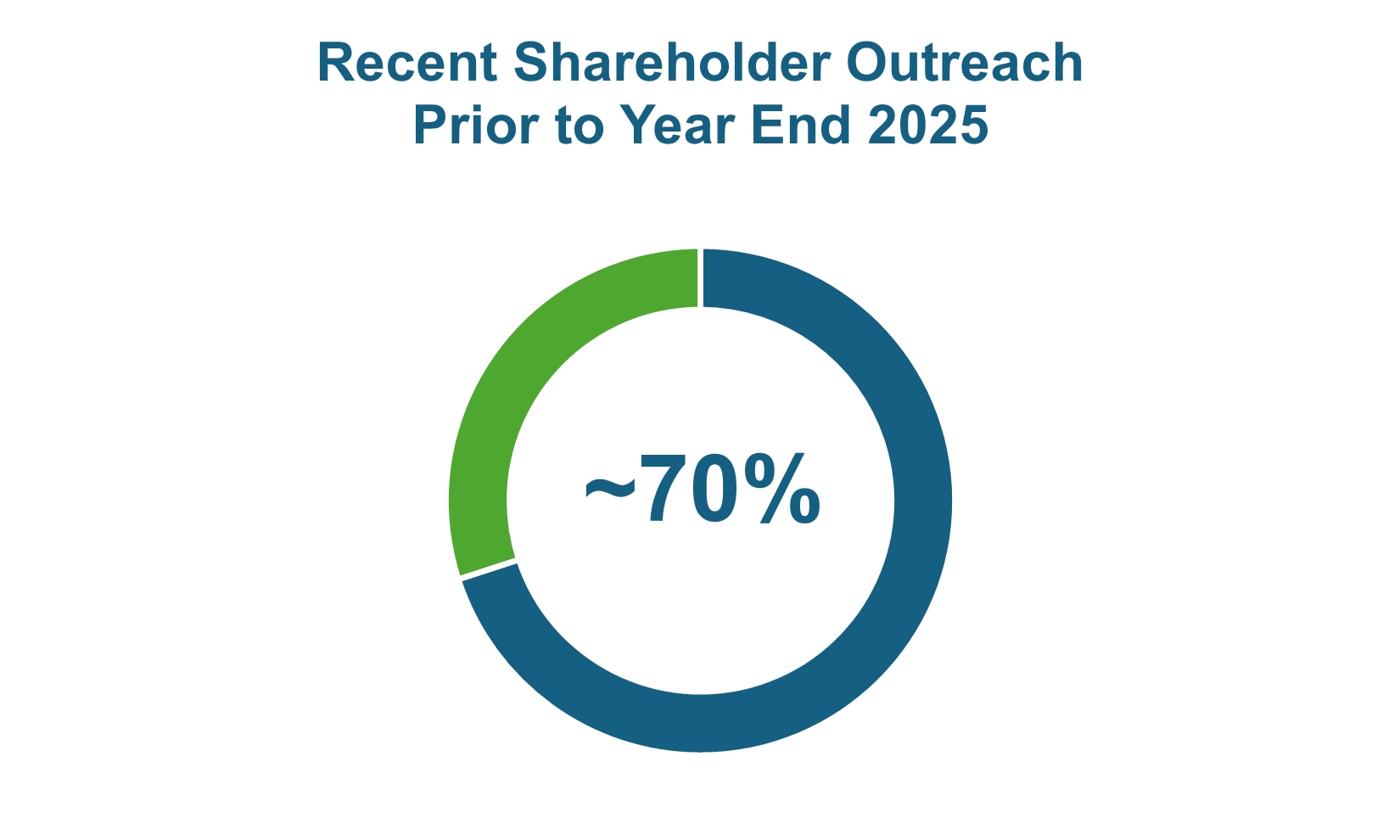
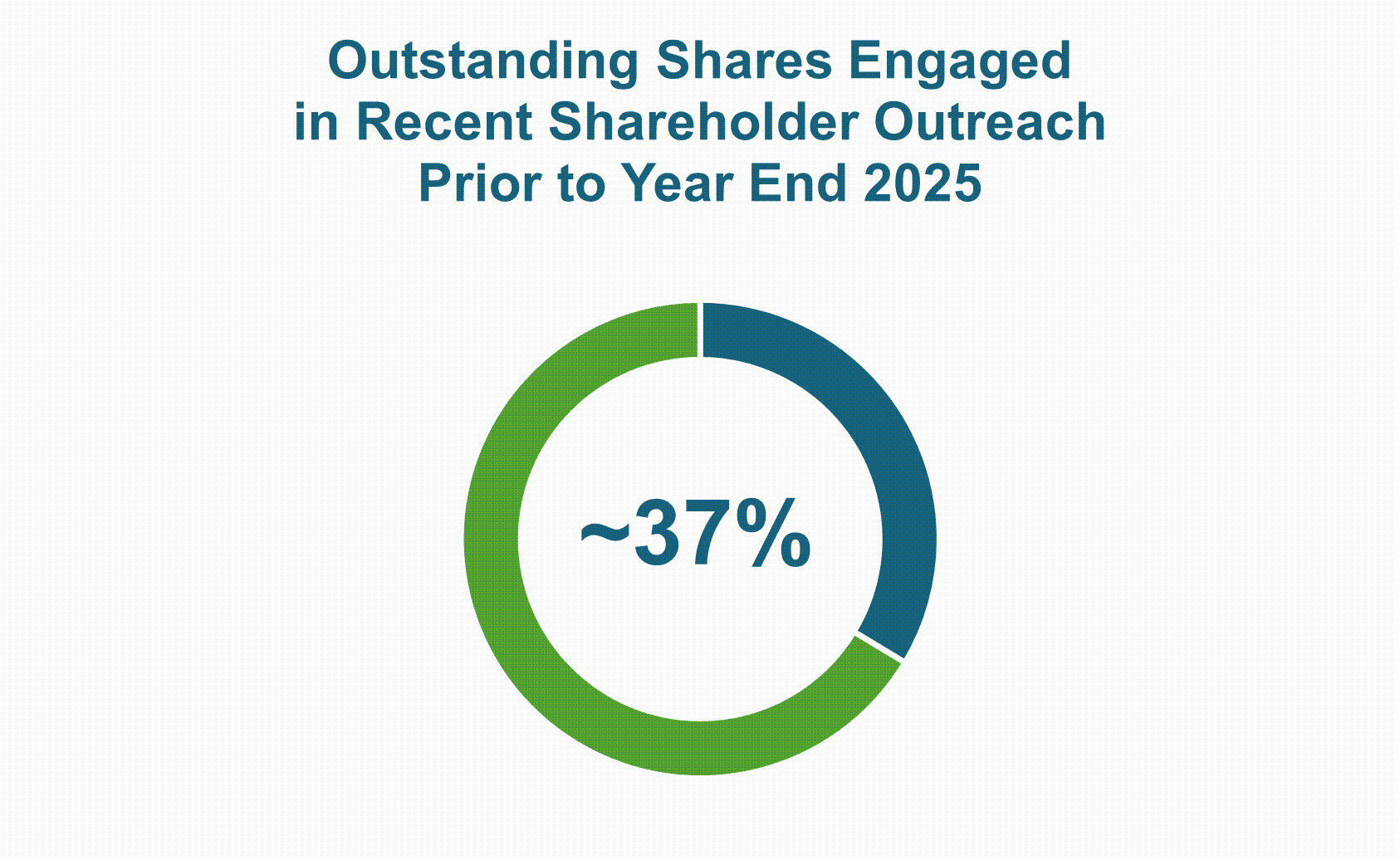
Teradyne is committed to regular and proactive engagement with our shareholders. We believe that listening to and understanding shareholder perspectives and priorities is important for shareholder value and addressing corporate governance. In 2025, we reached out to shareholders representing approximately 70% of our outstanding shares and ultimately engaged in discussions with investors representing approximately 37% of our outstanding shares. As part our shareholder engagement efforts over the last year, we heard from shareholders on key corporate governance, executive compensation, and business development-related matters. A significant focus of these engagements was a non‑binding shareholder proposal submitted in 2025 requesting that the Company prepare a report on its political contributions and expenditures. Although the Board did not support the proposal, it received slightly more than 50% of the votes cast, prompting the Board and management to undertake enhanced, targeted engagement to better understand shareholder perspectives on the Company’s political spending practices. Consistent with broader market expectations to respond meaningfully to majority‑supported proposals, even when non‑binding, our engagement process was designed to gather insight into investor viewpoints and identify opportunities for governance enhancements aligned with shareholder priorities, including areas beyond the related shareholder proposal.
Following this outreach and the Board's subsequent review of shareholder input, peer practices, and evolving governance norms, the Board determined that it was in the best interests of our shareholders to implement a series of responsive actions, including: • incorporating political-spending oversight responsibilities into the Nominating and Corporate Governance Committee charter; • Adopting enhanced policies governing political contributions and expenditures; and • Disclosing trade association membership and contributions beginning with the 2026 Corporate Social Responsibility Report.
|
|
Please see "Fiscal Year 2026 Compensation Decisions" in the Compensation Discussion & Analysis for more regarding executive compensation changes made based on shareholder feedback.
Teradyne also hosted a Financial Analyst day on March 11, 2025, at Teradyne’s corporate headquarters. The event featured presentations from members of the Teradyne leadership team who shared in-depth reviews of Teradyne’s strategic imperatives, operating and growth strategy, and business outlook.
These actions reflect the Board's commitment to integrating shareholder feedback into its governance oversight and maintaining practices aligned with evolving expectations.
|
|
Shareholders Engaged (% of Stock Outstanding) |
|
|
|

Teradyne, Inc. | 2026 Notice of Annual Meeting & Proxy Statement | Page 18
Corporate Governance and Board of Directors
Shareholder Communications with Board of Directors
Shareholders and other interested parties may communicate with one or more members of the Board, including the Chair, or the non-management directors as a group by writing to the non-management directors, Board of Directors, 600 Riverpark Drive, North Reading, MA 01864 or by electronic mail at nonmanagementdirectors@teradyne.com. Any communications that relate to ordinary business matters that are not within the scope of the Board’s responsibilities, such as customer complaints, will be sent to the appropriate executive. Solicitations, junk mail and other similarly frivolous or inappropriate communications will not be forwarded, but will be made available to any director who wishes to review them.
Board Meetings and Director Attendance
The Board met five times during the year ended December 31, 2025. The non-employee directors, all of whom are independent, held executive sessions in which they met without management after each regularly scheduled meeting during 2025. The Chair of the Board presides over all Board meetings and each executive session. During 2025, each director attended at least 75% of the total number of meetings of the Board and committee meetings held while such person served as a director. Under our Corporate Governance Guidelines, each director is expected to attend each annual meeting of shareholders. All nine then-serving directors, including Mr. Tamer, whose service as a director ended at the conclusion of the meeting, attended the 2025 Annual Meeting of Shareholders held on May 9, 2025. |
|
|
|
|
2025 Average Board and Committee Meeting Attendance |
|
|
|
|
||
|
|
||
|
|
||
|
97.78% |
|
|
|
|
||
|
|
|
Teradyne, Inc. | 2026 Notice of Annual Meeting & Proxy Statement | Page 19
Corporate Governance and Board of Directors
Board Committees
The Board has three standing committees: an Audit Committee, a Compensation Committee and a Nominating and Corporate Governance Committee. In accordance with the Nasdaq listing standards, all of the committees are comprised of independent directors. The members of each committee are appointed by the Board based on the recommendation of the Nominating and Corporate Governance Committee. Each committee performs a self-assessment and reviews its charter annually. Actions taken by any committee are reported to the Board, usually at the next Board meeting following the action. The table below shows the current membership of each of the standing committees:
INDEPENDENT DIRECTORS |
|
|
|
Audit Committee |
|
Compensation Committee |
|
Nominating and Corporate Governance Committee |
Drew Henry |
|
|
|
|
|
|
|
|
Peter Herweck |
|
|
|
|
|
|
|
|
Mercedes Johnson |
|
|
|
|
|
|
|
|
Ernest E. Maddock |
|
|
|
|
|
|
|
|
Marilyn Matz |
|
|
|
|
|
|
|
|
Necip Sayiner |
|
|
|
|
|
|
|
|
Paul J. Tufano |
|
|
|
|
|
|
|
|
Bridget van Kralingen |
|
|
|
|
|
|
|
|
INSIDE DIRECTORS |
|
|
|
|
|
|
|
|
Gregory S. Smith |
|
|
|
|
|
|
|
|








|
|
Independent Chair of the Board |
|
|
|
Committee Member |
|
|
Committee Chairperson |
|
|
|
Financial Expert |

The Board will appoint committee members for the 2026-2027 term following the election of directors at the Annual Meeting.
Teradyne, Inc. | 2026 Notice of Annual Meeting & Proxy Statement | Page 20
Corporate Governance and Board of Directors
Audit Committee
|
Current Members Mercedes Johnson (Chair) Ernest E. Maddock Paul Tufano Necip Sayiner Former board member Ford Tamer served as a member of the Audit Committee until May 2025. Mr. Tufano was appointed to the Audit Committee in May 2025. Mr. Sayiner was appointed to the Audit Committee in July 2025. Independence The Audit Committee has four members, all of whom have been determined by the Board to be independent pursuant to SEC rules, including the independence rules applicable to audit committee members and Nasdaq listing standards, as well as Teradyne’s independence standards. In addition, the Board determined that each member of the Audit Committee is financially literate and an “audit committee financial expert” as defined in the rules and regulations promulgated by the SEC. Meetings Eight meetings during fiscal year 2025. |
|
Responsibilities The Audit Committee’s oversight responsibilities, described in greater detail in its charter (available on our website at www.teradyne.com under “Investor Relations”), include, among other things: • overseeing matters relating to the financial disclosure and reporting process, including the system of internal controls; • reviewing the internal audit function and annual internal audit plan; • supervising compliance with business ethics and legal and regulatory requirements; • reviewing related parties transactions; • reviewing the Company’s cybersecurity program including the Company’s contingency plans in the event of a cybersecurity incident; • reviewing and approving the appointment, compensation, activities and independence of the independent registered public accounting firm including the selection of the lead audit partner who is rotated every five years; and • conducting an enterprise risk management review, including financial and AI risk assessment and management. |
|
2025 Average |
|
|
|
95% |
|
|
Teradyne, Inc. | 2026 Notice of Annual Meeting & Proxy Statement | Page 21
Corporate Governance and Board of Directors
Compensation Committee
|
Current Members Peter Herweck (Chair) Drew Henry Marilyn Matz Bridget van Kralingen Mr. Tufano served as a member of the Compensation Committee until May 2025. Mr. Henry was appointed to the Compensation Committee in July 2025. Independence The Compensation Committee has four members, all of whom have been determined by the Board to be independent pursuant to SEC rules and Nasdaq listing standards, including the independence standards applicable to compensation committee members, as well as Teradyne’s independence standards. Meetings Four meetings during fiscal year 2025. |
|
Responsibilities The Compensation Committee’s primary responsibilities, discussed in greater detail in its charter (available on our website at www.teradyne.com under “Investor Relations”), include, among other things: • overseeing and assessing the risks associated with Teradyne’s compensation programs, policies and practices; • recommending changes and/or recommending the adoption of new compensation plans to the Board, as appropriate; • reviewing and recommending to the Board each year the compensation for non-employee directors; • evaluating and recommending to the independent directors of the Board the annual cash and equity compensation and benefits to be provided to the Chief Executive Officer; • administering the executive compensation recoupment policy; • overseeing human capital management matters; and • reviewing and approving of the cash and equity compensation and benefit packages of the other executive officers. |
|
2025 Average |
|
|
|
100% |
|
Teradyne, Inc. | 2026 Notice of Annual Meeting & Proxy Statement | Page 22
Corporate Governance and Board of Directors
Nominating and Corporate Governance Committee
|
Current Members Marilyn Matz (Chair) Drew Henry Peter Herweck Bridget van Kralingen Mr. Tufano served as a member of the Nominating and Corporate Governance Committee until May 2025. Mr. Henry was appointed to the Nominating and Corporate Governance Committee in July 2025. Independence The Nominating and Corporate Governance Committee has four members, all of whom have been determined by the Board to be independent pursuant to SEC rules and Nasdaq listing standards, as well as Teradyne’s independence standards. Meetings Four meetings during fiscal year 2025. |
|
Responsibilities The Nominating and Corporate Governance Committee’s primary responsibilities, discussed in greater detail in its charter (available on our website at www.teradyne.com under “Investor Relations”), include, among other things: • identifying individuals qualified to become Board members and considering nominees proposed by shareholders; • recommending to the Board the nominees for election or re-election as directors at the annual meeting of shareholders; • developing and recommending to the Board a set of corporate governance principles; • overseeing and advising the Board with respect to corporate governance matters, including those related to the Company's use of artificial intelligence; • assisting the Board with reviewing and overseeing the Company’s sustainability strategy, goals and initiatives; • reviewing the Company’s succession plans with respect to the Chief Executive Officer and other senior executives; • overseeing the Company's political activities, contributions to trade associations, and reporting of its political expenditures; and • overseeing the evaluation of the Board. |
|
2025 Average |
|
|
|
100% |
|
Teradyne, Inc. | 2026 Notice of Annual Meeting & Proxy Statement | Page 23
PROPOSAL NO. 1: ELECTION OF DIRECTORS
The Board presently consists of nine members, eight of whom are independent directors. The current terms of the directors expire at the Annual Meeting. The Board, based on the recommendation of the Nominating and Corporate Governance Committee, has nominated all current directors for re-election. If elected, each director will hold office until the 2027 Annual Meeting of Shareholders (the “2027 Annual Meeting”) and until his or her successor shall have been duly elected and qualified.
Teradyne has no reason to believe that any of the nominees will be unable to serve; however, if any nominee is unable to serve or for good cause will not serve as a director, the discretionary authority provided in the enclosed proxy will be exercised to vote for a substitute candidate designated by the Board, unless the Board chooses to reduce its own size.
As of the Record Date, the size of the Board was fixed at nine members.
The following table sets forth information regarding the nominees to be elected at the Annual Meeting.
Name, Age and Primary Occupation |
Director |
Other Noteworthy Experience |
Other Current Public |
Andrew “Drew” C. Henry, 64 Executive VP of Arm Holdings |
2025 |
Other executive and senior leadership roles with Arm Holdings since 2017 |
|
Peter Herweck, 59 |
2020 |
Former CEO of the AVEVA Group plc Automation business |
|
Mercedes Johnson, 72 |
2014 |
Former Interim CFO of Intersil Corporation Former CFO of Lam Research Corporation |
Synopsys, Inc. |
Ernest E. Maddock, 67 |
2022 |
Former CFO of Riverbed Technology, Inc. |
Ultra Clean Holdings, Inc. |
Marilyn Matz, 72 |
2017 |
Co-founder of Paradigm4, Inc. |
|
Dr. Necip Sayiner, 60 Former EVP and General Manager, Renesas Electronics |
2025 |
Former CEO of Intersil Corporation Former CEO of Silicon Laboratories
|
Sandisk Technologies, Inc. Axcelis Technologies, Inc. Rambus Inc. |
Gregory S. Smith, 63 |
2023 |
Former President of Robotics at Teradyne Business of Teradyne |
Technoprobe S.p.A. |
Paul J. Tufano, 72 |
2005 |
Former CFO of Alcatel-Lucent |
EnerSys |
Bridget van Kralingen, 62 |
2024 |
Former CEO of IBM’s Global Markets and Global Consulting Divisions with Deloitte Consulting Former Director, Royal Bank of Canada |
Travelers Insurance Schrödinger |






|
Independent |
|
Independent Chair of the Board |


Teradyne, Inc. | 2026 Notice of Annual Meeting & Proxy Statement | Page 24
Proposal No. 1: Election of Directors
Nominees for Director
The following sets forth the principal occupation of the nominees to be elected at the Annual Meeting during at least the past five years, any other public company boards on which the nominee serves or has served in the past five years, and the nominee’s qualifications to serve on the Board.
Andrew “Drew” C. Henry |
|
Peter Herweck |
||||
Director Since |
Age |
Committees |
|
Director Since |
Age |
Committees |
2025 |
64 |
Compensation, Nominating & Governance |
|
2020 |
59 |
Compensation (Chair), Nominating & Governance |
Professional Experience |
|
Professional Experience |
||||
Mr. Henry serves as the Executive Vice President, Physical AI Business Unit and as Executive Vice President, Strategy and Ecosystems of Arm Holdings, a semiconductor and software design company, since January 2026 and March 2023, respectively. Mr. Henry has served in various executive vice president and senior leadership roles at Arm Holdings in strategy, marketing and operations since 2017. Prior to this, Mr. Henry served as CEO at Acetti Software from 2016 through 2017. Director Qualifications Mr. Henry contributes valuable executive experience with over 30 years of deep industry experience across the semiconductor, computing and technology sectors, with a focus on strategic growth, platform development, and operational execution. Other Current Public Company Directorships None |
|
Mr. Herweck served as the Chief Executive Officer of Schneider Electric, an energy management and industrial automation company, from May 2023 through November 2024. Prior to serving as Schneider Electric’s Chief Executive Officer, Mr. Herweck served as Chief Executive Officer of the AVEVA Group plc, a technology consulting company, from May 2021 to March 2023. Prior to AVEVA Group, Mr. Herweck served as Executive Vice President of Schneider Electric’s global Industrial Automation business and on Schneider Electric’s Executive Committee from October 2016 to April 2021. Director Qualifications Mr. Herweck contributes valuable executive experience within the global industrial automation industry as well as extensive knowledge of the issues affecting complex industrial automation companies. Other Current Public Company Directorships None Former Public Company Directorships Held in Last Five Years • AVEVA Group plc (March 2018 to January 2023) |
||||
Teradyne, Inc. | 2026 Notice of Annual Meeting & Proxy Statement | Page 25
Proposal No. 1: Election of Directors
Mercedes Johnson |
|
Ernest E. Maddock |
Director Since |
Age |
Committees |
|
Director Since |
Age |
Committees |
2014 |
72 |
Audit (Chair) |
|
2022 |
67 |
Audit |
Professional Experience |
|
Professional Experience |
||||
Ms. Johnson served as Interim Chief Financial Officer of Intersil Corporation, a semiconductor company, from April 2013 to September 2013 and as Senior Vice President and Chief Financial Officer of Avago Technologies Limited, a semiconductor design company, from December 2005 to August 2008. Prior to joining Avago, Ms. Johnson was Senior Vice President, Finance, of Lam Research Corporation from June 2004 to January 2005 and Chief Financial Officer of Lam from May 1997 to May 2004. Director Qualifications Ms. Johnson contributes valuable industry and operational experience as a former senior financial executive at semiconductor and semiconductor equipment companies as well as a current member of the boards of directors of global technology companies. Other Current Public Company Directorships • Synopsys, Inc., since February 2017 • Analog Devices, Inc., since August 2021 |
|
Mr. Maddock served as Senior Vice President and Chief Financial Officer of Micron Technology, Inc., a semiconductor manufacturer, from 2015 until his retirement in 2018. Prior to that, he served as Executive Vice President and Chief Financial Officer of Riverbed Technology, Inc. from 2013 to 2015. From 1997 to 2013, Mr. Maddock served in various roles at Lam Research Corporation, culminating in the position of Chief Financial Officer from 2008 to 2013. Director Qualifications Mr. Maddock contributes over 35 years of experience in the technology industry serving in operations, technology and finance roles including 10 years as a public company Chief Financial Officer. Other Current Public Company Directorships • Ultra Clean Holdings, Inc., since June 2018 • Avnet, Inc., since August 2021 • Ouster, Inc., since January 2022 |
||||
Former Public Company Directorships Held in Last Five Years |
|
|
||||
• Maxim Integrated Products (September 2019 to August 2021) • Millicom International Cellular S.A. (May 2019 to May 2023) |
|
|||||
Teradyne, Inc. | 2026 Notice of Annual Meeting & Proxy Statement | Page 26
Proposal No. 1: Election of Directors
Nominees for Director
Marilyn Matz |
|
Dr. Necip Sayiner |
||||
Director Since |
Age |
Committees |
|
Director Since |
Age |
Committees |
2017 |
72 |
Compensation, Nominating & Governance (Chair) |
|
2025 |
60 |
Audit |
Professional Experience |
|
Professional Experience |
||||
Ms. Matz is a co-founder of Paradigm4, Inc., a tech-enabled data science company, and has served as Chief Executive Officer and Chair of the Board of Directors since December 2009. Previously, Ms. Matz was a co-founder of Cognex Corporation where she held a variety of leadership positions in engineering and business operations from March 1981 to December 2008 including her final role as Senior Vice President and Business Unit Manager of its PC Vision Products Group. Director Qualifications Ms. Matz contributes valuable technical expertise and leadership experience from more than 40 years in automation, machine vision and software analytics related industries. Other Current Public Company Directorships None
|
|
Dr. Sayiner was most recently the Executive Vice President of Renesas Electronics Corporation from February 2017 to March 2019 and the President of Renesas Electronics America from July 2017 to March 2019. Previously, he was the President, Chief Executive Officer and a Director of Intersil Corporation from March 2013 until its acquisition by Renesas Electronics Corporation in February 2017. Prior to Intersil, from September 2005 to April 2012, he served as President and Chief Executive Officer, and Director of Silicon Laboratories. Dr. Sayiner served as Chairman of the Semiconductor Industry Association, or SIA, from December 2015 to November 2016 and as Vice Chairman from November 2014 to December 2015. Director Qualifications Dr. Sayiner brings over 25 years of leadership experience in the semiconductor industry with a track record of value creation. Dr. Sayiner has deep technical expertise and leadership experience across networking and analog mixed signal, driving targeted growth through end market diversification. Other Current Public Company Directorships • Sandisk Technologies, Inc., since February 2025 • Axcelis Technologies, Inc,, since February 2024 • Rambus Inc., since October 2019 Former Public Company Directorships Held in Last Five Years • Power Integrations (April 2018 to May 2023) |
||||
Teradyne, Inc. | 2026 Notice of Annual Meeting & Proxy Statement | Page 27
Proposal No. 1: Election of Directors
Nominees for Director
Gregory S. Smith |
|
Paul J. Tufano |
||||
Director Since |
Age |
Committees |
|
Director Since |
Age |
Committees |
2023 |
63 |
- |
|
2005 |
72 |
Audit |
Professional Experience |
|
Professional Experience |
||||
Mr. Smith is President and Chief Executive Officer of Teradyne. Mr. Smith was President of Robotics at Teradyne from October 2020 through July 2023. Prior to leading Robotics, Mr. Smith was President of the Semiconductor Test Business, Teradyne’s largest operating segment, from February 2016 to October 2020. Mr. Smith began his career at Raytheon as a test engineer and held numerous engineering and management roles in the semiconductor test industry before joining Teradyne in 2006. Director Qualifications Mr. Smith contributes valuable executive experience from his 19 years in multiple management roles, including as President and Chief Executive Officer of Teradyne. Other Current Public Company Directorships • Technoprobe S.p.A., since May 2024 |
|
Mr. Tufano served as President and Chief Executive Officer of Benchmark Electronics, Inc., an engineering design and advanced manufacturing services company, from September 2016 to March 2019. Mr. Tufano served as Chief Financial Officer of Alcatel-Lucent from December 2008 to September 2013 and Chief Operating Officer of Alcatel-Lucent from January 2013 to September 2013. He was Executive Vice President of Alcatel-Lucent from December 2008 to January 2013. He also served as a consultant for Alcatel-Lucent from September 2013 to April 2014. Mr. Tufano was Executive Vice President and Chief Financial Officer of Solectron Corporation from January 2006 to October 2007 and Interim Chief Executive Officer from February 2007 to October 2007. Prior to joining Solectron, Mr. Tufano worked at Maxtor Corporation where he was President and Chief Executive Officer from February 2003 to November 2004, Executive Vice President and Chief Operating Officer from April 2001 to February 2003 and Chief Financial Officer from July 1996 to February 2003. From 1979 until he joined Maxtor Corporation in 1996, Mr. Tufano held a variety of management positions in finance and operations at International Business Machines Corporation. Director Qualifications Mr. Tufano contributes widespread knowledge of the issues confronting complex technology and manufacturing companies and extensive financial reporting and operational expertise. Other Current Public Company Directorships • EnerSys, since April 2015 |
||||
Teradyne, Inc. | 2026 Notice of Annual Meeting & Proxy Statement | Page 28
Proposal No. 1: Election of Directors
Nominees for Director
Bridget van Kralingen |
||
Director Since |
Age |
Committees |
2024 |
62 |
Compensation, |
Ms. van Kralingen has been a Partner at Motive Partners, a private equity firm, since November 2022. Prior to Motive Partners, she served in various leadership positions at IBM Corporation, a technology and consulting company, from April 2004 through December 2021, including most recently leading IBM’s Global Sales and Markets Division. Before joining IBM in 2004, Ms. van Kralingen served as Managing Partner, US Financial Services with Deloitte Consulting. Director Qualifications Ms. van Kralingen contributes extensive global business experience as a former executive of a global technology company and has significant expertise in information technology services, international operations, and global sales and business development. Other Current Public Company Directorships • Travelers Insurance, since January 2022 • Discovery Limited, since June 2022 • Schrödinger, since February 2025 Former Public Company Directorships Held in Last Five Years • Royal Bank of Canada, June 2011 to April 2024 |
||
Teradyne, Inc. | 2026 Notice of Annual Meeting & Proxy Statement | Page 29
Proposal No. 1: Election of Directors
Director Qualifications and Experience
Each director nominee brings a diversity of skills and experiences to the Board that are complementary and, together, cover the spectrum of areas that impact the Company’s current and evolving business as set forth in the Qualifications and Skills matrix below. As the matrix is a summary, it does not include all the skills, experience, qualifications and attributes that each director nominee offers, and the fact that a particular experience, skill or qualification is not listed does not mean that a director nominee does not possess it.
Qualifications/Skills |
|
|
|
|
|
|
|
|
|
Business Operations |
|
|
|
|
|
|
|
|
|
C-Level Experience |
|
|
|
|
|
|
|
|
|
Corporate Governance |
|
|
|
|
|
|
|
|
|
Cybersecurity and Information Security |
|
|
|
|
|
|
|
|
|
Artificial Intelligence & Emerging Technology |
|
|
|
|
|
|
|
|
|
Responsible Business Oversight |
|
|
|
|
|
|
|
|
|
Financial Expertise |
|
|
|
|
|
|
|
|
|
Global Business Expertise |
|
|
|
|
|
|
|
|
|
Semiconductor and Electronics Industry Experience |
|
|
|
|
|
|
|
|
|
Robotics Industry Experience |
|
|
|
|
|
|
|
|
|
Legal/Regulatory Compliance and Risk Oversight |
|
|
|
|
|
|
|
|
|
M&A Experience |
|
|
|
|
|
|
|
|
|
Sales/Marketing Experience |
|
|
|
|
|
|
|
|
|
Strategic Planning |
|
|
|
|
|
|
|
|
|
Technical Product Development Expertise |
|
|
|
|
|
|
|
|
|









Teradyne, Inc. | 2026 Notice of Annual Meeting & Proxy Statement | Page 30
Proposal No. 1: Election of Directors
The qualifications and skills of our director nominees were assessed using the following definitions:
Business Operations |
Experience managing sophisticated, large-scale manufacturing operations, facilities and processes. |
C-Level Experience |
Experience as a current or former CEO or C-Suite Officer of a publicly listed company. |
Corporate Governance |
Experience or knowledge of relevant corporate governance issues and policies, including experience as a current or former director. |
Cybersecurity and Information Security |
Experience overseeing and managing corporate cybersecurity programs or proficiency in cybersecurity risks and risk mitigation. |
Artificial Intelligence & Emerging Technology |
Experience in the development, deployment or governance of AI and other emerging technologies, enabling effective oversight of Teradyne’s innovation strategy and technology-related risks. |
Responsible Business Oversight |
Experience with overseeing responsible business matters and corporate sustainability. |
Financial Expertise |
Experience including analyzing financial statements and capital structures and overseeing accounting or financial reporting and internal controls. |
Global Business Expertise |
Experience managing a business with substantial global operations. |
Semiconductor and Electronics Industry Experience |
Experience as a senior executive at a company in the semiconductor and electronics industry. |
Robotics Industry Experience |
Experience as a senior executive at a company in the robotics industry. |
Legal/Regulatory Compliance and Risk Oversight |
Experience managing or overseeing legal, regulatory, compliance, ethics-related, or complex business risk management matters. |
M&A Experience |
Experience with mergers and acquisitions, including for instance strategic commercial transactions, divestitures or business integration. |
Sales/Marketing Experience |
Experience growing market share/revenue, including experience with marketing or identifying and developing new markets for products and services. |
Strategic Planning |
Experience as a current or former executive with significant experience in business development and strategic planning. |
Technical Product Development Expertise |
Experience in developing new products, software and solutions, including experience overseeing or managing research and development efforts. |
Teradyne, Inc. | 2026 Notice of Annual Meeting & Proxy Statement | Page 31
Proposal No. 1: Election of Directors
Board Demographics
Please see below for information regarding the tenure and age of our director nominees.
TENURE |
|
|
|
|
|
0 to 5 Years |
|
|
|||
5 to 10 Years |
|
|
|
|
|
> 10 Years |
|
|
|
||
AGE |
|
|
|
|
|
Less than 65 |
|
|
|
||
|
|
|
|
|
|
65 or greater |
|
|
|||














This combination of tenure and age diversity supports robust oversight, continuity of institutional knowledge, and the infusion of new skills that align with Teradyne’s long-term strategy.
|
|
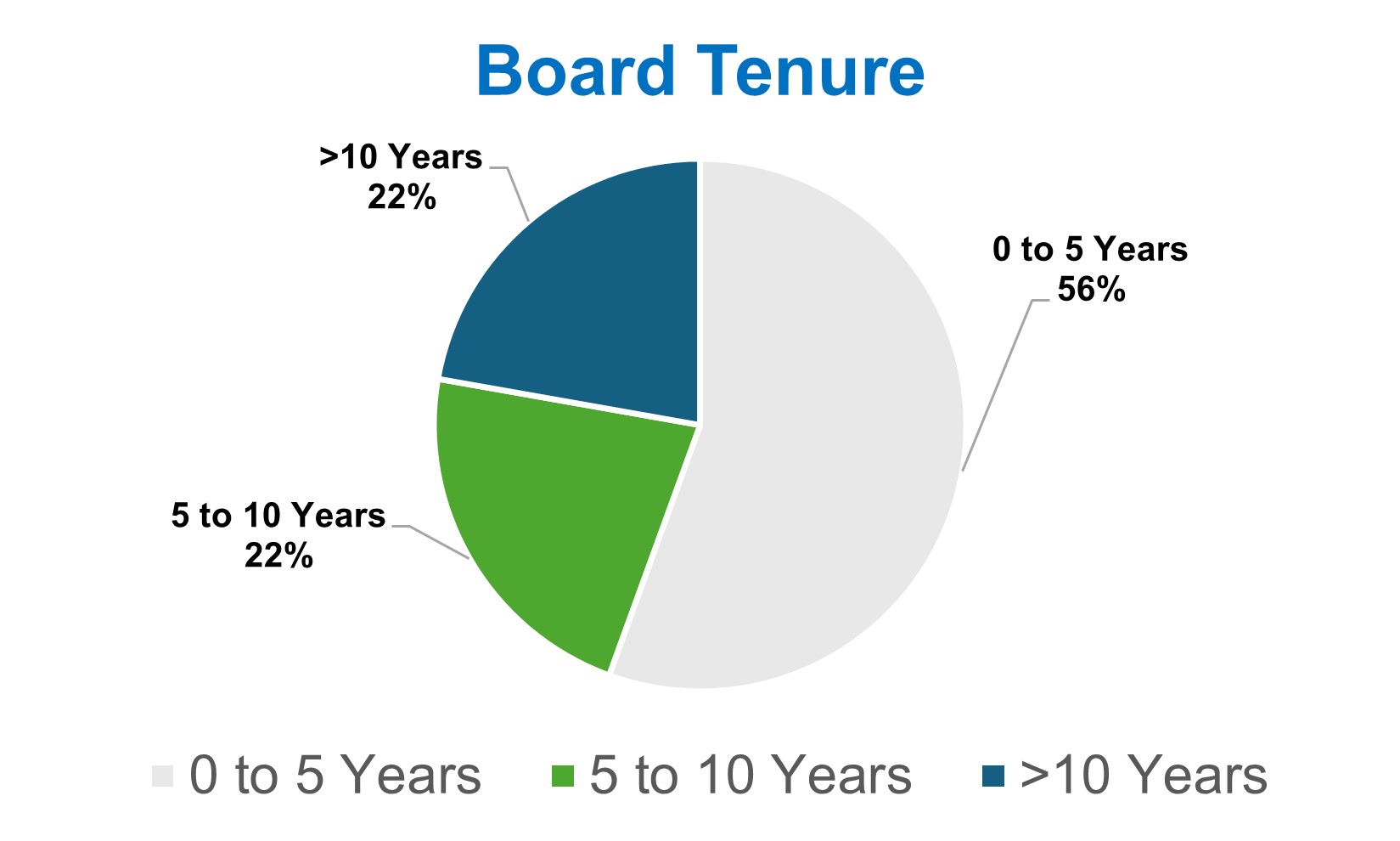
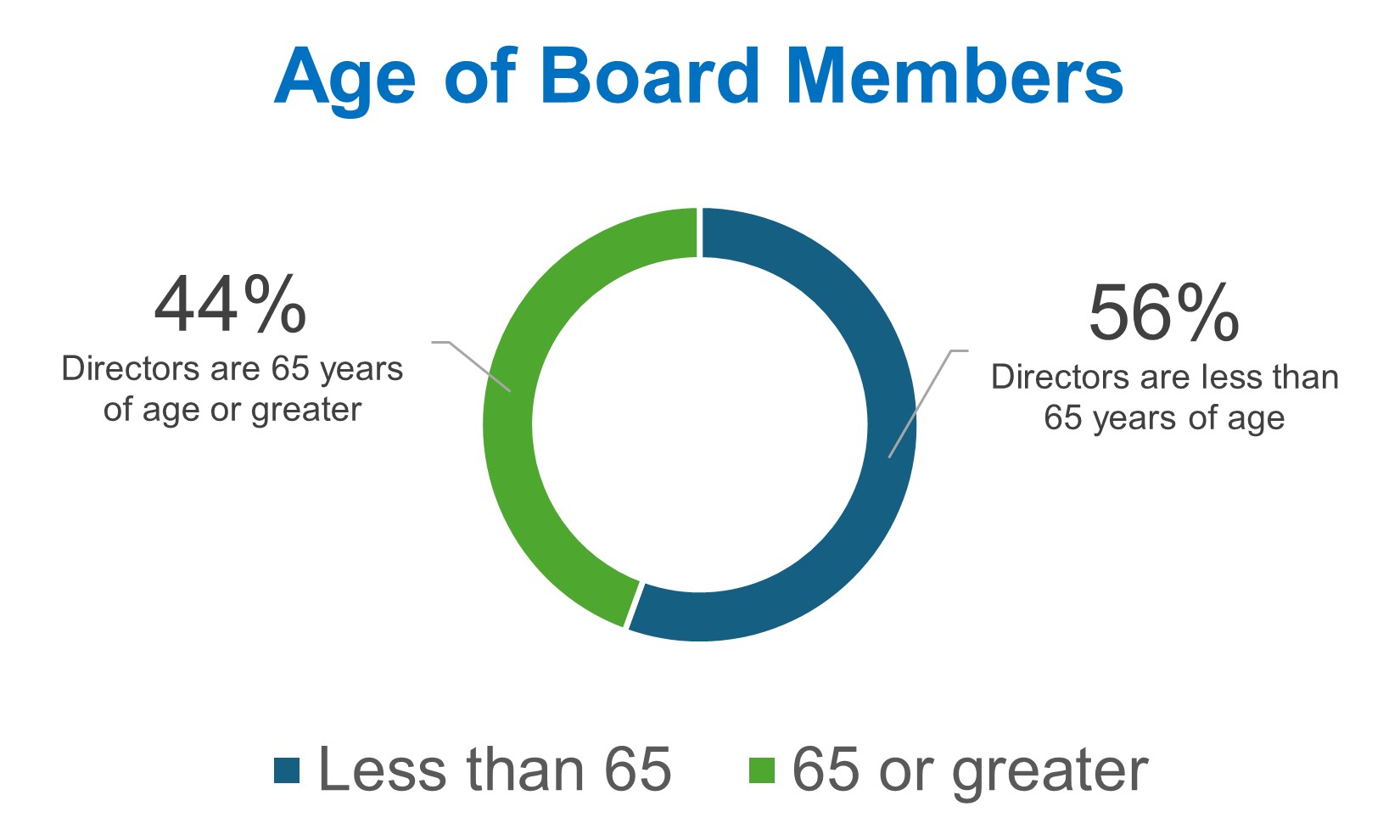
Eight out of nine directors on Teradyne's Board are independent, including the Board Chair, under Nasdaq and SEC standards. This reflects our commitment to effective, objective oversight.
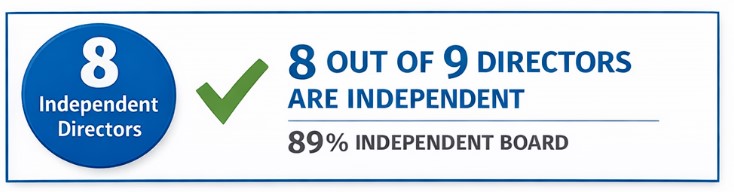
Teradyne, Inc. | 2026 Notice of Annual Meeting & Proxy Statement | Page 32
Proposal No. 1: Election of Directors
Director Compensation
Director Compensation Highlights
Teradyne uses a combination of cash and stock-based incentive compensation to attract and retain qualified candidates to serve on the Board. Every year, Compensia, Inc. (“Compensia”), the Compensation Committee’s independent compensation consulting firm, conducts an analysis of director compensation, including a review of benchmark data, and reports to the Compensation Committee any recommendations regarding director compensation. The Compensation Committee considers Compensia’s annual input as part of its annual review of director compensation. Non-employee directors’ compensation is determined by the Board at the recommendation of the Compensation Committee. Directors who are employees of Teradyne receive no compensation for their service as a director.
Cash Compensation
After a review of peer benchmarking data and global survey data regarding director compensation, the Compensation Committee, with input from Compensia, recommended that the Board maintain the same non-employee director compensation as provided in 2024. In 2025, the non-employee directors received annual cash retainers and non-employee directors serving as Independent Chair and committee chairs received additional fees for their service, as set forth in the table below:
2025 Annual Retainers: |
|
|
|
|
All Non-Employee Directors |
|
$ |
90,000 |
|
Independent Chair |
|
$ |
100,000 |
|
Audit Committee Chair |
|
$ |
30,000 |
|
Compensation Committee Chair |
|
$ |
20,000 |
|
Nominating and Governance Committee Chair |
|
$ |
15,000 |
|
Stock-Based Compensation
Each non-employee director receives an annual equity award having a fair market value equal to $230,000 on the earlier of (i) the date of the Annual Meeting or (ii) the last Thursday in May. This annual equity award, which is granted in the form of restricted stock units, vests in full on the earlier of (i) the first anniversary of the date of grant or (ii) the date of the following year’s Annual Meeting of Shareholders.
Each new non-employee director is granted an equity award on the date first elected or appointed to the Board having a fair market value equal to $230,000, pro-rated to reflect the period between the director’s date of election or appointment and the date of the next annual board grant. This equity award, which is also granted in the form of restricted stock units, vests in full on the earlier of the first anniversary of the grant date or the date of the next annual meeting of shareholders, subject to the director’s service through that date.
Equity awards to non-employee directors are granted under the shareholder-approved Teradyne, Inc. Equity and Cash Compensation Incentive Plan (the “Equity Plan”).
Director Deferral Program
To facilitate stock ownership and provide for tax planning flexibility, non-employee directors may elect to defer receipt of their cash and/or equity awards and have the compensation notionally invested into (1) an interest-bearing account (based on ten-year Treasury note interest rates) or (2) a deferred stock unit (“DSU”) account. If a non-employee director elects to participate in this deferral program,
Teradyne, Inc. | 2026 Notice of Annual Meeting & Proxy Statement | Page 33
Proposal No. 1: Election of Directors
they will receive either the cash value of the interest-bearing account or the shares of the Company’s common stock underlying the DSUs, in either case, within 90 days following the end of their board service.
Director Stock Ownership Guidelines
The Company maintains stock retention and stock ownership guidelines to align the interests of the non-employee directors with those of the Company’s shareholders and ensure that the directors have an ongoing financial stake in the Company’s success. Pursuant to these guidelines, the non-employee directors are expected to attain (within five years from the date of initial election or appointment to the Board) and maintain an investment level in shares of the Company’s common stock equal to five times their annual cash retainer. Shares underlying unvested restricted stock units are not considered owned for purposes of determining whether the stock ownership guidelines have been met. All of the non-employee directors met the ownership guidelines as of December 31, 2025, except for Mr. Maddock, who joined the Board in 2022, Ms. van Kralingen, who joined the Board in January 2024, and Mr. Henry and Dr. Sayiner who each joined the Board in July 2025, all of whom have additional time to satisfy the guidelines.
Anti-Hedging and Anti-Pledging
As noted above, Board has adopted, through the Insider Trading Policy, a policy prohibiting employees, executives and directors from engaging in hedging and pledging activities.
Shareholder-Approved Limits on Non-Employee Director Compensation
The Equity Plan limits the aggregate amount or value, as applicable, of total annual cash and equity compensation that may be paid or granted, as applicable, to each non-employee director to an amount not to exceed $750,000.
Director Compensation Table for 2025
The table below summarizes the compensation Teradyne paid to non-employee directors for the fiscal year ended December 31, 2025.
Name |
|
Fees Earned or Paid |
|
|
Stock Awards ($) |
|
|
Total ($) |
|
|||
Ford Tamer(4) |
|
$ |
22,500 |
|
|
$ |
— |
|
|
$ |
22,500 |
|
Peter Herweck |
|
$ |
110,000 |
|
|
$ |
230,015 |
|
|
$ |
340,015 |
|
Mercedes Johnson |
|
$ |
120,000 |
|
|
$ |
230,015 |
|
|
$ |
350,015 |
|
Ernest E. Maddock |
|
$ |
90,000 |
|
|
$ |
230,015 |
|
|
$ |
320,015 |
|
Marilyn Matz |
|
$ |
105,000 |
|
|
$ |
230,015 |
|
|
$ |
335,015 |
|
Paul J. Tufano |
|
$ |
190,000 |
|
|
$ |
230,015 |
|
|
$ |
420,015 |
|
Bridget A. van Kralingen |
|
$ |
90,000 |
|
|
$ |
230,015 |
|
|
$ |
320,015 |
|
Necip Sayiner |
|
$ |
67,500 |
|
|
$ |
195,973 |
|
|
$ |
263,473 |
|
Drew Henry |
|
$ |
67,500 |
|
|
$ |
195,973 |
|
|
$ |
263,473 |
|
The Board recommends a vote FOR the election to the Board of each of the director nominees.
Teradyne, Inc. | 2026 Notice of Annual Meeting & Proxy Statement | Page 34
EXECUTIVE OFFICERS
The following identifies and sets forth biographical information regarding our executive officers as of March 27, 2026. The background of Gregory S. Smith is described under “Proposal No. 1—Directors.”
Executive Officer |
|
Age |
|
Position |
|
Business Experience for The Past 5 Years |
Michelle Turner |
|
52 |
|
Vice President, Chief Financial Officer and Treasurer |
|
• Teradyne, Chief Financial Officer and Treasurer of Teradyne, since November 2025 • L3 Harris Technologies, Inc., a technology company, defense contractor, and information technology services provider, Senior Vice President and CFO (January 2022 to December 2023) • Johnson & Johnson, a pharmaceutical, biotechnology, and medical technologies company, VP, CFO, Enterprise Supply Chain (September 2017 to December 2021) |
|
|
|
|
|
|
|
Ryan Driscoll |
|
48 |
|
Vice President, General Counsel and Secretary |
|
• Teradyne, Various Positions ▪ Vice President, General Counsel and Secretary, since February 2024 ▪ Deputy General Counsel (November 2009 to February 2024) |
|
|
|
|
|
|
|
Shannon Poulin |
|
55 |
|
President, Semiconductor Test |
|
• Teradyne, President, Semiconductor Test since March 2025 • Altera – Intel, a semiconductor manufacturer, GM and COO, (September 2021 to November 2024) • Intel, a technology company, VP, Sales and Product (May 1999 to September 2021) |
|
|
|
|
|
|
|
Regan Mills |
|
56 |
|
President, Product Test |
|
• Teradyne, Various Positions ▪ President, Product Test since March 2025 ▪ VP, Semiconductor Test, Marketing (February 2019 to March 2025) |
|
|
|
|
|
|
|
Jean Pierre Hathout |
|
56 |
|
President, Robotics |
|
• Teradyne, Various Positions ▪ President of Robotics, since September 2025 ▪ Universal Robots, President, (May 2025 to September 2025) ▪ Mobile Industrial Robots, President (May 2023 to May 2025) • SIT Controls USA, Inc., a climate control product manufacturer, President USA (July 2017 to May 2023) |
Teradyne, Inc. | 2026 Notice of Annual Meeting & Proxy Statement | Page 35
PROPOSAL NO. 2: ADVISORY VOTE ON COMPENSATION OF NAMED EXECUTIVE OFFICERS
As required pursuant to Section 14A of the Exchange Act, we are requesting our shareholders cast a non-binding advisory vote on the compensation of our named executive officers as disclosed in the Compensation Discussion and Analysis and the compensation tables of this proxy statement. Specifically, shareholders are being asked to approve the following resolution at the Annual Meeting:
RESOLVED, that the shareholders of the Company approve, in a non-binding, advisory vote, the compensation of the Company’s named executive officers as disclosed in the Company’s proxy statement under the headings “Compensation Discussion and Analysis” and “Executive Compensation Tables” pursuant to Item 402 of Regulation S-K.
This non-binding advisory vote is commonly referred to as a “say-on-pay” vote and is held annually. It is expected that the next say-on-pay vote will occur at the 2027 Annual Meeting of Shareholders. Compensation policies and decisions take into account the results of the shareholder advisory vote on executive compensation.
The Board recommends a vote FOR the advisory resolution approving the compensation of the Company’s named executive officers as described in this proxy statement.
Teradyne, Inc. | 2026 Notice of Annual Meeting & Proxy Statement | Page 36
EXECUTIVE COMPENSATION
Compensation Discussion and Analysis
We believe we have implemented an executive compensation program that fosters a performance-oriented environment by tying a significant portion of each executive officer’s cash and equity compensation to the achievement of short-term and long-term performance targets that are important to Teradyne and its shareholders. This approach is designed to focus the executive officers on creating shareholder value over the long-term and on delivering exceptional performance throughout fluctuations in business cycles, as well as to attract, motivate, reward and retain the senior management talent required to achieve Teradyne’s corporate objectives. Teradyne believes that its compensation policies and practices reflect a pay-for-performance philosophy and are strongly aligned with the long-term interests of shareholders.
This Compensation Discussion and Analysis describes the material elements of Teradyne’s executive compensation program during the fiscal year ended December 31, 2025. It also provides an overview of Teradyne’s executive compensation philosophy, as well as Teradyne’s principal compensation policies and practices as they relate to executive compensation. Finally, it analyzes how and why the Compensation Committee arrived at the specific compensation decisions for Teradyne’s executive officers, including the named executive officers, in 2025, and discusses the key factors that the Compensation Committee considered in determining the compensation of the named executive officers.
This Compensation Discussion and Analysis provides information with respect to the following persons who, pursuant to SEC rules, constitute our “named executive officers” for 2025:
Gregory S. Smith |
Sanjay Mehta |
Michelle Turner |
Ryan Driscoll |
Shannon Poulin |
Regan Mills |
President and Chief Executive Officer |
Former Vice President, Chief Financial Officer, and Treasurer |
Vice President, Chief Financial Officer, and Treasurer |
Vice President, General Counsel and Secretary |
President, Semiconductor Test |
President, Product Test |
As detailed in the section titled 2025 Executive Officer Transitions above, Mr. Poulin succeeded Mr. Burns as President, Semiconductor Test effective April 9, 2025, Mr. Mills was promoted to the newly created executive position President, Product Test effective March 24, 2025, and Ms. Turner succeeded Mr. Mehta as Vice President, Chief Financial Officer, and Treasurer effective November 3, 2025.
Fiscal 2025 Performance Overview
In 2025, Teradyne generated revenue of $3.19 billion, an approximately 13% increase over 2024 revenues. Teradyne also delivered $3.47 in GAAP earnings per share (“EPS”) and $3.96 in non-GAAP EPS leading to an approximately 4.5% increase in GAAP EPS over 2024 and a 23% increase in non-GAAP EPS over 2024.(1)
Teradyne’s Semiconductor Test business increased its revenues approximately 19% from 2024, primarily driven by AI-related demand in compute, networking and memory. Revenue for the Product Test Group grew 8% in 2025, driven by strength in defense and aerospace. The Product Test Group also successfully integrated Quantifi Photonics. In 2025, Robotics saw three consecutive quarters of growth starting in Q2.
Teradyne generated $674.4 million in operating cash flow and $450 million in free cash flow(1) in 2025 and returned $785 million, or 116% of operating cash flow or 174% of free cash flow, to our shareholders through share repurchases and dividends. The dividend and repurchase programs reflect the Company’s continued confidence in its business and the ability to return capital to its shareholders while retaining sufficient financial flexibility to pursue growth opportunities through both internal investments and acquisitions.
Teradyne, Inc. | 2026 Notice of Annual Meeting & Proxy Statement | Page 37
Executive Compensation
Financial and Strategic Highlights(1)
Annual revenue growth |
|
GAAP EPS of $3.47
Non-GAAP EPS(2) of $3.96 |
|
GAAP EPS growth of 4.5%
Non-GAAP EPS(2) growth of 23% |
|
|
|
|
|
|
|
|
|
|
SOC |
|
$674 Million |
|
19% |
Fiscal 2025 Compensation Highlights
For 2025, the performance-based compensation for the Company’s named executive officers was tied to the Company’s PBIT, two-year rolling revenue growth rate, vital goals, and relative TSR.
As discussed below, while the Compensation Committee established challenging performance goals for 2025, the strong business environment and Teradyne's 2025 results resulted in above‑target performance and above‑target payouts for Teradyne’s named executive officers. Further, as a result of our performance against our three-year 2023 performance-based restricted stock units ("PSUs") targets, Teradyne’s named executive officers who received a PSU grant in 2023 earned 136.71% of their 2023 target PSUs following the conclusion of the 2023 to 2025 performance period.
Teradyne, Inc. | 2026 Notice of Annual Meeting & Proxy Statement | Page 38
Executive Compensation
Our Compensation Philosophy
The objective of the executive compensation program is to provide a competitive level of compensation that achieves the following objectives:
|
Pay For Performance |
|
Link executive officer compensation closely to corporate performance and reward an appropriate balance of near- and long-term results |
|
|
|
|
|
|
|
Competitive Excellence |
|
Encourage competitive excellence of Teradyne’s products and services and motivate executive officers to exceed financial and operational targets |
|
|
|
|
|
|
|
Risk Management |
|
Motivate executive officers to achieve our short-term and long-term operating and financial goals without encouraging excessive or inappropriate risk taking |
|
|
|
|
|
|
|
Shareholder Alignment |
|
Align the interests of executive officers with the interests of our shareholders |
|
|
|
|
|
|
|
Attract and Retain |
|
Attract and retain qualified executive officers |
|
2025 Executive Compensation Summary
The four core elements of our named executive officer direct compensation are base salary, an annual variable cash incentive opportunity, an annual profit bonus opportunity (as applicable and described in detail below) and annual equity awards. The graphic below reflects the approximate general distribution of these four core elements of named executive officer target total direct compensation awarded during 2025. For purposes of the charts below, performance-based restricted stock units are valued based on target level of achievement.
Chief Executive Officer |
|
Average of the Other Named Executive Officers |
|
|
|
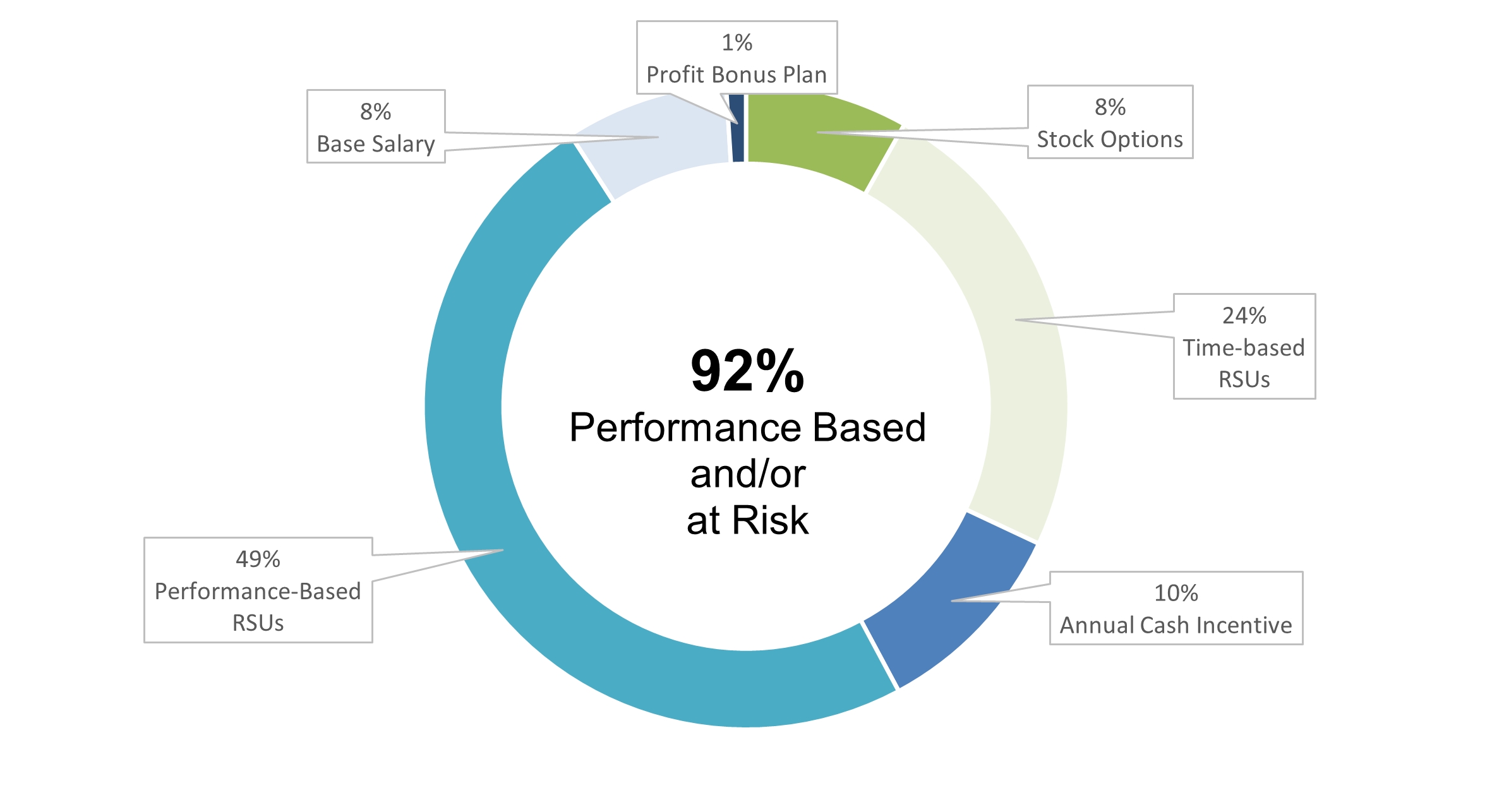
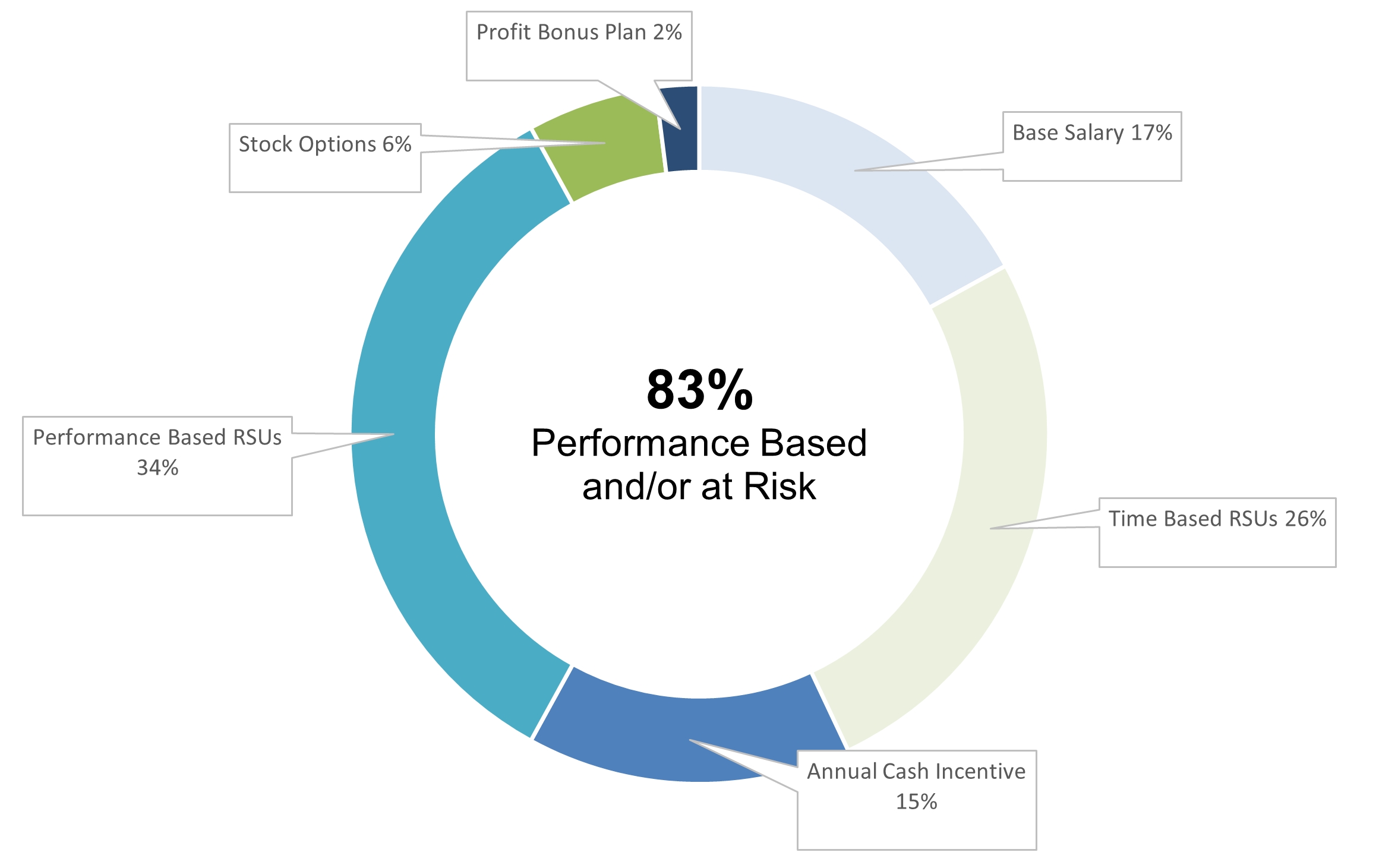
Teradyne, Inc. | 2026 Notice of Annual Meeting & Proxy Statement | Page 39
Executive Compensation
We believe we have implemented an executive compensation program that fosters a performance-oriented environment by tying a significant portion of each executive officer’s cash and equity compensation to the achievement of short-term and long-term performance targets that are important to Teradyne and its shareholders. This approach is designed to focus the executive officers on creating shareholder value over the long term and on delivering exceptional performance throughout fluctuations in business cycles.
Pay for Performance
While the Compensation Committee established challenging performance goals for 2025, Teradyne's strong performance resulted in above‑target payouts for Teradyne’s named executive officers for the fiscal year, with variable cash compensation payouts ranging from 131% of target to 145% of target. This is in contrast to 2024 where all of the named executive officers except for our then President of Semiconductor Test received below-target variable cash compensation payouts with a range between 58% and 91% of target.
This variance in compensation demonstrates that the program effectively rewards the executive officers when there is superior performance by Teradyne and appropriately adjusts compensation downward in the case of less-than-superior performance, the Compensation Committee continues to review the executive compensation program and its mix of short- and long-term incentives to ensure it reflects the correct balance between short-term financial performance and long-term shareholder return. The Compensation Committee also continues to establish challenging performance metrics reflecting Teradyne’s business objectives and strategy.
Our shareholders may cast an annual advisory vote on our named executive compensation (the “Say-On-Pay Vote”). Although the vote is non-binding, the Compensation Committee considers the results of the Say-On-Pay Vote when making compensation decisions, allowing our shareholders to provide input on our compensation philosophy, policies and practices. At our 2025 Annual Meeting of Shareholders, the vote on the compensation of our named executive officers (“NEOs”) passed with approximately 95% of the votes cast (excluding abstentions), a significant increase from the 89% approval received at our 2024 Annual Meeting of Shareholders. In addition to our annual Say-On-Pay Vote, we are committed to ongoing engagement with our shareholders to gain valuable insight into the issues that matter most to them and to enable Teradyne to address them effectively. Please see “Shareholder Engagement” on page 18 for more information. |
Approximately 95% of voted shares (cast “for” or “against”) approved our NEOs' compensation last year.
|
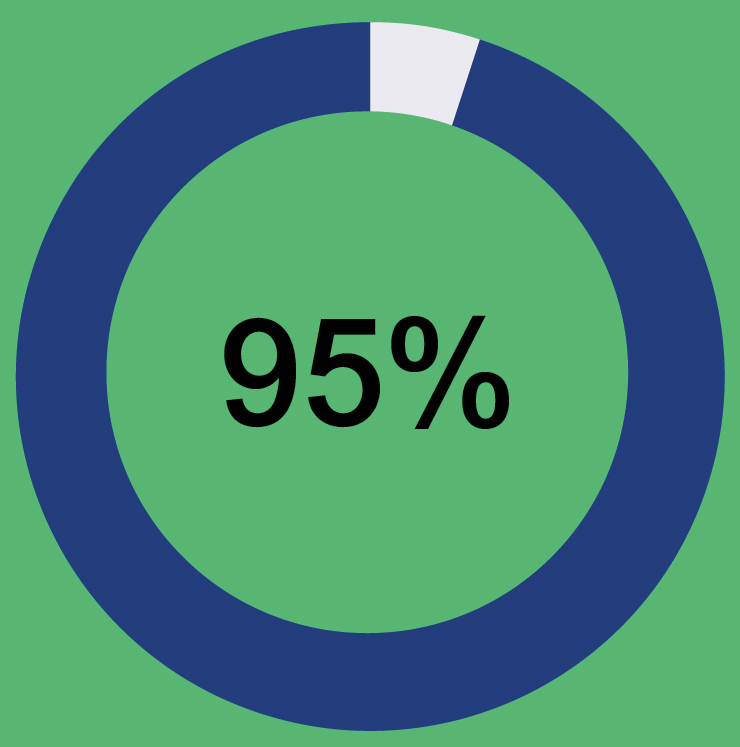
The Compensation Committee believes that our most recent Say-on-Pay voting results demonstrate strong support for our compensation philosophy and executive compensation program. The Compensation Committee did not make any significant changes to our executive compensation program in fiscal 2025, other than removing the human capital goal from our variable cash incentive compensation to simplify our program and incentivize executives to focus on our financial performance.
Teradyne, Inc. | 2026 Notice of Annual Meeting & Proxy Statement | Page 40
Executive Compensation
Compensation Practices and Governance Policies
|
|
|
What We Do |
|
What We Don’t Do |
|
|
|
|
|
|
|
|
|
|
|
|


Teradyne, Inc. | 2026 Notice of Annual Meeting & Proxy Statement | Page 41
Executive Compensation
2025 Executive Compensation
|
|
Core Compensation Element |
Purpose |
Key Characteristics |
|
|
|
|
|
|
|
|
|
|
|
|
|
|
|
|
|||
Base Salary |
• Compensates our executive officers for expected levels of day-to-day performance |
• Reflects expertise and scope of responsibilities in a competitive market for executive talent |
|||
|
|
|
|
||
|
|
|
|
|
|
|
|
||||
Annual Variable Cash Opportunity |
• Aligns executive officer performance with near-term financial and organizational objectives |
• Multiple measurable performance metrics: ▪ Including financial and organizational performance metrics • Requires significant levels of achievement before payments are earned |
|||
|
|||||
Annual Profit Bonus Award Opportunity |
• Allows eligible employees to participate in our growth by encouraging performance that increases profit |
• Payout is based on the annual PBIT percentage (non-GAAP profit before interest and taxes) for the combined Semiconductor Test and Product Test (excluding Wireless Test) results measured against peer profitability targets • Each division excluded from the Profit Bonus Plan, including Robotics, is eligible to receive a profit-sharing or growth plan cash incentive based on certain specified financial goals |
|||
|
|
|
|
||
|
|
|
|
|
|
|
|
|
|
||
Annual Performance-based RSUs |
• Aligns interests of executive officers with long-term shareholder interests through incentivizing PBIT and relative stock price growth over a multi-year performance period • Modifier helps align payouts with shareholder experience • Encourages retention |
• 50% of the performance-based RSUs vest based upon the determination of Teradyne’s TSR performance relative to the New York Stock Exchange Composite Index over a three-year performance period • 50% of the performance-based RSUs vest based on three-year cumulative PBIT |
|||
|
|
|
|
||
|
|
|
|
||
|
|
|
|||
Annual Time-based RSUs |
• Aligns interests of executive officers with long-term shareholder interests as their value is tied to stock price growth • Encourages retention |
• Four-year vesting subject to continued employment |
|||
|
|
|
|
||
|
|
|
|
||
|
|
|
|||
Stock Options |
• Aligns interests of executive officers with long-term shareholder interests through incentivizing long-term stock price growth as stock options only become valuable if the stock price increases from the grant date • Encourages retention |
• Four-year vesting subject to continued employment • Expire seven years after the applicable grant date |
|||




Base Salary
To align cash compensation with the competitive market, the Compensation Committee, and the independent members of the Board in the case of the Chief Executive Officer, approved increases in the 2025 base salaries for Messrs. Smith and Driscoll in January 2025.
Teradyne, Inc. | 2026 Notice of Annual Meeting & Proxy Statement | Page 42
Executive Compensation
The increase in Mr. Mills's base salary was a result of his appointment as President, Product Test in May 2025. Ms. Turner's and Mr. Poulin's initial base salaries reflect their role and responsibilities as well as internal pay equity, market competitiveness, and historical pay considerations. The 2024 and 2025 base salaries for our named executive officers are set forth below:
Named Executive Officer |
|
2024 Base Salary |
|
2025 Base Salary |
|
Percentage Increase |
||||||||||||
Gregory S. Smith |
|
|
$ |
925,000 |
|
|
|
|
$ |
980,000 |
|
|
|
|
|
5.9 |
% |
|
Sanjay Mehta |
|
|
$ |
640,000 |
|
|
|
|
$ |
640,000 |
|
|
|
|
|
0.0 |
% |
|
Michelle Turner(1) |
|
|
$ |
— |
|
|
|
|
$ |
640,000 |
|
|
|
|
|
0.0 |
% |
|
Ryan Driscoll |
|
|
$ |
425,000 |
|
|
|
|
$ |
467,250 |
|
|
|
|
|
9.9 |
% |
|
Shannon Poulin(1) |
|
|
$ |
— |
|
|
|
|
$ |
650,000 |
|
|
|
|
|
0.0 |
% |
|
Regan Mills(1) |
|
|
$ |
271,267 |
|
|
|
|
$ |
320,000 |
|
|
|
|
|
18.0 |
% |
|
(1) Ms. Turner and Messrs. Poulin and Mills were each appointed as an executive officer in fiscal 2025. Ms. Turner and Mr. Poulin were not employed by Teradyne in fiscal 2024.
2025 Salary Decreases
In April 2025, in response to then evolving macroeconomic conditions and reduced near-term growth expectations, the Company implemented a series of cost management actions designed to align executive compensation and overall spending with business performance. As uncertainty increased due to global trade and tariff developments, the Company revised its full-year growth outlook and took proactive measures to limit operating expense growth relative to revenue.
Consistent with this approach, management implemented a temporary 5% reduction in base salary for members of senior leadership, including the named executive officers, for the period from July 1, 2025 through December 31, 2025. These actions were part of a broader enterprise-wide initiative focused on disciplined spending, which also included heightened controls on discretionary expenses and a temporary hiring freeze.
The Board and management believe these measures demonstrate a clear commitment to aligning executive compensation outcomes with Company performance and shareholder interests, while preserving the Company’s ability to continue investing in critical product development and long-term growth opportunities during periods of economic uncertainty.
Variable Cash Compensation Program
We utilize annual variable cash incentive compensation to align named executive officer performance with near-term financial and strategic objectives goals. These cash incentive payments can be earned by our named executive officers only if we achieve a significant level of our financial and strategic performance goals, which are intended to advance our long-term strategic plans and, ultimately, shareholder value. Our Compensation Committee grants cash incentive compensation opportunities under our variable cash compensation program and approves cash incentive targets, performance goals and payouts that determine how much of the target will be paid at each level of achievement of our performance goals.
Variable Compensation Targets
A variable compensation target is the amount of variable cash incentive compensation that a named executive officer could earn if we achieve our performance goals, expressed as a percentage of the named executive officer’s base salary. In reviewing targets, our Compensation Committee takes into consideration each executive officer’s role and responsibilities, our financial performance projections, the budget for the coming year, pay at comparable companies, historical compensation levels and the resulting total model compensation (i.e., salary plus target variable cash compensation) that can be earned given the individual’s base salary and related target variable compensation opportunity. The variable compensation targets for each of our named executive officers for fiscal 2025
Teradyne, Inc. | 2026 Notice of Annual Meeting & Proxy Statement | Page 43
Executive Compensation
as compared to fiscal 2024 are summarized below. For fiscal 2025, in no event could an actual variable compensation payment to any named executive officer exceed 200% of the executive officer’s target opportunity.
Named Executive Officer |
|
2024 Variable Compensation Opportunity |
|
2025 Variable Compensation Opportunity |
|
Percentage Increase |
||||||||||||
Gregory S. Smith |
|
|
|
125 |
% |
|
|
|
|
125 |
% |
|
|
|
|
0 |
% |
|
Sanjay Mehta |
|
|
|
80 |
% |
|
|
|
|
100 |
% |
|
|
|
|
25 |
% |
|
Michelle Turner(1) |
|
|
|
— |
|
|
|
|
|
100 |
% |
|
|
|
|
— |
|
|
Ryan Driscoll |
|
|
|
75 |
% |
|
|
|
|
85 |
% |
|
|
|
|
13 |
% |
|
Shannon Poulin(1) |
|
|
|
— |
|
|
|
|
|
89 |
% |
|
|
|
|
— |
|
|
Regan Mills(1) |
|
|
|
70 |
% |
|
|
|
|
85 |
% |
|
|
|
|
21 |
% |
|
(1) Ms. Turner and Messrs. Poulin and Mills were each appointed as an executive officer in fiscal 2025. Ms. Turner and Mr. Poulin were not employed by Teradyne in fiscal 2024.
The increase in Messrs. Mehta's and Driscoll's target variable compensation opportunity was made to more closely align their target cash compensation with the competitive market. The increase in Mr. Mills's target variable compensation opportunity was a result of his promotion to President, Product Test in March 2025. Ms. Turner's and Mr. Poulin's initial target variable compensation opportunities reflect their role and responsibilities as well as internal pay equity, market competitiveness, and historical pay considerations.
Variable Cash Compensation Program Design
Each January, the Compensation Committee sets operating, financial and strategic goals for the variable compensation program to align executive compensation with both Teradyne’s short-term financial and operating strategy and its long-term profitable growth strategy.
For 2025, the variable cash compensation program for Messrs. Smith, Mehta, and Driscoll and Ms. Turner was based on three important performance components: (i) the Company's two-year rolling revenue growth rate, (ii) the Company's PBIT, and (iii) the weighted average achievement of the Vital Goals established for each of our operating divisions, each as further described below.
Variable Compensation Goal |
Description |
Weighting |
Threshold Goal |
Target Goal |
Maximum Goal |
Revenue Growth |
Two-year rolling revenue growth rate |
30% |
-12% |
2% |
12% |
PBIT |
PBIT is a non-GAAP financial measure equal to GAAP income from operations excluding restructuring and other; amortization of acquired intangible assets; acquisition and divestiture related charges or credits; pension actuarial gains and losses; non-cash convertible debt interest expense; and certain other gains and charges |
20% |
10% |
21% |
36% |
Vital Goals(1) |
Predetermined, objective, measurable, and auditable metrics which include strategic design-ins, market share gains and expansion, gross margin and bookings goals, new product introductions, releases and adoptions, engineering project milestones, cost controls and growth targets |
50% |
N/A |
N/A |
N/A |
In establishing the threshold, target and maximum two-year rolling revenue growth rate and PBIT rate achievement goals, the Compensation Committee reviewed the 2024 revenue growth rate and PBIT rate of all companies in the S&P 500, our 2025 peer group (as further described in the section below entitled “Competitive Positioning”) and the additional semiconductor companies described in
Teradyne, Inc. | 2026 Notice of Annual Meeting & Proxy Statement | Page 44
Executive Compensation
the table below (collectively, the “VC Comparison Group”). After consultation with its independent compensation consultant, the Compensation Committee set the threshold, target and maximum two-year rolling revenue growth rate and PBIT rate achievement goals for the 2025 variable cash compensation program at the 10th percentile, 50th percentile and 90th percentile of the VC Comparison Group, respectively.
Additional Semiconductor Companies Included in VC Comparison Group |
|
Advantest Corp. |
KLA Corporation |
Applied Materials, Inc. |
Kulicke & Soffa Industries, Inc. |
ASML Holding NV |
Lam Research Corporation |
Cohu, Inc. |
Veeco Instruments, Inc. |
For 2025, the variable cash compensation program for Messrs. Poulin and Mills incorporated both Company-wide and division-specific performance components, which included financial performance targets and Vital Goals, with each component weighted at 50% of their respective total opportunity. The Company-wide goals and their respective weights are set forth below. Please see the table above for the threshold, target, and maximum goals.
Company-Wide Goal |
Weighting |
Revenue Growth |
30% |
PBIT |
20% |
Vital Goals |
50% |
Total weighting: 50% |
|
The division specific goals and their respective weights are set forth below.
Division-Wide Goal |
Weighting |
Division Revenue Growth |
30% |
Division PBIT |
20% |
Division Vital Goals |
50% |
Total weighting: 50% |
|
The Vital Goals are a set of predetermined, objective, measurable, and auditable operating metrics that reflect the Compensation Committee’s pay‑for‑performance philosophy. Because the Vital Goals are explicitly defined and tied to quantifiable outcomes, they are not subject to discretion or interpretation. Although the Company does not publicly disclose the specific target levels for these goals due to their competitively sensitive nature, the types of metrics included provide transparency into their design. For example, the Vital Goals for our Semiconductor Test and Product Test groups include metrics such as strategic and program design‑ins, new product releases, improved gross margins, market expansion bookings, inventory efficiency improvements, and increased revenue from key customers.
As an illustration of how Vital Goals operate in practice, the 2024 Variable Cash Compensation program included a market‑expansion‑bookings Vital Goal for our SOC business unit. For that year, the Compensation Committee, for NEOs other than the CEO, and in the case of the CEO the full Board established predetermined threshold, target, and maximum goals of $14 million, $24 million, and $48 million, respectively. Because these goals were fully defined in advance and tied to objective, measurable and auditable performance, the payout calculation involved no discretion. In 2024, the SOC business unit achieved market‑expansion bookings below the $14 million threshold, and therefore did not earn any credit for that particular Vital Goal. This example demonstrates how Vital Goals translate operational performance into compensation outcomes and implement the Company’s pay‑for‑performance philosophy.
The Compensation Committee, for NEOs other than the CEO, and the full Board, for the CEO, approved the full set of 2025 Vital Goals and their associated achievement ranges in January 2025. In August 2025, the Compensation Committee updated the Product Test
Teradyne, Inc. | 2026 Notice of Annual Meeting & Proxy Statement | Page 45
Executive Compensation
Vital Goals solely to reflect the Company’s acquisition of Quantifi Photonics, which was integrated into the Product Test Group. Final performance determinations for 2025 were approved in January 2026 by the Compensation Committee for the NEOs other than the CEO and the Board for the CEO.
Variable Cash Compensation Performance (Messrs. Smith, Mehta, and Driscoll and Ms. Turner)
As noted above, for 2025, the variable cash compensation program for Ms. Turner and Messrs. Smith, Mehta, and Driscoll was based on three important performance components: (i) the Company’s two‑year rolling revenue growth rate, (ii) the Company’s PBIT, and (iii) the weighted‑average achievement of the Vital Goals established for each of our operating divisions.
The Company performed strongly against our Company-wide financial metrics, achieving above-target performance. The Company also achieved at-or-above target performance on 31 of the 59 Vital Goals. This resulted in a Vital Goal achievement level of 124% of target, which, together with Company-wide performance outcomes, produced a total variable cash compensation payout equal to 136% of target for Ms. Turner and Messrs. Smith, Mehta, and Driscoll.
Company-wide |
||||||||||||
|
|
|
|
|
|
|
|
|
|
|
|
|
Goal |
|
Threshold |
|
Target |
|
Maximum |
|
Actual |
|
Weighting |
|
Result |
|
|
|
|
|
|
|
|
|
|
|
|
|
|
|
|
|
|
|
|
|
|
|
|
|
|
Revenue Growth |
|
(12)% |
|
2% |
|
12% |
|
9.35% |
|
30.00% |
|
174% |
|
|
|
|
|
|
|
|
|
|
|
|
|
PBIT(1) |
|
10% |
|
21% |
|
36% |
|
22.2% |
|
20.0% |
|
108% |
|
|
|
|
|
|
|
|
|
|
|
|
|
Vital Goals |
|
N/A |
|
N/A |
|
N/A |
|
N/A |
|
50.00% |
|
124% |
|
|
|
|
|
|
|
|
|
|
|
|
|
|
|
|
|
|
|
|
|
|
|
|
|
|
|
|
|
|
|
|
|
|
|
|
|
|
|
Total Company-wide Payout |
|
136% |
||||||||||
|
|
|
|
|
|
|
|
|
|
|
|
|
Ms. Turner's 2025 variable cash compensation payout was pro-rated based on the number of months during 2025 that she was employed by Teradyne. Mr. Mehta was employed by the Company for the full year so his 2025 variable cash compensation payout was not pro-rated.
Variable Cash Compensation Performance (Mr. Poulin)
As noted above, for Mr. Poulin, the 2025 variable cash compensation program incorporated both Company‑wide and division‑specific performance components, each weighted at 50% of his total opportunity. Accordingly, his payout was based equally on total Company financial performance and Company‑wide Vital Goals, and on the financial performance and Vital Goal achievement of the Semiconductor Test division, which he leads. The division‑specific component reflected the Semiconductor Test division’s revenue growth rate, its non‑GAAP PBIT performance, and achievement of the division’s Vital Goals.
Consistent with the design of the Company‑wide program, the Semiconductor Test division’s Vital Goals are predetermined, objective, measurable, and auditable metrics. Because the Vital Goals are explicitly defined and tied to quantifiable outcomes, they are not subject to discretion or interpretation. These goals reflect the operational priorities and competitive environment of the division. Although the Company does not disclose specific target levels because they represent competitively sensitive information, examples of the types of metrics used for the Semiconductor Test division include strategic design‑ins, new product releases, improved gross margins, market expansion bookings, inventory efficiency improvements, and increased revenue from key customers.
For 2025, the Semiconductor Test division performed strongly against its financial metrics, achieving above‑target performance. The Semiconductor Test division also achieved at-or-above-target performance on 14 of the 18 Vital Goals across its businesses. This resulted in a Semiconductor Test division achievement level of 153% of target, which, together with Company‑wide performance outcomes, produced a total variable cash compensation payout equal to 145% of target for Mr. Poulin. Mr. Poulin's variable cash compensation payout was pro-rated based on the number of months during 2025 that he was employed by Teradyne.
Teradyne, Inc. | 2026 Notice of Annual Meeting & Proxy Statement | Page 46
Executive Compensation
Semiconductor Test Group |
||||
|
|
|
|
|
Goal |
|
Weighting |
|
Result |
|
|
|
|
|
|
|
|
|
|
Company Performance |
|
50.00% |
|
136% |
|
|
|
|
|
Semiconductor Test Group Performance |
|
50.00% |
|
153% |
|
|
|
|
|
|
|
|
|
|
|
|
|
|
|
Total Semiconductor Test Group Payout |
|
145% |
||
|
|
|
|
|
Variable Cash Compensation Performance (Mr. Mills)
As noted above, for Mr. Mills, the 2025 variable cash compensation program for his time as President, Product Test incorporated both Company‑wide and division‑specific performance components, each weighted at 50% of his total opportunity. Accordingly, his payout was based equally on total Company financial performance and Company‑wide Vital Goals, and on the financial performance and Vital Goal achievement of the Product Test division, which he leads. The division‑specific component reflected the Product Test division’s revenue growth rate, its non‑GAAP PBIT performance, and achievement of the division’s Vital Goals.
Consistent with the design of the overall program, the Product Test Group’s Vital Goals are predetermined, objective, measurable, and auditable metrics. Because the Vital Goals are explicitly defined and tied to quantifiable outcomes, they are not subject to discretion or interpretation. These goals are tailored to the operational priorities of the Product Test Group. Although the Company does not disclose specific performance targets because they contain confidential, competitively sensitive information, examples of the types of metrics used for the Product Test Group include new segment and program design‑ins, new product releases, customer qualification milestones, and improvements in inventory efficiency.
For 2025, the Product Test Group performed strongly against its financial metrics, achieving above-target performance. The Product Test Group also achieved at‑or‑above target performance on 14 of the 29 Vital Goals across its four businesses. This resulted in a Product Test Group achievement level of 110% of target, which, together with Company‑wide performance of 136% of target described above, determined Mr. Mills’s variable cash compensation payout of 123% for his time as President, Product Test.
Product Test Group |
||||
|
|
|
|
|
Goal |
|
Weighting |
|
Result |
|
|
|
|
|
|
|
|
|
|
Company Performance |
|
50.00% |
|
136% |
|
|
|
|
|
Product Test Group Performance |
|
50.00% |
|
110% |
|
|
|
|
|
|
|
|
|
|
|
|
|
|
|
Total Product Test Achievement |
|
123% |
||
|
|
|
|
|
Mr. Mills's actual variable compensation payout for 2025 was prorated to reflect (1) a bonus achievement level of 154% for our System-on-a-Chip (SOC) and memory test business units within the Semiconductor Test division in fiscal 2025 for the number of months in which he served in this prior role and (ii) the bonus achievement level of 123% for the number of months which he served as President, Product Test, leading to a total payout of 131% of target.
Teradyne, Inc. | 2026 Notice of Annual Meeting & Proxy Statement | Page 47
Executive Compensation
Variable Cash Compensation Payout
The table below shows the amount of the fiscal 2025 variable cash compensation awards that were earned as compared to each named executive officer’s respective target variable cash compensation opportunity.
Named Executive Officer |
|
2025 Target Variable Compensation Opportunity |
|
2025 Target Variable Compensation Opportunity |
Payout Percentage |
Actual 2025 Payout |
||||||||||||
Gregory S. Smith |
|
|
|
125 |
% |
|
|
|
$ |
1,225,000 |
|
|
136% |
|
$ |
1,666,000 |
|
|
Sanjay Mehta |
|
|
|
100 |
% |
|
|
|
$ |
640,000 |
|
|
136% |
|
$ |
870,400 |
|
|
Michelle Turner (2) |
|
|
|
100 |
% |
|
|
|
$ |
106,667 |
|
|
136% |
|
$ |
145,067 |
|
|
Ryan Driscoll |
|
|
|
85 |
% |
|
|
|
$ |
397,163 |
|
|
136% |
|
$ |
540,141 |
|
|
Shannon Poulin (2) |
|
|
|
89 |
% |
|
|
|
$ |
482,083 |
|
|
145% |
|
$ |
699,021 |
|
|
Regan Mills |
|
|
|
85 |
% |
|
|
|
$ |
272,000 |
|
|
131% |
|
$ |
356,320 |
|
|
Profit Bonus Plan
Effective January 1, 2025, we replaced our prior Cash Profit Sharing Plan with a new Profit Bonus Plan to better align with market practices, strengthen compensation governance, introduce a cap, and create a more balanced mix of fixed and variable pay. As part of this transition, a portion of prior cash profit sharing compensation opportunity was converted into base salary, and the remaining component was restructured as a fixed annual target equal to 6% of model cash compensation. “Model cash compensation” is defined as base salary plus the participant’s target cash incentive opportunity under our variable cash compensation program.
Under the new Profit Bonus Plan, annual payouts are determined based on the non‑GAAP profit before interest and taxes (“PBIT”) target percentage for our combined Semiconductor Test and Product Test Groups (excluding Wireless Test). The Compensation Committee, and, in the case of the Chief Executive Officer, the independent members of the Board, established a non‑GAAP PBIT target using externally benchmarked, peer‑based profitability data. The plan applies to all eligible employees, including our executive officers, and incorporates a defined payout range from 0% for performance at or below a minimum PBIT threshold, to 6% at target, and up to a capped maximum of 18% for performance at or above an upper PBIT benchmark. This structure enhances predictability, introduces a formal cap aligned with market practice, and more closely links rewards to relative profitability performance.
Overall, the Profit Bonus Plan is expected to provide greater income stability through increased base salary, reduce downside risk in periods of below‑market profitability, and improve alignment with peer compensation practices including introducing a cap, while maintaining Teradyne’s strong pay‑for‑performance orientation. Beginning in 2025, all profit‑based annual awards are administered under this new plan structure.
For 2025, the Compensation Committee, and, in the case of the Chief Executive Officer, the independent members of the Board, established a threshold, target, and maximum PBIT of 10%, 21%, and 36% respectively. Based on actual 2025 PBIT of 22.2%, the Profit Bonus Plan delivered a payout equal to 11.26% of model cash compensation to eligible employees.
Teradyne, Inc. | 2026 Notice of Annual Meeting & Proxy Statement | Page 48
Executive Compensation
The table below sets forth the model cash compensation and pro rata portion of total model cash compensation of each eligible named executive officer under our Profit Bonus Plan, as well as each named executive officer’s actual payouts under the Profit Bonus Plan for 2025.
Named Executive Officer |
|
2025 Model Cash Compensation |
|
|
Actual Total 2025 Profit Bonus Distribution |
|
||
|
|
|
|
|
|
|
||
Gregory S. Smith |
|
$ |
2,205,000 |
|
|
$ |
248,283 |
|
Sanjay Mehta |
|
$ |
1,280,000 |
|
|
$ |
144,128 |
|
Michelle Turner(2) |
|
$ |
1,280,000 |
|
|
$ |
24,021 |
|
Ryan Driscoll |
|
$ |
864,413 |
|
|
$ |
97,333 |
|
Shannon Poulin(2) |
|
$ |
1,228,500 |
|
|
$ |
115,274 |
|
Regan Mills |
|
$ |
864,413 |
|
|
$ |
66,659 |
|
2025 Equity Awards
Equity compensation is designed to align executive compensation with shareholder return, motivate longer-term Company performance, and attract, retain and reward talented individuals. Teradyne’s equity compensation program provides three types of equity incentives:
Type of Equity Incentive |
Description |
Performance-Based RSUs |
Split equally between awards that vest based on the achievement of TSR and cumulative PBIT percentage, in each case, measured at the end of a multi-year performance period |
Time-Based RSUs |
Vest in equal installments annually over four years conditioned upon continued service, which supports Teradyne’s employee retention efforts |
Stock Options |
Vest in equal installments annually over four years conditioned upon continued service, where executives only benefit if Teradyne’s stock price appreciates |
Equity awards are made under the shareholder-approved Equity Plan. The grant date value of awards granted to the named executive officers is based upon peer group data provided by Compensia, global survey data, and each executive’s relative contribution, performance and responsibility within the organization. The Compensation Committee assesses these factors each year for each executive officer.
In January 2025, the Compensation Committee, and, in the case of the Chief Executive Officer, the independent members of the Board, approved the 2025 equity awards for Messrs. Smith, Mehta, and Driscoll. The Compensation Committee approved the 2025 equity awards for Ms. Turner and Mr. Poulin upon their respective appointments as executive officers. Mr. Mills received a non-executive employee equity grant in January 2025 and an additional equity grant in April 2025 in connection with his promotion to President, Product Test as set forth in the Grant of Plan-Based Awards Table below. The Compensation Committee and the independent
Teradyne, Inc. | 2026 Notice of Annual Meeting & Proxy Statement | Page 49
Executive Compensation
members of the Board determined it was appropriate to continue to award equity in 2025 in the form of performance-based RSUs, time-based RSUs and non-qualified stock options in the proportions set forth below.
|
Performance-Based RSUs |
Time-Based RSUs |
Stock Options |
|
|
|
|
|
|
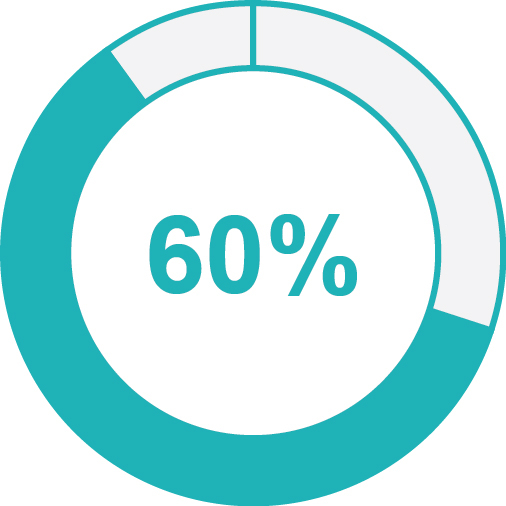
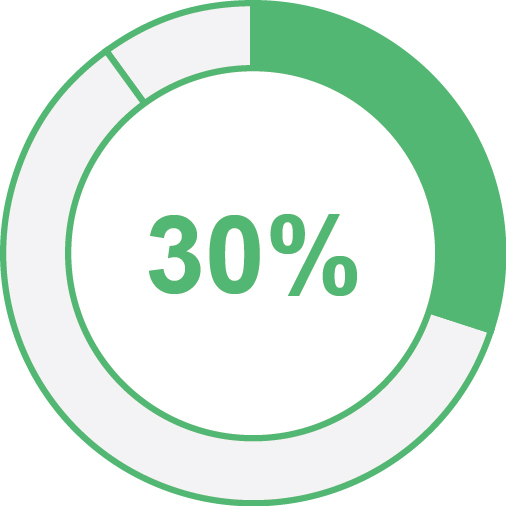
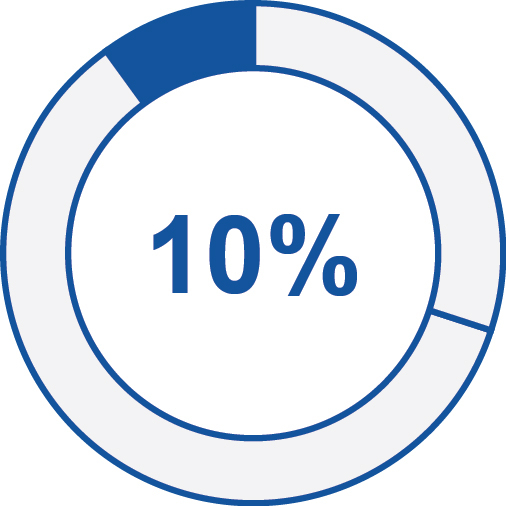
In setting the 2025 equity award levels, the Compensation Committee considered benchmarking data against our peer group and generally aimed for the 50th-percentile when setting the final values. The 2024 and 2025 target equity award values for the named executive officers are set forth below:
Named Executive Officer |
|
|
2024 Target |
|
|
|
|
2025 Target |
|
|
|
Percentage |
||
Gregory S. Smith |
|
|
$ |
9,250,000 |
|
|
|
|
$ |
10,333,333 |
|
|
|
11.71% |
Sanjay Mehta |
|
|
$ |
3,400,000 |
|
|
|
|
$ |
3,400,000 |
|
|
|
— |
Michelle Turner(1) |
|
|
$ |
— |
|
|
|
|
$ |
6,800,000 |
|
|
|
— |
Ryan Driscoll |
|
|
$ |
800,000 |
|
|
|
|
$ |
1,200,000 |
|
|
|
50.00% |
Shannon Poulin(1) |
|
|
$ |
— |
|
|
|
|
$ |
3,500,000 |
|
|
|
— |
Regan Mills(1) |
|
|
$ |
200,000 |
|
|
|
|
$ |
550,000 |
|
|
|
175.00% |
The Compensation Committee in the case of Mr. Mills and Mr. Driscoll, and the independent members of the Board in the case of Mr. Smith, approved an increase in their respective target equity values based on market competitiveness and after considering their individual performance to date. Ms. Turner's and Mr. Poulin's initial equity values reflect their role and responsibilities as well as internal pay equity, market competitiveness, and historical pay considerations.
The specific number of RSUs was calculated based upon the closing market price of Teradyne’s common stock on the grant date (with performance-based awards determined based on target performance) and the specific number of options was calculated based upon the Black-Scholes grant date fair value. The table below sets forth the grant date equity values of the 2025 performance-based RSUs, time-based RSUs, and stock options for each named executive officer. The grant date for the 2025 equity awards approved by the Compensation Committee or the independent members of the Board, as applicable, for Messrs. Smith, Mehta, and Driscoll was January 31, 2025. The grant dates for the 2025 equity awards approved by the Compensation Committee for Ms. Turner and Messrs. Poulin and Mills are their respective appointments as executive officers.
Name of Executive Officer |
|
Number of |
|
|
Number of |
|
|
Number of |
|
|
Value of |
|
|
Value of |
|
|
Value of |
|
|
Total Equity |
|
|||||||
Gregory S. Smith |
|
|
53,546 |
|
|
|
26,773 |
|
|
|
23,143 |
|
|
|
7,086,467 |
|
|
|
3,100,046 |
|
|
|
1,033,335 |
|
|
|
11,219,848 |
|
Sanjay Mehta |
|
|
17,619 |
|
|
|
8,810 |
|
|
|
7,615 |
|
|
|
2,331,787 |
|
|
|
1,020,110 |
|
|
|
340,010 |
|
|
|
3,691,907 |
|
Michelle Turner |
|
|
22,287 |
|
|
|
11,144 |
|
|
|
9,156 |
|
|
|
5,910,895 |
|
|
|
2,027,651 |
|
|
|
680,016 |
|
|
|
8,618,562 |
|
Ryan Driscoll |
|
|
6,219 |
|
|
|
2,523 |
|
|
|
2,134 |
|
|
|
823,061 |
|
|
|
360,107 |
|
|
|
120,019 |
|
|
|
1,303,187 |
|
Shannon Poulin |
|
|
25,421 |
|
|
|
5,046 |
|
|
|
4,267 |
|
|
|
1,995,083 |
|
|
|
1,035,819 |
|
|
|
350,009 |
|
|
|
3,380,911 |
|
Regan Mills |
|
— |
|
|
|
5,618 |
|
|
— |
|
|
— |
|
|
|
550,072 |
|
|
— |
|
|
|
550,072 |
|
||||
Teradyne, Inc. | 2026 Notice of Annual Meeting & Proxy Statement | Page 50
Executive Compensation
Performance-Based RSUs
Earned performance-based RSUs will vest on the third anniversary of the applicable 2025 grant date, with (1) 50% of the performance-based RSUs eligible to vest based upon the determination of Teradyne’s TSR performance relative to the New York Stock Exchange Composite Index (ticker symbol: NYA) (the “NYA Index”) over a performance period from January 31, 2025 to December 31, 2027 and (2) 50% of the performance-based RSUs eligible to vest based on three-year cumulative PBIT, in each case, as described below.
Metric |
Objective |
Vesting Conditions |
TSR (50% of performance-based RSUs) |
||
• Teradyne’s TSR performance measured against the NYA Index • Measured over the period from January 31, 2025 to December 31, 2027 • TSR reflects a 45-day price averaging method at both the beginning and the end of the performance period
|
• Aligns the interests of executive officers with the interests of shareholders • Provides a significant incentive for the executive officers to focus on increasing long-term shareholder value • The NYA Index, which consists of over 2,000 companies listed on the New York Stock Exchange, represents a broad, diverse group of high-quality investment alternatives to Teradyne’s common stock |
• Teradyne’s TSR percentage point gain minus that of the NYA Index will determine the portion earned at the end of fiscal 2027 • 0% of the TSR PSUs vest if Teradyne’s TSR performance underperforms the NYA Index TSR by 25% or more • TSR PSUs begin to vest at 0% of target only if Teradyne’s TSR performance underperforms the NYA Index TSR by less than 25% • 100% of the TSR PSUs vest if Teradyne’s TSR performance is equal to the NYA Index TSR • A maximum of 200% of the TSR PSUs vest if Teradyne’s TSR outperforms the NYA Index TSR by 25% or more |
|
|
|
PBIT(1) (50% of performance-based RSUs) |
||
• Aggregate PBIT over a 3-year performance period (or average of 3 years of PBIT) • Measured over the period from January 1, 2025 to December 31, 2027 |
• Provides an incentive to maintain a high level of profitability over the long term |
• Earned portion vests based on achievement against threshold, target and maximum PBIT goals (10%, 21% and 36%, respectively) |
Teradyne, Inc. | 2026 Notice of Annual Meeting & Proxy Statement | Page 51
Executive Compensation
The number of performance-based RSUs that may be paid out based on relative TSR performance and PBIT rate, which ranges from 0% to 200% of target, are each illustrated below:
|
|
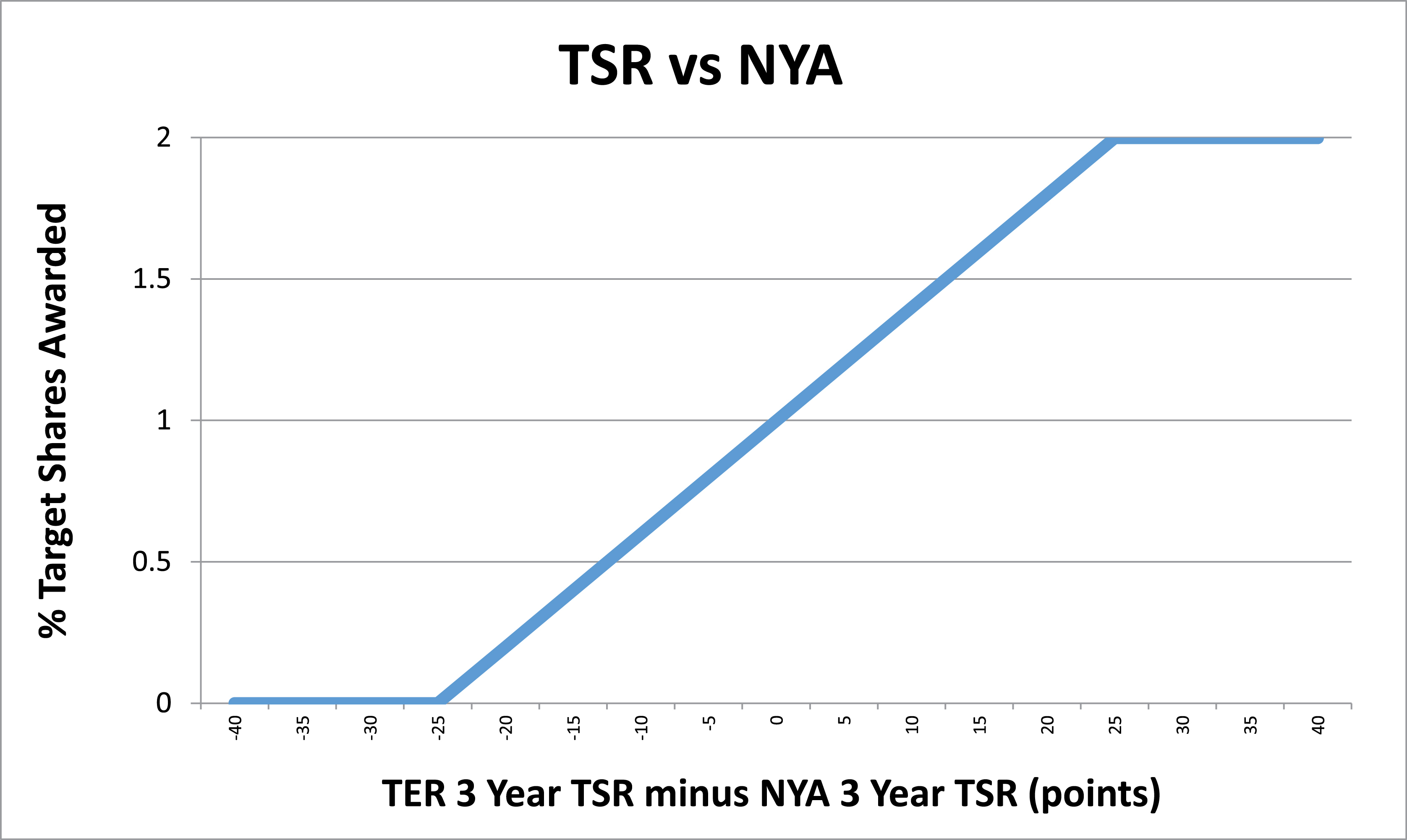
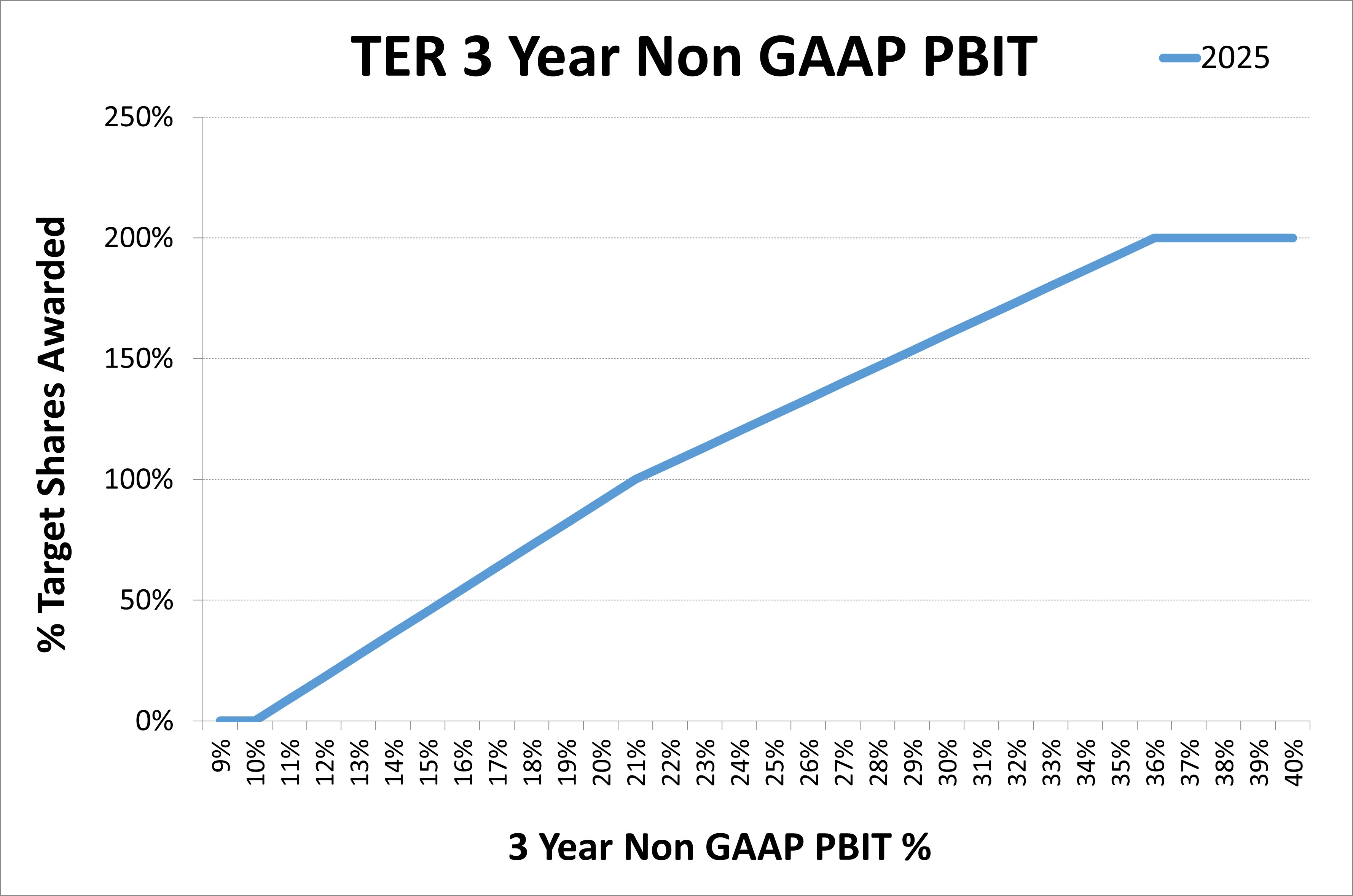
The final number of performance-based RSUs earned will be determined by the Compensation Committee and the independent members of the Board, as applicable, after the completion of the performance period. All of the performance-based RSUs earned will vest on the later of the third anniversary of the respective grant date and the date the Compensation Committee and the independent members of the Board, as applicable, determine the number of shares earned, generally subject to continued employment through such date.
Time-Based RSUs
The 2025 time-based RSUs for all employees, including named executive officers, vest in equal installments annually over four years, commencing on the first anniversary of the grant date, generally subject to continued employment through each vesting date.
Stock Options
The 2025 stock option grants vest in equal installments annually over four years, commencing on the first anniversary of the grant date, generally subject to continued employment through each vesting date, and have a term of seven years from the date of grant.
2026 Determination of Performance Achievement for 2023 Performance-Based RSU Grant
In 2023, the Company granted performance‑based RSUs to the individuals who were serving as named executive officers at that time. Mr. Mehta and Mr. Smith are our only current NEOs who were also executive officers then, and thus the only current NEOs who received this grant. These performance‑based RSUs vested on the third anniversary of the January 27, 2023 grant date, with (1) 50% eligible to vest based on Teradyne’s relative TSR performance compared to the NYA Index over a performance period from January 27, 2023 to December 31, 2025 and (2) 50% eligible to vest based on cumulative PBIT over a three‑year period, as described below. None of our other current NEOs received this 2023 grant.
Metric |
Measurement Period |
Metric Objective (50% of Target) |
Vesting Conditions |
TSR |
Teradyne’s TSR performance measured against the NYA Index at the end of the performance period (using a 45-day price averaging method at both the beginning and the end of the performance period on December 31, 2025) |
• Aligns the interests of executive officers with the interests of shareholders • Provides a significant incentive for the executive officers to focus on increasing long-term shareholder value • The NYA Index, which consists of over 2,000 companies listed on the New York Stock Exchange, represents a broad, diverse group of high-quality |
• Teradyne’s TSR percentage point gain minus that of the NYA Index determined the portion earned at the end of fiscal 2025 • 0% of the TSR PSUs vest if Teradyne’s TSR performance underperforms the NYA Index TSR by 25% or more • TSR PSUs begin to vest at 0% of target only if Teradyne’s TSR performance underperforms the NYA Index TSR by less than 25% |
Teradyne, Inc. | 2026 Notice of Annual Meeting & Proxy Statement | Page 52
Executive Compensation
Metric |
Measurement Period |
Metric Objective (50% of Target) |
Vesting Conditions |
|
|
investment alternatives to Teradyne’s common stock |
• 100% of the TSR PSUs vested if Teradyne’s TSR performance is equal to the NYA Index TSR • A maximum of 200% of the TSR PSUs vested if Teradyne’s TSR outperformed the NYA Index TSR by 25% or more |
PBIT(1) |
Measured over the period from January 1, 2023 to December 31, 2025 |
• Provides an incentive to maintain a high level of profitability over the long term |
• Earned portion vested at end of fiscal 2025 based on achievement against threshold, target and maximum PBIT goals (13%, 24% and 40%, respectively) |
The number of 2023 performance-based RSUs that were eligible to be paid out based on relative TSR performance and PBIT rate are each illustrated below, which payout could range from 0% to 200% of target:
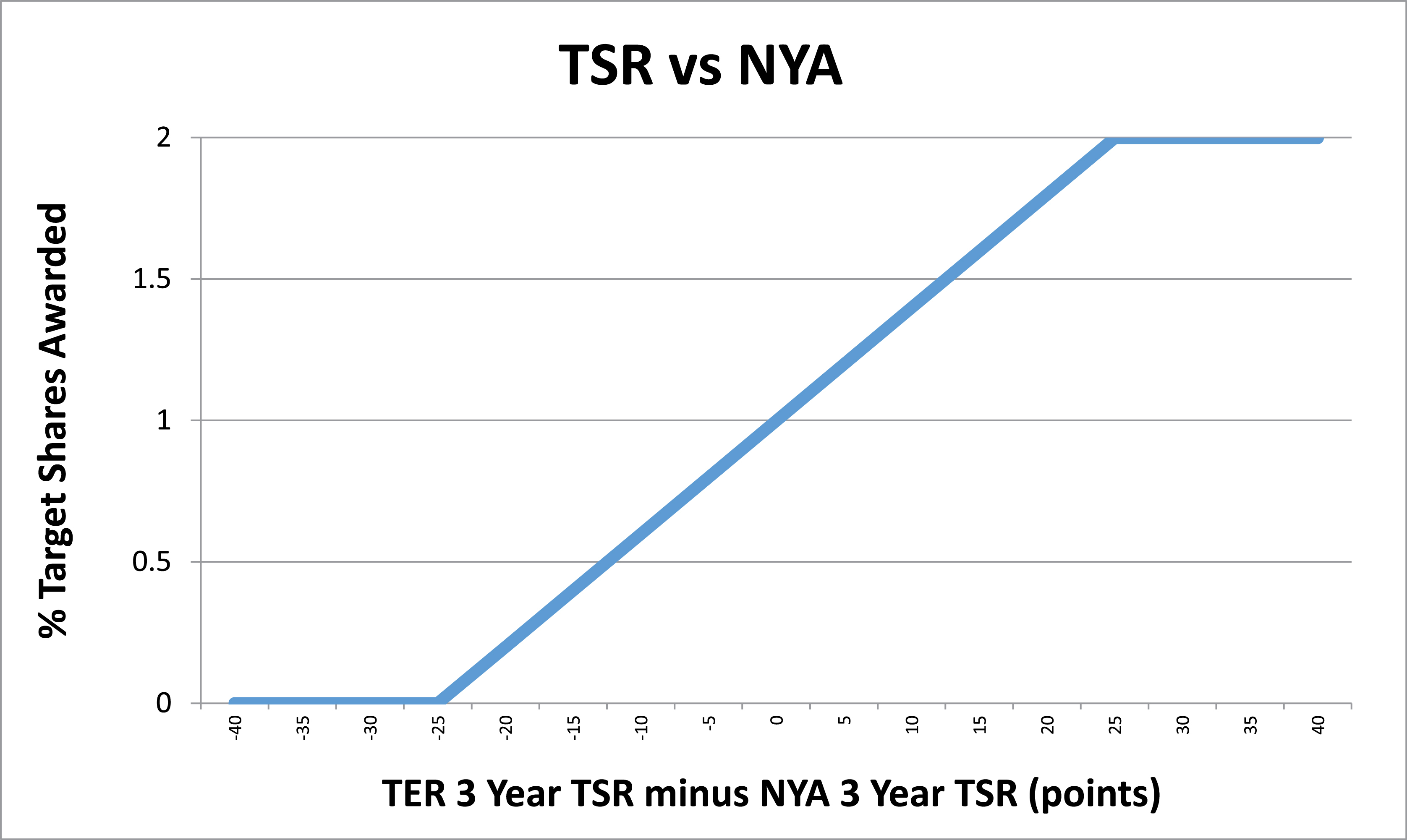
Teradyne, Inc. | 2026 Notice of Annual Meeting & Proxy Statement | Page 53
Executive Compensation
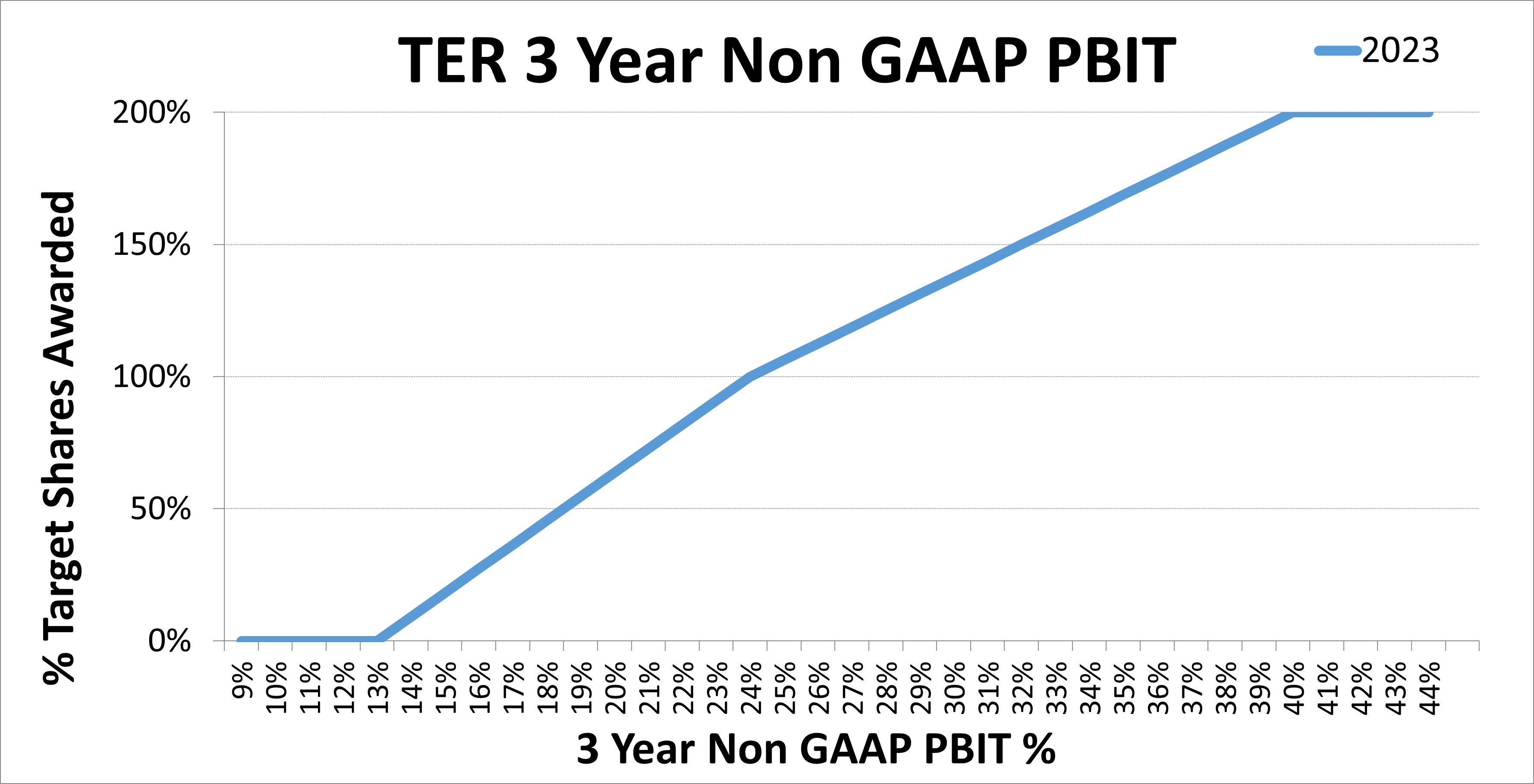
In January 2026, the Compensation Committee reviewed performance against the 2023 performance-based RSU targets and determined actual achievement against those targets as described below:
Metric |
Actual Performance |
% of Target Achievement |
TSR |
Teradyne’s TSR percentage point gain (104.69%) minus that of the NYA Index (40.60%) was determined at the end of fiscal 2025, resulting in 64.09% |
200% |
PBIT(1) |
21.08% |
73.42% |
Total Final Achievement |
136.71% |
|
The achievement described above resulted in the release of shares to each named executive officer as set forth in the table below:
Name of Executive Officer |
|
2023 Performance- |
|
|
2023 Performance- |
|
||
Gregory S. Smith |
|
|
43,504 |
|
|
|
59,475 |
|
Sanjay Mehta |
|
|
20,882 |
|
|
|
28,548 |
|
Michelle Turner(1) |
|
|
— |
|
|
|
— |
|
Ryan Driscoll(1) |
|
|
— |
|
|
|
— |
|
Shannon Poulin(1) |
|
|
— |
|
|
|
— |
|
Regan Mills(1) |
|
|
— |
|
|
|
— |
|
Teradyne, Inc. | 2026 Notice of Annual Meeting & Proxy Statement | Page 54
Executive Compensation
Status of Performance-Based RSU Awards
|
2023 |
2024 |
2025 |
|
Goals |
Threshold |
Target |
Maximum |
Performance |
Result(1) |
|
Fiscal 2023 Relative (2023-2025 |
100% Completed |
|
TSR |
N/A |
N/A |
N/A |
64.09% |
200% |
|||
Fiscal 2023 PBIT(3) (2023-2025 |
100% Completed |
|
PBIT |
13% |
24% |
40% |
21.08% |
73.42% |
|||
Fiscal 2024 Relative (2024-2026 |
|
2/3 Completed |
|
TSR |
N/A |
N/A |
N/A |
In progress |
In |
||
Fiscal 2024 PBIT(3) (2024-2026 |
|
2/3 Completed |
|
PBIT |
11% |
21% |
39% |
In progress |
In |
||
Fiscal 2025 Relative (2025-2027 |
|
|
1/3 Completed |
|
TSR |
N/A |
N/A |
N/A |
In progress |
In |
|
Fiscal 2025 PBIT(3) (2025-2027 |
|
|
1/3 Completed |
|
PBIT |
10% |
21% |
36% |
In progress |
In |
|
Teradyne, Inc. | 2026 Notice of Annual Meeting & Proxy Statement | Page 55
Executive Compensation
Severance and Change in Control Benefits
NAME OF PLAN |
MATERIAL FEATURES |
RATIONALE |
|
|
|
CEO Severance Agreement |
• Provides for the following severance payments and benefits in connection with a termination (other than for death, disability or cause) outside of the period commencing 3 months prior to, and ending 24 months following, a change in control: ▪ 2 years’ severance payments at annual model compensation rate (i.e., salary plus target variable cash compensation) ▪ 2 years’ continued vesting of time-based equity awards ▪ 3 years’ continued vesting of performance-based equity awards ▪ 2 years’ continued health, dental and vision insurance coverage • Subject to the CEO's execution and non-revocation of a general release in favor of Teradyne and continued compliance with certain post-employment restrictive covenants, including a three-year post-employment customer and employee non-hire and non-solicitation covenant and a three-year post-employment non-competition covenant |
• The employment of our CEO is “at will,” meaning we can terminate our CEO at any time, and our CEO can terminate employment with us at any time • Provides reasonable compensation if our CEO leaves Teradyne under certain circumstances in consideration for a release of claims and complying with post-employment restrictive covenants, which span multiple years • Provides for benefits which help us attract a talented CEO and maintain a consistent management team |
|
|
|
Former CFO Severance Agreement (Mr. Mehta) |
• Provides for the following severance payments and benefits in connection with a termination (other than for death, disability or cause) outside of the period commencing 3 months prior to, and ending 24 months following, a change in control: ▪ 1 year’s severance payments at annual model compensation rate (i.e., salary plus target variable cash compensation) ▪ 1 year’s continued health, dental and vision insurance coverage • Subject to the former CFO's execution and non-revocation of a general release in favor of Teradyne and continued compliance with certain post-employment restrictive covenants, including a one-year post-employment customer and employee non-hire and non-solicitation covenant and a one-year post-employment non-competition covenant |
• The employment of our former CFO is “at will,” meaning we can terminate our former CFO at any time, and our former CFO can terminate employment with us at any time • Provides reasonable compensation if our former CFO leaves Teradyne under certain circumstances in consideration for a release of claims and complying with post-employment restrictive covenants, which span multiple years |
|
|
|
Change in Control Agreements |
• Provide for the following severance payments and benefits in connection with a termination without cause or resignation for good reason during the period commencing 3 months prior to, and ending 24 months following, a change in control: ▪ 2 years’ severance payments at annual model compensation rate (i.e., salary plus target variable cash compensation) ▪ Prorated target cash incentive for year of termination ▪ Full accelerated vesting of equity awards (with performance-based awards vesting at target) ▪ 2 years' continued health, dental and vision insurance coverage • Subject to the executive’s execution and non-revocation of a general release in favor of Teradyne and the executive’s continued compliance with certain post-employment restrictive covenants |
• The employment of our named executive officers is “at will,” meaning we can terminate them at any time, and they can terminate employment with us at any time • Provide reasonable compensation if an executive officer leaves Teradyne under certain circumstances in order to facilitate transition to new employment • “Double-trigger” provisions preserve morale and productivity, and encourage executive retention in the event of a change in control |
Teradyne, Inc. | 2026 Notice of Annual Meeting & Proxy Statement | Page 56
Executive Compensation
NAME OF PLAN |
MATERIAL FEATURES |
RATIONALE |
|
|
|
Continued Retirement Vesting |
• If a named executive officer retires (or otherwise terminates due to death or a termination without cause) after at least 10 years of service and having reached the age of 60, then performance-based RSUs will vest on the third anniversary of the date of grant based on actual performance at the end of the performance period (provided any performance-based RSUs awarded less than 365 days prior to the date of termination will be prorated based on the number of days the named executive officer was employed by Teradyne during the 365 day period) • Pursuant to an Executive Retirement Policy adopted by the Board in January 2024 (the “Executive Retirement Policy”), if a named executive officer retires after reaching the age of 65 and has at least 10 years of service to Teradyne, then unvested time-based RSUs and unvested stock options granted will continue to vest (provided any time-based awards awarded less than 365 days prior to the date of termination will be prorated based on the number of days the named executive officer was employed by Teradyne during the 365 day period) and any vested stock options (including those that become vested pursuant to the Executive Retirement Policy) may be exercised for the remainder of the generally applicable term of such option, which in all cases is no later than 7 years from the date of grant • Continued vesting following retirement or termination, other than for cause, is subject to the named executive officer’s continued compliance with any post-employment obligations to Teradyne |
• Preserves morale and productivity and encourages long-term retention of our executive officers • Retirement vesting is consistent with competitive market practice • Performance awards only pay out based on actual performance, consistent with governance best practices |
Other Benefits
TYPE OF PLAN |
MATERIAL FEATURES |
RATIONALE |
|
|
|
401(k) Plan |
In the U.S., Teradyne maintains the Teradyne, Inc. Savings Plan (the “401(k) Plan”), which is available to all employees and provides a discretionary employer matching contribution. |
Provides executive officers with competitive broad-based employee benefits on the same terms as are generally available to the majority of our employees. |
Supplemental Savings Plan |
In the U.S., Teradyne maintains a non-qualified retirement plan, the Teradyne, Inc. Supplemental Savings Plan (the “Supplemental Savings Plan”), for certain employees whose benefits would otherwise be capped based on restrictions imposed by the Internal Revenue Service. |
Provides executive officers the opportunity to participate in retirement benefits that would otherwise be capped based on restrictions imposed by the Internal Revenue Service. For additional information regarding the Supplemental Savings Plan, see the Nonqualified Deferred Compensation Table. |
Retirement Plan |
Teradyne provides a separate defined benefit retirement plan, the Retirement Plan for Employees of Teradyne, Inc. (the “Retirement Plan”). |
This is a legacy retirement plan that was adopted when such benefits were considered market. No named executive officer is currently accruing benefits under the Retirement Plan and no new participants were included in this retirement plan after December 1, 1999. For additional information, see the Pension Benefits Table. |
ESPP |
Teradyne offers an Employee Stock Purchase Plan, which allows participating employees to purchase shares of common stock at a 15% discount through regular payroll deductions of up to 10% of their annual compensation, to a maximum of $25,000 per calendar year, not to exceed 6,000 shares. |
Provides executive officers with the opportunity to purchase shares of common stock at a 15% discount on the same terms as are generally available to the majority of our employees. |
Teradyne, Inc. | 2026 Notice of Annual Meeting & Proxy Statement | Page 57
Executive Compensation
TYPE OF PLAN |
MATERIAL FEATURES |
RATIONALE |
|
|
|
Additional Retirement Benefits |
Based on age and service, Mr. Smith qualifies for broad-based employee retiree benefits, which include eligibility to receive a pro-rated amount of variable cash compensation through the date of retirement and eligibility to continue in Teradyne’s health, dental and vision programs. For additional information regarding certain other benefits that executives may be entitled to receive in connection with retirement, refer to the section entitled “Severance and Change in Control Benefits”. |
Provides executive officers with competitive broad-based employee benefits on the same terms as are generally available to the majority of our employees. |
Health and Welfare Benefits
|
To attract and retain highly qualified employees, Teradyne offers benefit programs designed to be competitive in each country in which Teradyne operates. All U.S. employees and executive officers participate in similar healthcare, life and disability insurance, and other welfare programs. |
Provides executive officers with competitive broad-based employee benefits on the same terms as are generally available to the majority of our employees. |
New-Hire Compensation Benefits
In connection with their recruitment, Ms. Turner and Mr. Poulin received a sign on bonus in the amount of $200,000 and $1,000,000, respectively, both of which are subject to pro‑rated repayment if they voluntarily resign within 24 months of their start date.
Further, the Company provided relocation benefits in the amount of $150,000 to both Ms. Turner and Mr. Poulin to facilitate their relocating to Massachusetts. If they voluntarily resign from the Company prior to the one-year anniversary of their start date or their relocation date, whichever is later, they must repay the full amount no later than their last day of employment with the Company. If they voluntarily resign from the Company on or after the one-year anniversary but prior to the second anniversary of their start date or their relocation date, whichever is later, they must repay 50% of the relocation benefit no later than their last day of employment with the Company.
Tax and Accounting Considerations
While Section 162(m) of the Internal Revenue Code of 1985, as amended (the “Code”) places a limit of $1.0 million dollars on the amount of compensation that we may deduct as a business expense in any year with respect to certain of our most highly paid executive officers, the Compensation Committee retains the right to award compensation that is not deductible as it believes that it is in the best interests of our shareholders to maintain flexibility in our approach to executive compensation in order to structure a program that we consider to be the most effective in attracting, motivating and retaining key executive officers. The Compensation Committee also takes into consideration the accounting treatment of the different forms of awards it may grant to executive officers.
Teradyne, Inc. | 2026 Notice of Annual Meeting & Proxy Statement | Page 58
Executive Compensation
Key Compensation and Governance Policies
The following table summarizes the key compensation governance policies applicable to our NEOs:
|
Policy |
|
|
Considerations |
|
|
Material Features |
|
|
Stock Ownership Guidelines |
|
|
• Aligns the interests of the executive officers with those of Teradyne’s shareholders and ensures that the executive officers responsible for overseeing operations have an ongoing financial stake in Teradyne’s success. |
|
|
• 6x base salary for CEO. • 3x base salary for CFO and President, Semiconductor Test. • 2x base salary for other executive officers • 5 years from executive officer designation to comply. The CEO has 5 years to comply from the date of implementation of the updated guidelines in January 2025. • During the 5-year transition period, must retain at least 50% of net-settled equity award shares until ownership requirement is met. • Compliance determination excludes any unvested grants of restricted stock units (including any unearned performance-based RSUs), any vested but unexercised stock options or any pledged Company stock. • At year end, all NEOs were at or above the stock ownership guideline investment levels or had additional time to comply. |
|
|
Anti-Hedging Policies |
|
|
• Permitting hedging is viewed as a poor pay program practice, as it insulates executives from stock price movement and reduces alignment with shareholders. Our anti-hedging policies, contained in our Insider Trading Policy, were adopted in part to avoid potential or apparent conflicts of interest resulting from bets against or hedges regarding our performance. |
|
|
• Prohibits employees, executives and directors from hedging Teradyne stock through short sales, prepaid variable forward contracts, equity swaps, collars and exchange funds. In addition, transactions in put options, call options or other derivative securities, on an exchange or in any other organized market, are prohibited by this policy. |
|
|
Anti-Pledging Policies |
|
|
• Our anti-pledging policies, contained in our Insider Trading Policy, acknowledge that pledging raises potential risks to shareholder value, particularly if the pledge is significant. |
|
|
• Prohibits holding Teradyne securities in a margin account or pledging Teradyne securities as collateral for loans. |
|
Teradyne, Inc. | 2026 Notice of Annual Meeting & Proxy Statement | Page 59
Executive Compensation
|
Policy |
|
|
Considerations |
|
|
Material Features |
|
|
Equity Grant Timing Policy |
|
|
• Equity award grants |
|
|
• Executives are generally granted annual equity awards in the first quarter of each fiscal year at a Compensation Committee meeting that is typically scheduled more than a year in advance and the effective date of such grants will not occur during a closed trading window. • The Company does not grant employee equity awards during blackout periods or otherwise while in the possession of material nonpublic information, except for new hire grants. New hire grants are automatically issued on the first trading day of the month following the month of the employee start date, in accordance with guidelines previously approved by the Compensation Committee. • Our equity grant timing policy provides that options will not be granted during the period starting four business days before, and ending one business day after, the filing of Form 10-K or Form 10-Q or the filing or furnishing of a Form 8-K containing material non-public information (excluding a Form 8-K that discloses only a material new option award grant) or on any such date when Teradyne is in possession of material non-public information. |
|
|
Clawback Policy |
|
|
• Permits the recovery of incentive compensation paid to executive officers in the event of a financial restatement that is compliant with Nasdaq listing standards and SEC requirements. |
|
|
• Applies to all executive officers and allows recoupment of performance-based cash and equity awards if we are required to restate our financial statements due to Teradyne’s material noncompliance with any financial reporting requirement under applicable securities laws. |
|
Approach to Determining Compensation
Our Compensation Decision-Making Process
In January 2025, the Compensation Committee reviewed the performance of the named executive officers during 2024 and conducted its annual assessment of executive compensation. In addition to the executive officers' performance during 2024, the Compensation Committee considered peer group data provided by Compensia, its independent executive compensation consultant, as well as global survey data in setting executive compensation for 2025.
Teradyne, Inc. | 2026 Notice of Annual Meeting & Proxy Statement | Page 60
Executive Compensation
Compensation Factors
In setting compensation levels for the executive officers (or in the case of the Chief Executive Officer, in making recommendations about such levels to the independent members of the Board), the Compensation Committee takes into account the factors described in the table below.
COMPENSATION FACTORS |
||
|
|
|
Internal Equity |
Competitive Market Data(1) |
Other Benefits Provided(2) |
Individual and Corporate Performance |
General and Industry-Specific Business Environment |
Roles and Responsibilities of Each Executive Officer |
Model Cash Compensation
Model cash compensation includes base salary and performance-based variable cash compensation measured at target. Base salary is designed to attract and retain talented executives and to provide a stable source of income. Variable cash compensation links the executive officers’ additional cash compensation to Teradyne’s annual financial and strategic performance objectives and motivates the executive officers to achieve Teradyne’s financial, operating and growth goals that are designed to align with shareholder interests.
Each January, the Compensation Committee sets model cash compensation for each executive officer, other than the Chief Executive Officer. The independent members of the Board set the model cash compensation for the Chief Executive Officer. The goal for such model cash compensation for each executive officer is that it should be competitive with that of individuals holding similar roles and responsibilities as reflected by the peer group and global survey data. The Compensation Committee and the Board also consider the performance of Teradyne relative to its peers, individual executive officer performance, the role and responsibilities of the executive officer and other benefits available to the executive officers, including Teradyne’s Profit Bonus Plan.
Annual Equity Awards
Prior to the beginning of each year, the Compensation Committee also approves an overall annual equity budget to be used for awards to executive officers, directors and employees, including new hires. Various factors are used in determining the annual equity award budget, including the total projected compensation expense to be incurred as a result of the equity awards, “overhang” from previously issued and outstanding awards, burn rates and competitive market data from the peer group, global survey data and compensation surveys. The Compensation Committee uses the stock price on the date of grant methodology as its calculation of the value of the awards for purposes of comparison with the equity values for peer companies and with prior year equity values for the named executive officers.
The independent members of the Board determine the award types and grant date value for the Chief Executive Officer and the Compensation Committee determines the award types and grant date value for each other executive officer. Management approves equity awards for all other employees within the overall equity budget pursuant to a delegation of authority from the Compensation Committee.
Role of the Compensation Committee
The Compensation Committee’s role is to fulfill certain responsibilities of the Board relating to compensation for Teradyne’s executive officers, and to review and oversee the administration of equity-based incentives, profit bonus plan, deferred compensation, retirement and pension plans, and other compensatory plans. The Compensation Committee recommends all aspects of the Chief Executive Officer's compensation to the independent members of the Board and is also responsible for approving all aspects of the other executive officers’ compensation. The Compensation Committee has the authority to select, retain and terminate compensation consultants, independent counsel and such other advisors as it determines to be necessary to carry out its responsibilities and to approve the fees and other terms of retention of any such advisors.
Teradyne, Inc. | 2026 Notice of Annual Meeting & Proxy Statement | Page 61
Executive Compensation
In 2025, as in prior years, the Compensation Committee retained Compensia, an executive compensation consulting firm, to assist it in carrying out its duties and responsibilities regarding executive and non-employee director compensation. In 2025, this engagement involved preparing (1) an executive officer compensation competitive analysis; (2) a director compensation competitive analysis; (3) a peer group analysis; and (4) a tally sheet analysis for executive officers. Compensia also assists the Compensation Committee in developing and understanding the design of our incentive compensation programs. To maintain the independence of its advice, Compensia provides no services to Teradyne other than the services provided to the Compensation Committee. In addition, the Compensation Committee annually conducts a conflict-of-interest assessment for Compensia and any other independent advisors engaged during the year using the factors applicable to compensation consultations under SEC rules and the Nasdaq listing standards, and, for 2025, no conflict of interest was identified.
The Compensation Committee also uses proprietary compensation surveys prepared by Radford, a global compensation consultant focused on technology companies.
Role of Executive Officers in Determining Executive Pay
The Chief Executive Officer makes individual compensation recommendations for the other executive officers to the Compensation Committee for its review and consideration. The Compensation Committee’s compensation consultant and members of Teradyne’s Human Resources department provide competitive market information to the Compensation Committee for comparative purposes. The executive officers do not determine any element of their own compensation or their total compensation amount.
Competitive Positioning
To ensure its compensation is competitive, Teradyne makes extensive use of comparative data for its worldwide employee programs and its executive officer compensation. This includes data gathered from surveys, the Compensation Committee’s compensation consultant, and public filings.
For purposes of determining 2025 compensation, the Compensation Committee asked Compensia to develop a competitive analysis of Teradyne’s peer companies, to analyze executive pay packages and to advise on the relationship of Teradyne’s short-term and long-term performance incentives to total compensation. In August 2024, Compensia recommended to the Compensation Committee a peer group that reflects organizations of comparable size (approximately $1.3 billion to $5.4 billion in revenue and approximately $7.0 billion to $70.0 billion market capitalization) and operations (product type and geographic scope) to Teradyne and that provides an appropriate sample size for comparisons. The Compensation Committee reviewed and approved a peer group that included the 18 companies listed below:
Teradyne 2025 Peer Group |
|
Cadence Design Systems |
Monolithic Power Systems(1) |
Cirrus Logic(1) |
ON Semiconductor |
Cognex |
PTC |
Entegris |
Qorvo |
Fortive |
Rockwell Automation |
Keysight Technologies |
Skyworks Solutions |
Marvell Technology |
Teledyne Technologies |
Microchip Technology |
Trimble Navigation |
MKS Instruments |
Zebra Technologies |
Teradyne, Inc. | 2026 Notice of Annual Meeting & Proxy Statement | Page 62
Executive Compensation
At the time the peer group was approved, Teradyne was below the median of the peer group in terms of revenue (20th percentile), and above the median of the peer group in terms of market capitalization (58th percentile).
Fiscal Year 2026 Compensation Decisions
After considering feedback from our shareholders, evaluating the practices of our peers, and confirming alignment with our compensation philosophy, the Compensation Committee, for all NEOs other than the CEO, and the Board, for the CEO, approved certain changes to the performance‑based restricted stock units that vest based on relative total shareholder return and that were granted to our executive officers in fiscal 2026 (the “2026 TSR PSUs”).
Beginning with the 2026 TSR PSUs, we will measure relative total shareholder return using the S&P 500 Index rather than the New York Stock Exchange Composite Index. The 2026 TSR PSUs will be measured on a percentile basis versus companies represented in the S&P 500, with payouts ranging from 0% of target at the 10th percentile to 200% of target at the 90th percentile. The Compensation Committee and the Board believe these changes strengthen the alignment of pay and performance by using a widely recognized, transparent benchmark and a payout structure that reflects our NEOs’ ability to drive sustainable growth and long‑term value creation.
Executive Compensation Risk Management
The following characteristics of our executive compensation program work to reduce the possibility of our executive officers, either individually or as a group, making excessively risky business decisions that could maximize short-term results at the expense of long-term value:
Compensation Committee Report
The Compensation Discussion and Analysis has been reviewed with management. Based on the review and discussion with management, the Compensation Committee has recommended to the Board of Directors (and the Board approved) that the Compensation Discussion and Analysis be included in this proxy statement and in the 2025 Form 10-K.
COMPENSATION COMMITTEE
Peter Herweck (Chair)
Drew Henry
Marilyn Matz
Bridget van Kralingen
Teradyne, Inc. | 2026 Notice of Annual Meeting & Proxy Statement | Page 63
Executive Compensation
Compensation Risk Assessment
Our Compensation Committee aims to establish company-wide compensation policies and practices that reward contributions to long-term shareholder value and do not promote unnecessary or excessive risk-taking. In furtherance of this objective, our Compensation Committee conducted an annual assessment of our company-wide compensation arrangements. The assessment process included, among other things, a review of:
Based upon this assessment, our Compensation Committee believes that our company-wide compensation policies and practices are reasonable and encourage appropriate behaviors without creating risks that are reasonably likely to have a material adverse effect on us.
Compensation Committee Interlocks and Insider Participation
The members of the Compensation Committee for the full fiscal year 2025 were Peter Herweck, Marilyn Matz, and Bridget van Kralingen. Paul J. Tufano served on the Compensation Committee during fiscal year 2025 up through the May 8, 2025 Annual Shareholder Meeting. Drew Henry became a member of the Compensation Committee on his appointment to the Board on July 1, 2025. No member of this committee was at any time during fiscal year 2025 or at any other time an officer or employee of the Company, and no member of this committee had any relationship with the Company requiring disclosure under Item 404 of Regulation S-K. No executive officer of the Company has served on the board of directors or compensation committee of any other entity that has or has had one or more executive officers who served as a member of the Compensation Committee during fiscal year 2025.
Executive Compensation Tables
Summary Compensation Table
The table below summarizes the total compensation paid or earned by each of the named executive officers during the fiscal years ended December 31, 2025, 2024 and 2023, respectively.
Name and Principal Position |
Year |
|
Salary |
|
|
Bonus |
|
|
Stock |
|
|
Option |
|
|
Non-Equity |
|
|
Change in |
|
|
All Other |
|
|
Total |
|
||||||||
Gregory S. Smith |
2025 |
|
$ |
959,457 |
|
|
$ |
— |
|
|
$ |
10,186,513 |
|
|
$ |
1,033,335 |
|
|
$ |
1,914,283 |
|
|
$ |
— |
|
|
$ |
14,000 |
|
|
$ |
14,107,588 |
|
President and |
2024 |
|
$ |
925,000 |
|
|
$ |
— |
|
|
$ |
8,487,013 |
|
|
$ |
925,013 |
|
|
$ |
1,409,830 |
|
|
$ |
— |
|
|
$ |
13,800 |
|
|
$ |
11,760,656 |
|
Chief Executive Officer |
2023 |
|
$ |
850,000 |
|
|
$ |
— |
|
|
$ |
7,445,275 |
|
|
$ |
750,024 |
|
|
$ |
1,050,810 |
|
|
$ |
— |
|
|
$ |
14,328 |
|
|
$ |
10,110,437 |
|
|
|
|
|
|
|
|
|
|
|
|
|
|
|
|
|
|
|
|
|
|
|
|
|
|
|
||||||||
Sanjay Mehta |
2025 |
|
$ |
626,584 |
|
|
$ |
— |
|
|
$ |
3,351,897 |
|
|
$ |
340,010 |
|
|
$ |
1,014,528 |
|
|
$ |
— |
|
|
$ |
48,038 |
|
|
$ |
5,381,057 |
|
Vice President, Chief |
2024 |
|
$ |
640,000 |
|
|
$ |
— |
|
|
$ |
3,119,682 |
|
|
$ |
340,013 |
|
|
$ |
663,880 |
|
|
$ |
— |
|
|
$ |
45,981 |
|
|
$ |
4,809,556 |
|
Financial Officer & Treasurer |
2023 |
|
$ |
600,000 |
|
|
$ |
— |
|
|
$ |
3,573,745 |
|
|
$ |
360,002 |
|
|
$ |
510,599 |
|
|
$ |
— |
|
|
$ |
23,559 |
|
|
$ |
5,067,905 |
|
|
|
|
|
|
|
|
|
|
|
|
|
|
|
|
|
|
|
|
|
|
|
|
|
|
|
||||||||
Michelle Turner |
2025 |
|
$ |
118,154 |
|
|
$ |
200,000 |
|
|
$ |
7,938,546 |
|
|
$ |
680,016 |
|
|
$ |
169,088 |
|
|
$ |
— |
|
|
$ |
210,481 |
|
|
$ |
9,316,285 |
|
Vice President, Chief |
2024 |
|
$ |
— |
|
|
$ |
— |
|
|
$ |
— |
|
|
$ |
— |
|
|
$ |
— |
|
|
$ |
— |
|
|
$ |
— |
|
|
$ |
— |
|
Financial Officer & Treasurer |
2022 |
|
$ |
— |
|
|
$ |
— |
|
|
$ |
— |
|
|
$ |
— |
|
|
$ |
— |
|
|
$ |
— |
|
|
$ |
— |
|
|
$ |
— |
|
|
|
|
|
|
|
|
|
|
|
|
|
|
|
|
|
|
|
|
|
|
|
|
|
|
|
||||||||
Ryan Driscoll |
2025 |
|
$ |
457,456 |
|
|
$ |
— |
|
|
$ |
1,183,168 |
|
|
$ |
120,019 |
|
|
$ |
637,474 |
|
|
$ |
— |
|
|
$ |
14,000 |
|
|
$ |
2,412,116 |
|
Vice President, General |
2024 |
|
$ |
425,000 |
|
|
$ |
— |
|
|
$ |
734,114 |
|
|
$ |
80,025 |
|
|
$ |
417,869 |
|
|
$ |
— |
|
|
$ |
14,550 |
|
|
$ |
1,671,558 |
|
Counsel and Secretary |
2023 |
|
$ |
— |
|
|
$ |
— |
|
|
$ |
— |
|
|
$ |
— |
|
|
$ |
— |
|
|
$ |
— |
|
|
$ |
— |
|
|
$ |
— |
|
|
|
|
|
|
|
|
|
|
|
|
|
|
|
|
|
|
|
|
|
|
|
|
|
|
|
||||||||
Shannon Poulin |
2025 |
|
$ |
526,571 |
|
|
$ |
1,000,000 |
|
|
$ |
3,090,903 |
|
|
$ |
350,009 |
|
|
$ |
814,295 |
|
|
$ |
— |
|
|
$ |
261,321 |
|
|
$ |
6,043,100 |
|
President, Semiconductor |
2024 |
|
$ |
— |
|
|
$ |
— |
|
|
$ |
— |
|
|
$ |
— |
|
|
$ |
— |
|
|
$ |
— |
|
|
$ |
— |
|
|
$ |
— |
|
Test |
2023 |
|
$ |
— |
|
|
$ |
— |
|
|
$ |
— |
|
|
$ |
— |
|
|
$ |
— |
|
|
$ |
— |
|
|
$ |
— |
|
|
$ |
— |
|
|
|
|
|
|
|
|
|
|
|
|
|
|
|
|
|
|
|
|
|
|
|
|
|
|
|
||||||||
Regan Mills |
2025 |
|
$ |
305,953 |
|
|
$ |
— |
|
|
$ |
550,072 |
|
|
$ |
— |
|
|
$ |
422,979 |
|
|
$ |
2,119 |
|
|
$ |
22,391 |
|
|
$ |
1,303,514 |
|
President, Product Test |
2024 |
|
$ |
— |
|
|
$ |
— |
|
|
$ |
— |
|
|
$ |
— |
|
|
$ |
— |
|
|
$ |
— |
|
|
$ |
— |
|
|
$ |
— |
|
|
2023 |
|
$ |
— |
|
|
$ |
— |
|
|
$ |
— |
|
|
$ |
— |
|
|
$ |
— |
|
|
$ |
— |
|
|
$ |
— |
|
|
$ |
— |
|
Teradyne, Inc. | 2026 Notice of Annual Meeting & Proxy Statement | Page 64
Executive Compensation
Maximum Possible Value of PSUs Using Grant Date Fair Value |
|
Gregory S. |
|
|
Sanjay |
|
|
Michelle |
|
|
Ryan |
|
|
Shannon |
|
|
Regan |
|||||
2025 |
|
|
12,400,000 |
|
|
|
4,080,000 |
|
|
|
8,160,000 |
|
|
|
1,440,000 |
|
|
|
4,200,058 |
|
|
— |
2024 |
|
|
11,100,174 |
|
|
|
4,080,174 |
|
|
— |
|
|
|
960,153 |
|
|
— |
|
|
— |
||
2023 |
|
|
9,000,108 |
|
|
|
4,320,068 |
|
|
— |
|
|
— |
|
|
— |
|
|
— |
|||
The number of performance-based RSUs that are earned will be determined by the Compensation Committee and the independent members of the Board, following the completion of the applicable three-year performance period, pursuant to the TSR and PBIT formulas (for performance-based RSUs granted in 2025, as described above in “2025 Equity Awards”). For a discussion of the assumptions underlying these valuations, please see Note R to the Consolidated Financial Statements included in the 2025 Form 10-K.
|
|
Company Contributions to Defined Contribution Plans (1) |
|
|
Relocation Expenses (2) |
|
|
Tax Assistance for Business-Related Items (2) |
|
|
Total-All Other Compensation |
|
||||
Gregory S. Smith |
|
$ |
14,000 |
|
|
$ |
— |
|
|
$ |
— |
|
|
$ |
14,000 |
|
Sanjay Mehta |
|
$ |
48,038 |
|
|
$ |
— |
|
|
$ |
— |
|
|
$ |
48,038 |
|
Michelle Turner |
|
$ |
— |
|
|
$ |
150,000 |
|
|
$ |
60,481 |
|
|
$ |
210,481 |
|
Ryan Driscoll |
|
$ |
14,000 |
|
|
$ |
— |
|
|
$ |
— |
|
|
$ |
14,000 |
|
Shannon Poulin |
|
$ |
14,000 |
|
|
$ |
150,000 |
|
|
$ |
97,321 |
|
|
$ |
261,321 |
|
Regan Mills |
|
$ |
22,391 |
|
|
$ |
— |
|
|
$ |
— |
|
|
$ |
22,391 |
|
Teradyne, Inc. | 2026 Notice of Annual Meeting & Proxy Statement | Page 65
Executive Compensation
Grants of Plan-Based Awards Table for 2025
The following table sets forth information concerning plan-based awards granted to the named executive officers during the fiscal year ended December 31, 2025.
Name |
Date |
|
Grant |
|
Type of |
|
Estimated Future Payouts under |
|
|
Estimated Future Payouts under |
|
|
All Other Stock Awards: Number of Shares of Stock or Units |
|
|
All Other Option Awards: Number of Securities Underlying Options |
|
|
Exercise or Base Price of Option Awards |
|
|
Grant Date Fair Value of Stock and Option Awards (8) |
|
||||||||||||||||||||
|
|
|
|
|
|
|
Threshold |
|
|
Target |
|
|
Maximum |
|
|
Threshold |
|
Target |
|
|
Maximum |
|
|
|
|
|
|
|
|
|
|
|
|
|
|||||||||
Gregory S. Smith |
|
|
|
|
VC (2) |
|
$ |
— |
|
|
$ |
1,225,000 |
|
|
$ |
2,450,000 |
|
|
— |
|
— |
|
|
— |
|
|
— |
|
|
— |
|
|
— |
|
|
$ |
— |
|
|||||
|
|
|
|
|
PBP(3) |
|
$ |
— |
|
|
$ |
132,300 |
|
|
$ |
396,900 |
|
|
— |
|
— |
|
|
— |
|
|
— |
|
|
— |
|
|
— |
|
|
$ |
— |
|
|||||
|
1/28/25 |
|
1/31/25 |
|
PRSU (4) |
|
$ |
— |
|
|
$ |
— |
|
|
$ |
— |
|
|
— |
|
|
53,466 |
|
|
|
106,932 |
|
|
— |
|
|
— |
|
|
— |
|
|
$ |
6,200,000 |
|
|||
|
1/28/25 |
|
1/31/25 |
|
RSU (5) |
|
$ |
— |
|
|
$ |
— |
|
|
$ |
— |
|
|
— |
|
— |
|
|
— |
|
|
|
26,773 |
|
|
— |
|
|
— |
|
|
$ |
3,100,046 |
|
||||
|
1/28/25 |
|
1/31/25 |
|
SO (6) |
|
$ |
— |
|
|
$ |
— |
|
|
$ |
— |
|
|
— |
|
— |
|
|
— |
|
|
— |
|
|
|
23,143 |
|
|
$ |
115.79 |
|
|
$ |
1,033,335 |
|
|||
|
|
|
|
|
|
|
|
|
|
|
|
|
|
|
|
|
|
|
|
|
|
|
|
|
|
|
|
|
|
|
|
|
|
|
|||||||||
Sanjay Mehta |
|
|
|
|
VC (2) |
|
$ |
— |
|
|
$ |
640,000 |
|
|
$ |
1,280,000 |
|
|
— |
|
— |
|
|
— |
|
|
— |
|
|
— |
|
|
— |
|
|
$ |
— |
|
|||||
|
|
|
|
|
PBP(3) |
|
$ |
— |
|
|
$ |
76,800 |
|
|
$ |
230,400 |
|
|
— |
|
— |
|
|
— |
|
|
— |
|
|
— |
|
|
— |
|
|
$ |
— |
|
|||||
|
1/28/25 |
|
1/31/25 |
|
PRSU (4) |
|
$ |
— |
|
|
$ |
— |
|
|
$ |
— |
|
|
— |
|
|
17,619 |
|
|
|
35,238 |
|
|
— |
|
|
— |
|
|
— |
|
|
$ |
2,040,000 |
|
|||
|
1/28/25 |
|
1/31/25 |
|
RSU (5) |
|
$ |
— |
|
|
$ |
— |
|
|
$ |
— |
|
|
— |
|
— |
|
|
— |
|
|
|
8,810 |
|
|
— |
|
|
— |
|
|
$ |
1,020,110 |
|
||||
|
1/28/25 |
|
1/31/25 |
|
SO (6) |
|
$ |
— |
|
|
$ |
— |
|
|
$ |
— |
|
|
— |
|
— |
|
|
— |
|
|
— |
|
|
|
7,615 |
|
|
$ |
115.79 |
|
|
$ |
340,010 |
|
|||
|
|
|
|
|
|
|
|
|
|
|
|
|
|
|
|
|
|
|
|
|
|
|
|
|
|
|
|
|
|
|
|
|
|
|
|||||||||
Michelle Turner |
|
|
|
|
VC (2) |
|
$ |
— |
|
|
$ |
640,000 |
|
|
$ |
1,280,000 |
|
|
— |
|
— |
|
|
— |
|
|
— |
|
|
— |
|
|
— |
|
|
$ |
— |
|
|||||
|
|
|
|
|
PBP(3) |
|
$ |
— |
|
|
$ |
76,800 |
|
|
$ |
230,400 |
|
|
— |
|
— |
|
|
— |
|
|
— |
|
|
— |
|
|
— |
|
|
$ |
— |
|
|||||
|
10/24/25 |
|
11/3/25 |
|
PRSU (4) |
|
$ |
— |
|
|
$ |
— |
|
|
$ — |
|
|
— |
|
|
22,288 |
|
|
|
44,576 |
|
|
— |
|
|
— |
|
|
— |
|
|
$ |
4,080,264 |
|
||||
|
10/24/25 |
|
11/3/25 |
|
RSU (5) |
|
$ |
— |
|
|
$ |
— |
|
|
$ — |
|
|
— |
|
— |
|
|
— |
|
|
|
11,144 |
|
|
— |
|
|
— |
|
|
$ |
2,040,132 |
|
|||||
|
10/24/25 |
|
11/3/25 |
|
SO (6) |
|
$ |
— |
|
|
$ |
— |
|
|
$ — |
|
|
— |
|
— |
|
|
— |
|
|
— |
|
|
|
9,156 |
|
|
$ |
183.07 |
|
|
$ |
680,016 |
|
||||
|
|
|
|
|
|
|
|
|
|
|
|
|
|
|
|
|
|
|
|
|
|
|
|
|
|
|
|
|
|
|
|
|
|
|
|||||||||
Ryan Driscoll |
|
|
|
|
VC (2) |
|
$ |
— |
|
|
$ |
397,163 |
|
|
$ |
794,325 |
|
|
— |
|
— |
|
|
— |
|
|
— |
|
|
— |
|
|
— |
|
|
$ |
— |
|
|||||
|
|
|
|
|
PBP(3) |
|
$ |
— |
|
|
$ |
51,865 |
|
|
$ |
155,595 |
|
|
— |
|
— |
|
|
— |
|
|
— |
|
|
— |
|
|
— |
|
|
$ |
— |
|
|||||
|
1/28/25 |
|
1/31/25 |
|
PRSU (4) |
|
$ |
— |
|
|
$ |
— |
|
|
$ |
— |
|
|
— |
|
|
6,219 |
|
|
|
12,438 |
|
|
— |
|
|
— |
|
|
— |
|
|
$ |
720,098 |
|
|||
|
1/28/25 |
|
1/31/25 |
|
RSU (5) |
|
$ |
— |
|
|
$ |
— |
|
|
$ |
— |
|
|
— |
|
— |
|
|
— |
|
|
|
3,110 |
|
|
— |
|
|
— |
|
|
$ |
360,107 |
|
||||
|
1/28/25 |
|
1/31/25 |
|
SO (6) |
|
$ |
— |
|
|
$ |
— |
|
|
$ |
— |
|
|
— |
|
— |
|
|
— |
|
|
— |
|
|
|
2,688 |
|
|
$ |
115.79 |
|
|
$ |
120,019 |
|
|||
|
|
|
|
|
|
|
|
|
|
|
|
|
|
|
|
|
|
|
|
|
|
|
|
|
|
|
|
|
|
|
|
|
|
|
|||||||||
Shannon Poulin |
|
|
|
|
VC (2) |
|
$ |
— |
|
|
$ |
578,500 |
|
|
$ |
1,157,000 |
|
|
— |
|
— |
|
|
— |
|
|
— |
|
|
— |
|
|
— |
|
|
$ |
— |
|
|||||
|
|
|
|
|
PBP(3) |
|
$ |
— |
|
|
$ |
73,710 |
|
|
$ |
221,130 |
|
|
— |
|
— |
|
|
— |
|
|
— |
|
|
— |
|
|
— |
|
|
$ |
— |
|
|||||
|
5/8/25 |
|
4/1/25 |
|
PRSU (4) |
|
$ |
— |
|
|
$ |
— |
|
|
$ |
— |
|
|
— |
|
|
25,421 |
|
|
|
50,842 |
|
|
— |
|
|
— |
|
|
— |
|
|
$ |
2,100,029 |
|
|||
|
5/8/25 |
|
4/1/25 |
|
RSU (5) |
|
$ |
— |
|
|
$ |
— |
|
|
$ |
— |
|
|
— |
|
— |
|
|
— |
|
|
|
12,711 |
|
|
— |
|
|
— |
|
|
$ |
1,050,056 |
|
||||
|
5/8/25 |
|
4/1/25 |
|
SO (6) |
|
$ |
— |
|
|
$ |
— |
|
|
$ |
— |
|
|
— |
|
— |
|
|
— |
|
|
— |
|
|
|
11,375 |
|
|
$ |
82.61 |
|
|
$ |
350,009 |
|
|||
|
|
|
|
|
|
|
|
|
|
|
|
|
|
|
|
|
|
|
|
|
|
|
|
|
|
|
|
|
|
|
|
|
|
|
|||||||||
Regan Mills |
|
|
|
|
VC (2) |
|
$ |
— |
|
|
$ |
272,000 |
|
|
$ |
544,000 |
|
|
— |
|
— |
|
|
— |
|
|
— |
|
|
— |
|
|
— |
|
|
$ |
— |
|
|||||
|
|
|
|
|
PBP(3) |
|
$ |
— |
|
|
$ |
35,520 |
|
|
$ |
106,560 |
|
|
— |
|
— |
|
|
— |
|
|
— |
|
|
— |
|
|
— |
|
|
$ |
— |
|
|||||
|
|
|
|
|
PRSU (4) |
|
$ |
— |
|
|
$ |
— |
|
|
$ |
— |
|
|
— |
|
— |
|
|
— |
|
|
— |
|
|
— |
|
|
— |
|
|
$ |
— |
|
|||||
|
1/28/25 |
|
1/31/25 |
|
RSU (5) |
|
$ |
— |
|
|
$ |
— |
|
|
$ |
— |
|
|
— |
|
|
2,591 |
|
|
— |
|
|
— |
|
|
— |
|
|
— |
|
|
$ |
300,012 |
|
||||
|
5/8/25 |
|
4/1/25 |
|
RSU (7) |
|
$ |
— |
|
|
$ |
— |
|
|
$ |
— |
|
|
— |
|
|
3,027 |
|
|
— |
|
|
— |
|
|
— |
|
|
— |
|
|
$ |
250,060 |
|
||||
|
|
|
|
|
|
|
|
|
|
|
|
|
|
|
|
|
|
|
|
|
|
|
|
|
|
|
|
|
|
|
|
|
|
|
|||||||||
|
|
|
|
|
|
|
|
|
|
|
|
|
|
|
|
|
|
|
|
|
|
|
|
|
|
|
|
|
|
|
|
|
|
|
|||||||||
VC – Variable Cash Compensation
PBP – Profit Bonus Plan
PRSU – Performance-based Restricted Stock Units
RSU – Time-based Restricted Stock Units
SO – Stock Options
Teradyne, Inc. | 2026 Notice of Annual Meeting & Proxy Statement | Page 66
Executive Compensation
Teradyne, Inc. | 2026 Notice of Annual Meeting & Proxy Statement | Page 67
Executive Compensation
Outstanding Equity Awards at Fiscal Year-End Table for 2025
The following table sets forth information concerning the outstanding equity awards held by the named executive officers at the fiscal year ended December 31, 2025.
Option Awards |
|
Stock Awards |
|
|
|||||||||||||||||||||||||||||
Name |
|
Number of |
|
|
Number of |
|
|
|
Option |
|
|
Option |
|
Number of |
|
|
Market |
|
|
|
Equity Incentive |
|
|
Equity Incentive |
|
|
|||||||
Gregory S. Smith |
|
|
4,597 |
|
|
— |
|
|
|
$ |
72.10 |
|
|
01/24/27 |
|
|
|
|
|
|
|
|
|
|
|
|
|
|
|||||
|
|
|
3,279 |
|
|
— |
|
|
|
$ |
113.48 |
|
|
01/29/28 |
|
|
|
|
|
|
|
|
|
|
|
|
|
|
|||||
|
|
|
2,884 |
|
|
|
962 |
|
(1) |
|
$ |
112.12 |
|
|
01/28/29 |
|
|
|
|
|
|
|
|
|
|
|
|
|
|
||||
|
|
|
9,169 |
|
|
|
9,169 |
|
(2) |
|
$ |
103.44 |
|
|
01/27/30 |
|
|
|
|
|
|
|
|
|
|
|
|
|
|
||||
|
|
|
6,166 |
|
|
|
18,501 |
|
(3) |
|
$ |
95.14 |
|
|
02/01/31 |
|
|
|
|
|
|
|
|
|
|
|
|
|
|
||||
|
|
— |
|
|
|
23,143 |
|
(4) |
|
$ |
115.79 |
|
|
01/31/32 |
|
|
|
|
|
|
|
|
|
|
|
|
|
|
|||||
|
|
|
|
|
|
|
|
|
|
|
|
|
|
|
1,004 |
|
|
$ |
199,695.60 |
|
(7) |
|
|
|
|
|
|
|
|||||
|
|
|
|
|
|
|
|
|
|
|
|
|
|
|
10,876 |
|
|
$ |
2,163,236.40 |
|
(8) |
|
|
|
|
|
|
|
|||||
|
|
|
|
|
|
|
|
|
|
|
|
|
|
|
21,876 |
|
|
$ |
4,351,136.40 |
|
(9) |
|
|
|
|
|
|
|
|||||
|
|
|
|
|
|
|
|
|
|
|
|
|
|
|
26,773 |
|
|
$ |
5,325,149.70 |
|
(10) |
|
|
|
|
|
|
|
|||||
|
|
|
|
|
|
|
|
|
|
|
|
|
|
|
59,475 |
|
|
$ |
14,210,956.50 |
|
(14) |
|
|
|
|
|
|
|
|||||
|
|
|
|
|
|
|
|
|
|
|
|
|
|
|
|
|
|
|
|
|
|
58,336 |
|
|
$ |
11,603,030.40 |
|
(15) |
|||||
|
|
|
|
|
|
|
|
|
|
|
|
|
|
|
|
|
|
|
|
|
|
53,466 |
|
|
$ |
10,634,387.40 |
|
(16) |
|||||
|
|
|
|
|
|
|
|
|
|
|
|
|
|
|
|
|
|
|
|
|
|
|
|
|
|
|
|||||||
Sanjay Mehta |
|
|
4,919 |
|
|
— |
|
|
|
$ |
113.48 |
|
|
01/29/28 |
|
|
|
|
|
|
|
|
|
|
|
|
|
|
|||||
|
|
|
4,806 |
|
|
|
1,603 |
|
(1) |
|
$ |
112.12 |
|
|
01/28/29 |
|
|
|
|
|
|
|
|
|
|
|
|
|
|
||||
|
|
|
4,401 |
|
|
|
4,401 |
|
(2) |
|
$ |
103.44 |
|
|
01/27/30 |
|
|
|
|
|
|
|
|
|
|
|
|
|
|
||||
|
|
|
2,266 |
|
|
|
6,801 |
|
(3) |
|
$ |
95.14 |
|
|
02/01/31 |
|
|
|
|
|
|
|
|
|
|
|
|
|
|
||||
|
|
— |
|
|
|
7,615 |
|
(4) |
|
$ |
115.79 |
|
|
01/31/32 |
|
|
1,673 |
|
|
$ |
332,760.00 |
|
(7) |
|
|
|
|
|
|
|
|||
|
|
|
|
|
|
|
|
|
|
|
|
|
|
|
5,221 |
|
|
$ |
1,038,457.00 |
|
(8) |
|
|
|
|
|
|
|
|||||
|
|
|
|
|
|
|
|
|
|
|
|
|
|
|
8,042 |
|
|
$ |
1,599,554.00 |
|
(9) |
|
|
|
|
|
|
|
|||||
|
|
|
|
|
|
|
|
|
|
|
|
|
|
|
8,810 |
|
|
$ |
1,752,309.00 |
|
(10) |
|
|
|
|
|
|
|
|||||
|
|
|
|
|
|
|
|
|
|
|
|
|
|
|
28,548 |
|
|
$ |
6,821,259.12 |
|
(14) |
|
|
|
|
|
|
|
|||||
|
|
|
|
|
|
|
|
|
|
|
|
|
|
|
|
|
|
|
|
|
|
21,443 |
|
|
$ |
4,265,012.70 |
|
(15) |
|||||
|
|
|
|
|
|
|
|
|
|
|
|
|
|
|
|
|
|
|
|
|
|
17,619 |
|
|
$ |
3,504,419.00 |
|
(16) |
|||||
|
|
|
|
|
|
|
|
|
|
|
|
|
|
|
|
|
|
|
|
|
|
|
|
|
|
|
|||||||
Michelle Turner |
|
— |
|
|
|
9,156 |
|
(5) |
|
$ |
183.07 |
|
|
11/03/32 |
|
|
|
|
|
|
|
|
|
|
|
|
|
|
|||||
|
|
|
|
|
|
|
|
|
|
|
|
|
|
|
11,144 |
|
|
$ |
2,216,541.60 |
|
(11) |
|
|
|
|
|
|
|
|||||
|
|
|
|
|
|
|
|
|
|
|
|
|
|
|
|
|
|
|
|
|
|
|
|
|
|
|
|||||||
|
|
|
|
|
|
|
|
|
|
|
|
|
|
|
|
|
|
|
|
|
|
|
|
|
|
|
|||||||
|
|
|
|
|
|
|
|
|
|
|
|
|
|
|
|
|
|
|
|
|
|
22,287 |
|
|
$ |
4,432,884.30 |
|
(17) |
|||||
|
|
|
|
|
|
|
|
|
|
|
|
|
|
|
|
|
|
|
|
|
|
|
|
|
|
|
|||||||
|
|
|
|
|
|
|
|
|
|
|
|
|
|
|
|
|
|
|
|
|
|
|
|
|
|
|
|||||||
Ryan Driscoll |
|
|
533 |
|
|
|
1,601 |
|
(3) |
|
$ |
95.14 |
|
|
02/01/31 |
|
|
|
|
|
|
|
|
|
|
|
|
|
|
||||
|
|
|
— |
|
|
|
2,688 |
|
(4) |
|
$ |
115.79 |
|
|
01/31/32 |
|
|
235 |
|
|
$ |
46,741.50 |
|
(7) |
|
|
|
|
|
|
|
||
|
|
|
|
|
|
|
|
|
|
|
|
|
|
|
653 |
|
|
$ |
129,881.70 |
|
(8) |
|
|
|
|
|
|
|
|||||
|
|
|
|
|
|
|
|
|
|
|
|
|
|
|
1,893 |
|
|
$ |
376,517.70 |
|
(9) |
|
|
|
|
|
|
|
|||||
|
|
|
|
|
|
|
|
|
|
|
|
|
|
|
3,110 |
|
|
$ |
618,579.00 |
|
(10) |
|
|
|
|
|
|
|
|||||
|
|
|
|
|
|
|
|
|
|
|
|
|
|
|
|
|
|
|
|
|
|
|
|
|
|
|
|||||||
|
|
|
|
|
|
|
|
|
|
|
|
|
|
|
|
|
|
|
|
|
|
5,046 |
|
|
$ |
1,003,649.40 |
|
(15) |
|||||
|
|
|
|
|
|
|
|
|
|
|
|
|
|
|
|
|
|
|
|
|
|
6,219 |
|
|
$ |
1,236,959.10 |
|
(16) |
|||||
|
|
|
|
|
|
|
|
|
|
|
|
|
|
|
|
|
|
|
|
|
|
|
|
|
|
|
|||||||
Shannon Poulin |
|
|
|
|
|
|
|
|
|
|
|
|
|
|
|
|
|
|
|
|
|
|
|
|
|
|
|||||||
|
|
|
— |
|
|
|
11,375 |
|
(6) |
|
$ |
82.61 |
|
|
04/01/32 |
|
|
|
|
|
|
|
|
|
|
|
|
|
|
||||
|
|
|
|
|
|
|
|
|
|
|
|
|
|
|
|
|
|
|
|
|
|
|
|
|
|
|
|||||||
|
|
|
|
|
|
|
|
|
|
|
|
|
|
|
12,711 |
|
|
$ |
2,528,217.90 |
|
(12) |
|
|
|
|
|
|
|
|||||
|
|
|
|
|
|
|
|
|
|
|
|
|
|
|
|
|
|
|
|
|
|
|
|
|
|
|
|||||||
|
|
|
|
|
|
|
|
|
|
|
|
|
|
|
|
|
|
|
|
|
|
25,421 |
|
|
$ |
5,056,236.90 |
|
(18) |
|||||
|
|
|
|
|
|
|
|
|
|
|
|
|
|
|
|
|
|
|
|
|
|
|
|
|
|
|
|||||||
|
|
|
|
|
|
|
|
|
|
|
|
|
|
|
|
|
|
|
|
|
|
|
|
|
|
|
|||||||
Regan Mills |
|
|
— |
|
|
|
— |
|
|
|
|
|
|
|
|
|
|
|
|
|
|
|
|
|
|
|
|
|
|||||
|
|
|
|
|
|
|
|
|
|
|
|
|
|
|
549 |
|
|
$ |
109,196.10 |
|
(7) |
|
|
|
|
|
|
|
|||||
|
|
|
|
|
|
|
|
|
|
|
|
|
|
|
1,112 |
|
|
$ |
221,176.80 |
|
(8) |
|
|
|
|
|
|
|
|||||
|
|
|
|
|
|
|
|
|
|
|
|
|
|
|
1,578 |
|
|
$ |
313,864.20 |
|
(9) |
|
|
|
|
|
|
|
|||||
|
|
|
|
|
|
|
|
|
|
|
|
|
|
|
2,591 |
|
|
$ |
515,349.90 |
|
(10) |
|
|
|
|
|
|
|
|||||
|
|
|
|
|
|
|
|
|
|
|
|
|
|
|
3,027 |
|
|
$ |
602,070.30 |
|
(13) |
|
|
|
|
|
|
|
|||||
Teradyne, Inc. | 2026 Notice of Annual Meeting & Proxy Statement | Page 68
Executive Compensation
Teradyne, Inc. | 2026 Notice of Annual Meeting & Proxy Statement | Page 69
Executive Compensation
Option Exercises and Stock Vested Table for 2025
The named executive officers exercised stock options during 2025 and vested in certain RSUs previously granted. The following table shows: (1) the number of shares acquired upon exercise of stock options and the value realized on exercise during 2025; and (2) the number of shares acquired as a result of the vesting of time- and performance-based RSUs and the value realized on vesting during 2025:
|
|
Option Awards |
|
|
Stock Awards |
|
||||||||||
Name |
|
Number of |
|
|
Value Realized on Exercise(1) |
|
|
Number of |
|
|
Value Realized |
|
||||
|
|
|
|
|
|
|
|
|
|
|
|
|
||||
Gregory S. Smith |
|
|
2,072 |
|
|
$ |
290,702 |
|
|
|
18,541 |
|
|
$ |
2,172,802 |
|
Sanjay Mehta |
|
|
— |
|
|
$ |
— |
|
|
|
14,842 |
|
|
$ |
1,776,569 |
|
Michelle Turner |
|
|
— |
|
|
$ |
— |
|
|
|
— |
|
|
$ |
— |
|
Ryan Driscoll |
|
|
— |
|
|
$ |
— |
|
|
|
1,412 |
|
|
$ |
164,823 |
|
Shannon Poulin |
|
|
— |
|
|
$ |
— |
|
|
|
— |
|
|
$ |
— |
|
Regan Mills |
|
|
— |
|
|
$ |
— |
|
|
|
2,137 |
|
|
$ |
254,020 |
|
Retirement and Post-Employment Tables
Pension Benefits Table for 2025
The Company offers a qualified Retirement Plan. In 1999, the Company closed the plan to new members.
Similar to most pension plans, Teradyne's Retirement Plan was designed such that the annual present value of the accrued benefit associated with the plan increases significantly as an employee both approaches retirement and increases his or her years of service. Other factors, that can influence year-on-year changes include one-time items such as discount rate changes, information updates, or mortality rate changes.
None of our named executive officers are accruing benefits under the Retirement Plan; however, Mr. Mills has a frozen accrued pension benefit equal to $328.18 monthly. The table below shows the present value, as of December 31, 2025, of accumulated benefits payable to our named executive officers under the Retirement Plan. As shown below, only Mr. Mills is entitled to benefits under the Retirement Plan. To calculate the present value of the accumulated benefit under the Retirement Plan, Teradyne's actuaries used the same assumptions as used in Teradyne's financial statements for the fiscal year ended December 31, 2025, a discount rate of 5.30% for the Retirement Plan.
Name |
|
Plan Name |
|
Number of Years |
|
|
Present Value of |
|
||
|
|
|
|
|
|
|
|
|
||
Regan Mills |
|
Retirement Plan |
|
|
28 |
|
|
$ |
26,738 |
|
Teradyne, Inc. | 2026 Notice of Annual Meeting & Proxy Statement | Page 70
Executive Compensation
Nonqualified Deferred Compensation Table for 2025
The Company maintains the Supplemental Savings Plan, which allows certain eligible employees who are actively employed by Teradyne to defer compensation in excess of limits under the 401(k) Plan and to receive supplemental matching contributions from the Company. In addition, employees who participate in the variable cash compensation plan may defer up to 85% of each year’s variable cash compensation payment into the Supplemental Savings Plan. The Supplemental Savings Plan is unfunded and is maintained primarily for the purpose of providing deferred compensation for a select group of management or “highly compensated employees” as defined in ERISA. In general, under the Supplemental Savings Plan, distribution of the deferrals and the vested matching contributions are made in one lump sum upon the participant’s retirement, disability or other termination of employment. In addition to the conditions of the Supplemental Savings Plan itself, certain restrictions are imposed by Section 409A of the Code regarding when participants will receive distributions under the Supplemental Savings Plan.
Because the Supplemental Savings Plan is intended to be an ERISA excess plan, the investment options available to participants are similar to those provided in the 401(k) Plan. Employees select the investment options from a portfolio of mutual funds. The earnings are credited based on the actual performance of the selected mutual funds.
The table below shows the aggregate balance of the deferred compensation amounts in the Supplemental Savings Plan for each named executive officer as of December 31, 2025 (only Messrs. Mehta, Mills, and Driscoll participated in this plan as of this date).
Name |
|
Executive |
|
|
Employer |
|
|
Aggregate |
|
|
Aggregate |
|
|
Aggregate |
|
|||||
|
|
|
|
|
|
|
|
|
|
|
|
|
|
|
|
|||||
Gregory S. Smith |
|
$ |
— |
|
|
$ |
— |
|
|
$ |
— |
|
|
$ |
— |
|
|
$ |
— |
|
Sanjay Mehta |
|
$ |
543,037 |
|
|
$ |
34,038 |
|
|
$ |
150,949 |
|
|
$ |
— |
|
|
$ |
1,908,323 |
|
Michelle Turner |
|
$ |
— |
|
|
$ |
— |
|
|
$ |
— |
|
|
$ |
— |
|
|
$ |
— |
|
Ryan Driscoll |
|
$ |
— |
|
|
$ |
— |
|
|
$ |
93,512 |
|
|
$ |
— |
|
|
$ |
587,287 |
|
Shannon Poulin |
|
$ |
— |
|
|
$ |
— |
|
|
$ |
— |
|
|
$ |
— |
|
|
$ |
— |
|
Regan Mills |
|
$ |
298,341 |
|
|
$ |
8,391 |
|
|
$ |
163,803 |
|
|
$ |
353,550 |
|
|
$ |
1,231,641 |
|
|
Gregory S. |
|
|
Sanjay |
|
|
Michelle |
|
|
Ryan |
|
|
Shannon |
|
|
Regan |
|
||||||
|
|
|
|
|
|
|
|
|
|
|
|
|
|
|
|
|
|
||||||
Total Employee Contributions |
|
— |
|
|
$ |
1,037,505 |
|
|
$ |
— |
|
|
|
18,757 |
|
|
$ |
— |
|
|
$ |
— |
|
Post-Termination Compensation Table
Change in Control Agreements
Teradyne maintains Change in Control Agreements with each of the named executive officers (the “Change in Control Agreements”). Under the Change in Control Agreements, in the event the employment of a named executive officer is terminated without cause or the named executive officer terminates their employment for good reason (each as defined in the Change in Control Agreement) within two years following, or three months prior and in contemplation of, a defined change in control of Teradyne, they will receive the following payments and/or benefits, subject to the named executive officer providing a general release of claims in favor of the Company and continued compliance with restrictive covenants:
Teradyne, Inc. | 2026 Notice of Annual Meeting & Proxy Statement | Page 71
Executive Compensation
The Change in Control Agreements provide that the salary continuation may be suspended, and prior payments recouped, if a named executive officer breaches the two-year non-competition and non-solicitation covenants contained in the Change in Control Agreement.
No Change in Control Agreement includes a provision for a tax gross-up payment. Amounts otherwise payable under the Change in Control Agreements will be reduced, to the extent necessary, so as not to constitute “excess parachute payments” within the meaning of Section 280G of the Code.
Chief Executive Officer Severance Agreement
Upon his appointment as Chief Executive Officer, Mr. Smith entered into an Agreement Regarding Termination Benefits (the “CEO Severance Agreement”). The term of this CEO Severance Agreement, entered into on February 1, 2023, is initially three years, and extends for additional one-year periods unless Teradyne gives notice of non-renewal to Mr. Smith. The CEO Severance Agreement contains a three-year post-employment customer and employee non-hire and non-solicitation covenant and a three-year post-employment non-competition covenant. In consideration of these covenants and subject to, among other conditions, Mr. Smith providing a general release of claims in favor of the Company, Mr. Smith is eligible to receive severance payments for two years at his annual model compensation rate (both base salary and variable cash compensation), continued vesting of non-performance based equity awards for two years and continued vesting of performance-based equity awards for three years, in each case, following his termination by the Company for any reason other than death, disability or cause, each as defined in the CEO Severance Agreement, or in a circumstance in which Mr. Smith would be eligible to receive payments pursuant to his Change in Control Agreement. During the two-year post-employment period, Mr. Smith is also eligible for ongoing health, dental and vision insurance plan coverage, provided on the same terms as those in effect at the date of his termination. If the Company terminates Mr. Smith’s employment due to his disability and Mr. Smith is not eligible to receive payments pursuant to his Change in Control Agreement, he is eligible to receive severance payments for two years, to the extent he is not eligible to receive disability insurance, and these payments will be reduced by any compensation Mr. Smith receives from other employment.
Former Chief Financial Officer Severance Agreement
Upon Mr. Mehta's appointment as Chief Financial Officer in 2019, Mr. Mehta entered into an Agreement Regarding Termination Benefits (the “Former CFO Severance Agreement”). The term of this Former CFO Severance Agreement, entered into on April 25, 2019, was initially three years, and extends for additional one-year periods unless Teradyne gives notice of non-renewal to Mr. Mehta. The Former CFO Severance Agreement contains a one-year, post-employment customer and employee non-hire and non-solicitation covenant and a one-year, post-employment non-competition covenant. In consideration of these covenants and subject to, among other conditions, Mr. Mehta providing a general release of claims in favor of the Company, Mr. Mehta is eligible to receive severance payments for one year at his annual model compensation rate (both base salary and variable cash compensation) following his termination by the Company for any reason other than death, disability or cause, each as defined in the Former CFO Severance Agreement, or in a circumstance in which Mr. Mehta would be eligible to payments pursuant to his Change in Control Agreement. During the one-year post-employment period, Mr. Mehta is also eligible for ongoing health, dental and vision insurance plan coverage, provided on the same terms as those in effect at the date of his termination. If the Company terminates Mr. Mehta’s employment due to his disability and Mr. Mehta is not eligible to receive payments pursuant to his Change in Control Agreement, he is eligible to receive severance payments for one year, to the extent he is not eligible to receive disability insurance, and these payments will be reduced by any compensation Mr. Mehta receives from other employment.
Other Arrangements
Other than the Chief Executive Officer and the Former Chief Financial Officer, none of the named executive officers have a severance agreement. Teradyne has a standard severance practice under which the Company may, in its discretion, offer severance payments to an employee, including a named executive officer, generally based on length of service. Any severance payments to named executive officers are conditioned upon the named executive officer entering into a written severance agreement containing customary obligations, such as non-competition, non-solicitation, non-disparagement and/or confidentiality obligations, and releasing Teradyne from any claims.
Details of the named executive officers’ participation in the Company’s retirement and deferred compensation plans are disclosed above in the Pension Benefits Table for 2025 and the Nonqualified Deferred Compensation Table for 2025.
Teradyne, Inc. | 2026 Notice of Annual Meeting & Proxy Statement | Page 72
Executive Compensation
In addition, if a named executive officer dies or retires or if their employment is terminated without cause after at least ten years of service and having reached the age of 60, then (a) 100% of the shares issued upon settlement of a performance-based RSU grant awarded more than 365 days prior to the date of termination of employment will vest on the date the Compensation Committee determines the number of shares underlying the performance-based RSU grant that are earned at the end of the performance period and (b) a pro-rata portion (based on the number of days the named executive officer was employed by the Company during the 365 day period) of the shares issued upon settlement of a performance-based RSU grant awarded less than 365 days prior to the date of termination of employment will vest on the date the Compensation Committee determines the number of shares underlying the performance-based RSU grant that are earned at the end of the performance period.
Also, pursuant to the Executive Retirement Policy adopted by the Board in January 2024, if a named executive officer retires after reaching the age of 65 and has at least ten years of service to the Company, then (a) unvested time-based RSUs and unvested stock options granted prior to a named executive officer’s retirement will continue to vest and (b) any vested stock options as of the applicable retirement date or stock options that become vested pursuant to the Executive Retirement Policy may be exercised for the remainder of the generally applicable term of such option, which in all cases is no later than seven years from the respective dates of grant. Only a pro-rata portion (based on the number of days the named executive officer was employed by the Company during the 365-day period) of any time-based RSU award or stock option award granted less than 365 days prior to the executive officer’s last day of employment will continue to vest pursuant to the Executive Retirement Policy. Continued vesting of time-based RSUs and stock options following retirement is subject to the named executive officer’s continued compliance with any post-employment obligations to Teradyne, including a non-competition period.
Teradyne, Inc. | 2026 Notice of Annual Meeting & Proxy Statement | Page 73
Executive Compensation
Potential Payments upon Termination or Termination Following a Change in Control
The following provides the details of potential payments and benefits that would be received by the named executive officers in the event of a termination of employment and/or a change in control, had the termination of employment and the change in control occurred on December 31, 2025. The following table does not reflect payments or benefits that are generally available to all salaried employees under standard company policies or benefits, such as the standard severance policy, subsidized rates for health, dental and vision programs for retirees, or long-term disability and life insurance.
|
|
Reason for |
|
Cash Severance (2) |
|
|
Pro-rated |
|
|
Benefits |
|
|
Value of |
|
|
Total |
|
|||||
Gregory S. Smith |
|
Change in Control |
|
$ |
— |
|
|
$ |
— |
|
|
$ |
— |
|
|
$ |
— |
|
|
$ |
— |
|
|
|
Change in Control and Qualifying Termination |
|
$ |
4,410,000 |
|
|
$ |
1,225,000 |
|
|
$ |
44,936 |
|
|
$ |
46,317,862 |
|
|
$ |
51,997,798 |
|
|
|
Not for Cause |
|
$ |
4,410,000 |
|
|
$ |
1,666,000 |
|
|
$ |
44,936 |
|
|
$ |
43,899,539 |
|
|
$ |
50,020,475 |
|
|
|
Disability |
|
$ |
4,410,000 |
|
|
$ |
1,666,000 |
|
|
$ |
— |
|
|
$ |
33,535,176 |
|
|
$ |
39,611,176 |
|
|
|
Death |
|
$ |
— |
|
|
$ |
1,666,000 |
|
|
$ |
— |
|
|
$ |
48,557,212 |
|
|
$ |
50,223,212 |
|
|
|
Retirement |
|
$ |
— |
|
|
$ |
1,666,000 |
|
|
$ |
— |
|
|
$ |
32,315,863 |
|
|
$ |
33,981,863 |
|
|
|
|
|
|
|
|
|
|
|
|
|
|
|
|
|
|
|
|||||
Sanjay Mehta |
|
Change in Control |
|
$ |
— |
|
|
$ |
— |
|
|
$ |
— |
|
|
$ |
— |
|
|
$ |
— |
|
|
|
Change in Control and Qualifying Termination |
|
$ |
2,560,000 |
|
|
$ |
640,000 |
|
|
$ |
75,968 |
|
|
$ |
17,987,776 |
|
|
$ |
21,263,744 |
|
|
|
Not for Cause |
|
$ |
1,280,000 |
|
|
$ |
— |
|
|
$ |
35,793 |
|
|
$ |
0 |
|
|
$ |
1,315,793 |
|
|
|
Disability |
|
$ |
1,280,000 |
|
|
$ |
870,400 |
|
|
$ |
— |
|
|
$ |
14,170,399 |
|
|
$ |
16,320,799 |
|
|
|
Death |
|
$ |
— |
|
|
$ |
870,400 |
|
|
$ |
— |
|
|
$ |
19,191,263 |
|
|
$ |
20,061,663 |
|
|
|
Retirement |
|
$ |
— |
|
|
$ |
— |
|
|
$ |
— |
|
|
$ |
— |
|
|
$ |
— |
|
|
|
|
|
|
|
|
|
|
|
|
|
|
|
|
|
|
|
|||||
Michelle Turner |
|
Change in Control |
|
$ |
— |
|
|
$ |
— |
|
|
$ |
— |
|
|
$ |
— |
|
|
$ |
— |
|
|
|
Change in Control and Qualifying Termination |
|
$ |
2,560,000 |
|
|
$ |
106,667 |
|
|
$ |
46,982 |
|
|
$ |
6,566,951 |
|
|
$ |
9,280,600 |
|
|
|
Not for Cause |
|
$ |
— |
|
|
$ |
— |
|
|
$ |
— |
|
|
$ |
— |
|
|
$ |
— |
|
|
|
Disability |
|
$ |
— |
|
|
$ |
145,067 |
|
|
$ |
— |
|
|
$ |
1,126,540 |
|
|
$ |
1,271,607 |
|
|
|
Death |
|
$ |
— |
|
|
$ |
145,067 |
|
|
$ |
— |
|
|
$ |
2,950,390 |
|
|
$ |
3,095,457 |
|
|
|
Retirement |
|
$ |
— |
|
|
$ |
— |
|
|
$ |
— |
|
|
$ |
— |
|
|
$ |
— |
|
|
|
|
|
|
|
|
|
|
|
|
|
|
|
|
|
|
|
|||||
Ryan Driscoll |
|
Change in Control |
|
$ |
— |
|
|
$ |
— |
|
|
$ |
— |
|
|
$ |
— |
|
|
$ |
— |
|
|
|
Change in Control and Qualifying Termination |
|
$ |
1,728,825 |
|
|
$ |
397,163 |
|
|
$ |
75,968 |
|
|
$ |
3,687,332 |
|
|
$ |
5,889,288 |
|
|
|
Not for Cause |
|
$ |
— |
|
|
$ |
— |
|
|
$ |
— |
|
|
$ |
— |
|
|
$ |
— |
|
|
|
Disability |
|
$ |
— |
|
|
$ |
540,141 |
|
|
$ |
— |
|
|
$ |
1,903,381 |
|
|
$ |
2,443,522 |
|
|
|
Death |
|
$ |
— |
|
|
$ |
540,141 |
|
|
$ |
— |
|
|
$ |
3,588,393 |
|
|
$ |
4,128,534 |
|
|
|
Retiremennt |
|
$ |
— |
|
|
$ |
— |
|
|
$ |
— |
|
|
$ |
— |
|
|
$ |
— |
|
|
|
|
|
|
|
|
|
|
|
|
|
|
|
|
|
|
|
|||||
Teradyne, Inc. | 2026 Notice of Annual Meeting & Proxy Statement | Page 74
Executive Compensation
|
|
Reason for |
|
Cash Severance (2) |
|
|
Pro-rated |
|
|
Benefits |
|
|
Value of |
|
|
Total |
|
|||||
Shannon Poulin |
|
Change in Control |
|
$ |
— |
|
|
$ |
— |
|
|
$ |
— |
|
|
$ |
— |
|
|
$ |
— |
|
|
|
Change in Control and Qualifying Termination |
|
$ |
2,457,000 |
|
|
$ |
482,083 |
|
|
$ |
30,959 |
|
|
$ |
8,642,886 |
|
|
$ |
11,612,928 |
|
|
|
Not for Cause |
|
$ |
— |
|
|
$ |
— |
|
|
$ |
— |
|
|
$ |
— |
|
|
$ |
— |
|
|
|
Disability |
|
$ |
— |
|
|
$ |
699,021 |
|
|
$ |
— |
|
|
$ |
1,861,046 |
|
|
$ |
2,560,067 |
|
|
|
Death |
|
$ |
— |
|
|
$ |
699,021 |
|
|
$ |
— |
|
|
$ |
7,429,615 |
|
|
$ |
8,128,636 |
|
|
|
Retirement |
|
$ |
— |
|
|
$ |
— |
|
|
$ |
— |
|
|
$ |
— |
|
|
$ |
— |
|
|
|
|
|
|
|
|
|
|
|
|
|
|
|
|
|
|
|
|||||
Regan Mills |
|
Change in Control |
|
$ |
— |
|
|
$ |
— |
|
|
$ |
— |
|
|
$ |
— |
|
|
$ |
— |
|
|
|
Change in Control and Qualifying Termination |
|
$ |
1,184,000 |
|
|
$ |
272,000 |
|
|
$ |
46,982 |
|
|
$ |
1,714,361 |
|
|
$ |
3,217,343 |
|
|
|
Not for Cause |
|
$ |
— |
|
|
$ |
356,320 |
|
|
$ |
— |
|
|
$ |
— |
|
|
$ |
356,320 |
|
|
|
Disability |
|
$ |
— |
|
|
$ |
356,320 |
|
|
$ |
— |
|
|
$ |
1,068,645 |
|
|
$ |
1,424,965 |
|
|
|
Death |
|
$ |
— |
|
|
$ |
356,320 |
|
|
$ |
— |
|
|
$ |
1,714,361 |
|
|
$ |
2,070,681 |
|
|
|
Retirement |
|
$ |
— |
|
|
$ |
356,320 |
|
|
$ |
— |
|
|
$ |
— |
|
|
$ |
356,320 |
|
CEO Pay Ratio
As required by Item 402(u) of Regulation S-K, Teradyne is providing the following information about the relationship of the annual total compensation of its employees to the annual total compensation of Mr. Smith, the Company’s Chief Executive Officer who was serving in such office on December 31, 2025. We have used the same median employee we identified for the fiscal year 2024 disclosure as there has not been a material change in our employee population or employee compensation arrangements since fiscal year 2024 that we reasonably believe would result in a significant change in our pay ratio disclosure. For our last completed fiscal year, which ended
Teradyne, Inc. | 2026 Notice of Annual Meeting & Proxy Statement | Page 75
Executive Compensation
December 31, 2025, a re-calculation of the median employee’s 2025 annual total compensation was conducted as required. The pay ratio information included below is a reasonable estimate calculated in a manner consistent with Item 402(u) of Regulation S-K.
For 2025, Teradyne’s last completed fiscal year:
To identify the median of the annual total compensation of all its employees (the “median employee”), the Company examined the target total cash compensation for all employees, excluding our Chief Executive Officer, who were employed by the Company on the Company’s determination date, November 30, 2023. “Target total cash compensation” consists of model cash compensation plus any target profit share payments. The Company used target total cash compensation for all employees as its consistently applied compensation measure because it reasonably reflects the Company’s annual compensation structure. Given its global population, the Company used currency exchange rates as of November 30, 2023 to determine target total cash compensation and therefore the median employee. The Company included all employees in all countries, whether employed on a full-time, part-time, temporary or seasonal basis. The Company did not use any cost-of-living adjustments in identifying the median employee.
Using target total cash compensation as the consistently applied compensation measure, the Company determined the median employee is a field applications engineer working in Asia. Teradyne calculated annual total compensation for the median employee using the same methodology it used for the Company’s Chief Executive Officer as set forth in the Summary Compensation Table of this proxy statement. As the median employee was not paid in US dollars, the Company used currency exchange rates as of December 31, 2025 to determine the median employee’s annual total compensation for 2025.
Teradyne, Inc. | 2026 Notice of Annual Meeting & Proxy Statement | Page 76
Executive Compensation
Pay versus Performance
In accordance with rules adopted by the SEC pursuant to the Dodd-Frank Wall Street Reform and Consumer Protection Act of 2010, we have provided the following disclosure regarding executive compensation for our principal executive officers (“PEOs”) and Non-PEO NEOs, and Company performance for the fiscal years listed below.
Pay versus Performance Table
|
|
Summary |
|
Summary |
|
Compensation |
|
Compensation |
|
Average |
|
Average |
|
Value of Initial Fixed $100 |
|
|
|
|
|||||||||||
Year |
|
for First |
|
for Second |
|
to First |
|
to Second |
|
for Non-PEO |
|
to Non-PEO |
|
TSR |
|
Peer Group |
|
Net Income |
|
||||||||||
|
|
|
|
|
|
|
|
|
|
|
|
|
|
|
|
|
|
|
|
|
|||||||||
2025 |
|
|
|
|
|
|
|
|
|
|
|
|
|
|
|
|
|
|
|
||||||||||
2024 |
|
|
|
|
|
|
|
|
|
|
|
|
|
|
|
|
|
|
|
||||||||||
2023 |
|
|
|
|
|
|
|
|
|
|
|
|
|
|
|
|
|
|
|
||||||||||
2022 |
|
|
|
|
|
|
( |
) |
|
|
|
|
|
( |
) |
|
|
|
|
|
|
||||||||
2021 |
|
|
|
|
|
|
|
|
|
|
|
|
|
|
|
|
|
|
|
||||||||||
2021 |
2022 |
2023 |
2024 |
2025 |
Gregory S. Smith |
Gregory S. Smith |
Sanjay Mehta |
Sanjay Mehta |
Sanjay Mehta |
Sanjay Mehta |
Sanjay Mehta |
Charles J. Gray |
Ryan Driscoll |
Ryan Driscoll |
Charles J. Gray |
Charles J. Gray |
Richard J. Burns |
Richard J. Burns |
Michelle Turner |
Bradford B. Robbins |
Richard J. Burns |
Ujjwal Kumar |
Ujjwal Kumar |
Regan Mills |
|
|
|
|
Shannon Poulin |
Year |
Summary |
|
Exclusion of Change in Pension Value for Second PEO |
|
Exclusion of |
|
Inclusion of Pension Service Cost for Second PEO |
|
Inclusion of |
|
Compensation |
|
||||||
2025 |
|
|
|
|
|
( |
) |
|
|
|
|
|
|
|||||
Year |
Average |
|
Average Exclusion of Change in Pension Value for Non-PEO NEOs |
|
Average |
|
Average Inclusion of Pension Service Cost for Non-PEO NEOs |
|
Average |
|
Average |
|
||||||
2025 |
|
|
|
( |
) |
|
( |
) |
|
|
|
|
|
|
||||
The amounts in the Inclusion of Equity Values in the tables above are derived from the amounts set forth in the following tables:
Teradyne, Inc. | 2026 Notice of Annual Meeting & Proxy Statement | Page 77
Executive Compensation
Year |
Year-End Fair |
|
Change in Fair |
|
Vesting-Date Fair |
|
Change in Fair |
|
Fair Value at Last |
|
Value of |
|
Total-Inclusion |
|
|||||||
2025 |
|
|
|
|
|
|
|
( |
) |
|
|
|
|
|
|
||||||
Year |
Average Year |
|
Average Change |
|
Average Vesting- |
|
Average Change |
|
Average Fair |
|
Average Value of |
|
Total - Average |
|
|||||||
2025 |
|
|
|
|
|
|
|
( |
) |
|
|
|
|
|
|
||||||
Teradyne, Inc. | 2026 Notice of Annual Meeting & Proxy Statement | Page 78
Executive Compensation
Relationship Between PEO and Non-PEO NEO Compensation Actually Paid and Company and Peer Group Total Shareholder Return
The following chart sets forth the relationship between Compensation Actually Paid to our PEOs, the average of Compensation Actually Paid to our Non-PEO NEOs, the Company’s cumulative TSR over the five most recently completed fiscal years, and the Peer Group’s TSR over the same period.
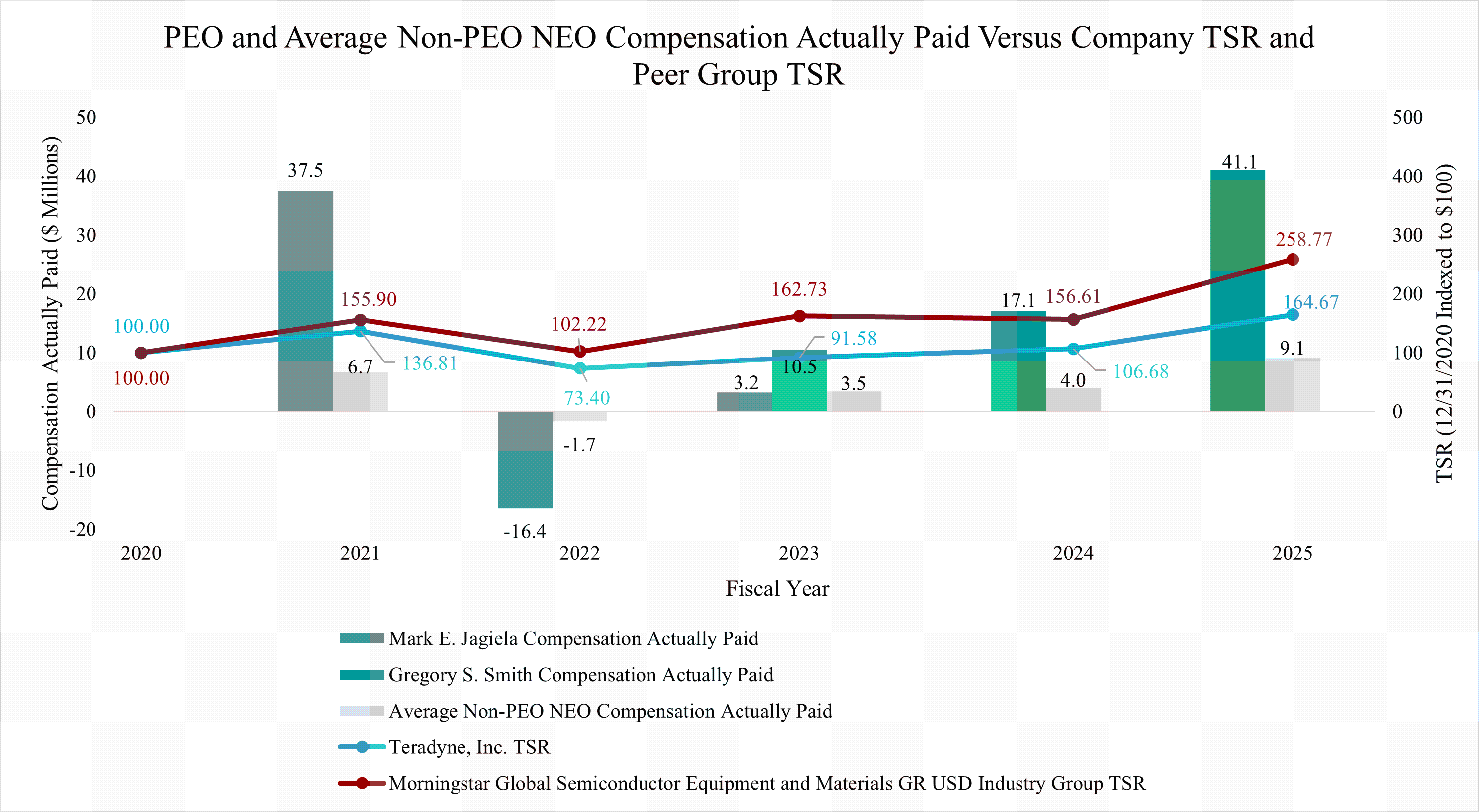
CEO compensation may appear higher than net income or TSR due to the timing and valuation of long-term incentive awards. The SEC’s definition of 'compensation actually paid' includes changes in the fair value of equity awards, which can fluctuate significantly based on stock price movements and vesting schedules.
Teradyne, Inc. | 2026 Notice of Annual Meeting & Proxy Statement | Page 79
Executive Compensation
Relationship Between PEO and Non-PEO NEO Compensation Actually Paid and Net Income
The following chart sets forth the relationship between Compensation Actually Paid to our PEOs, the average of Compensation Actually Paid to our Non-PEO NEOs, and our net income during the five most recently completed fiscal years.
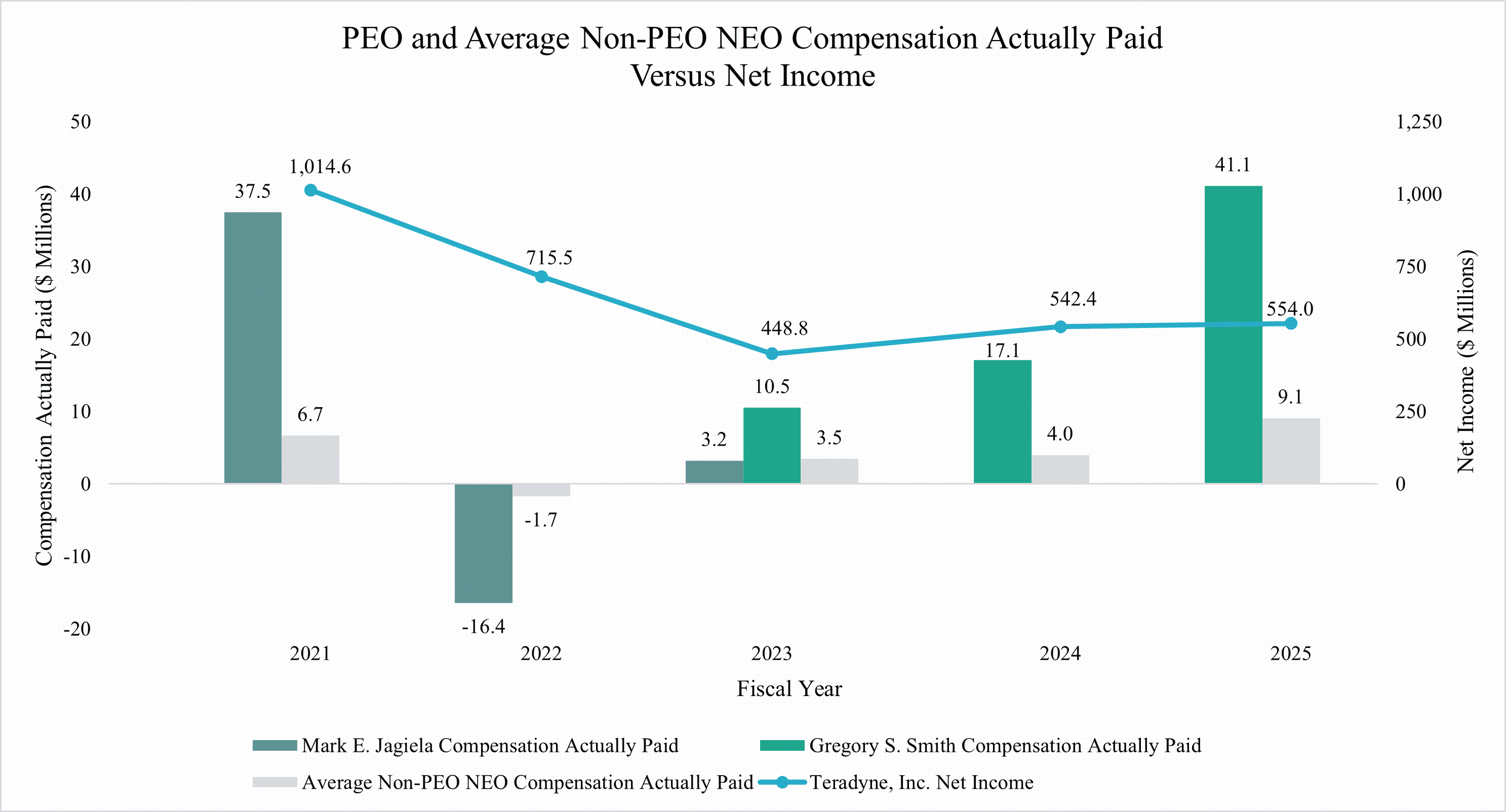
CEO compensation may appear higher than net income or TSR due to the timing and valuation of long-term incentive awards. The SEC’s definition of 'compensation actually paid' includes changes in the fair value of equity awards, which can fluctuate significantly based on stock price movements and vesting schedules.
Teradyne, Inc. | 2026 Notice of Annual Meeting & Proxy Statement | Page 80
Executive Compensation
Relationship Between PEOs and Non-PEO NEO Compensation Actually Paid and PBIT
The following chart sets forth the relationship between Compensation Actually Paid to our PEOs, the average of Compensation Actually Paid to our Non-PEO NEOs and our PBIT during the five most recently completed fiscal years.
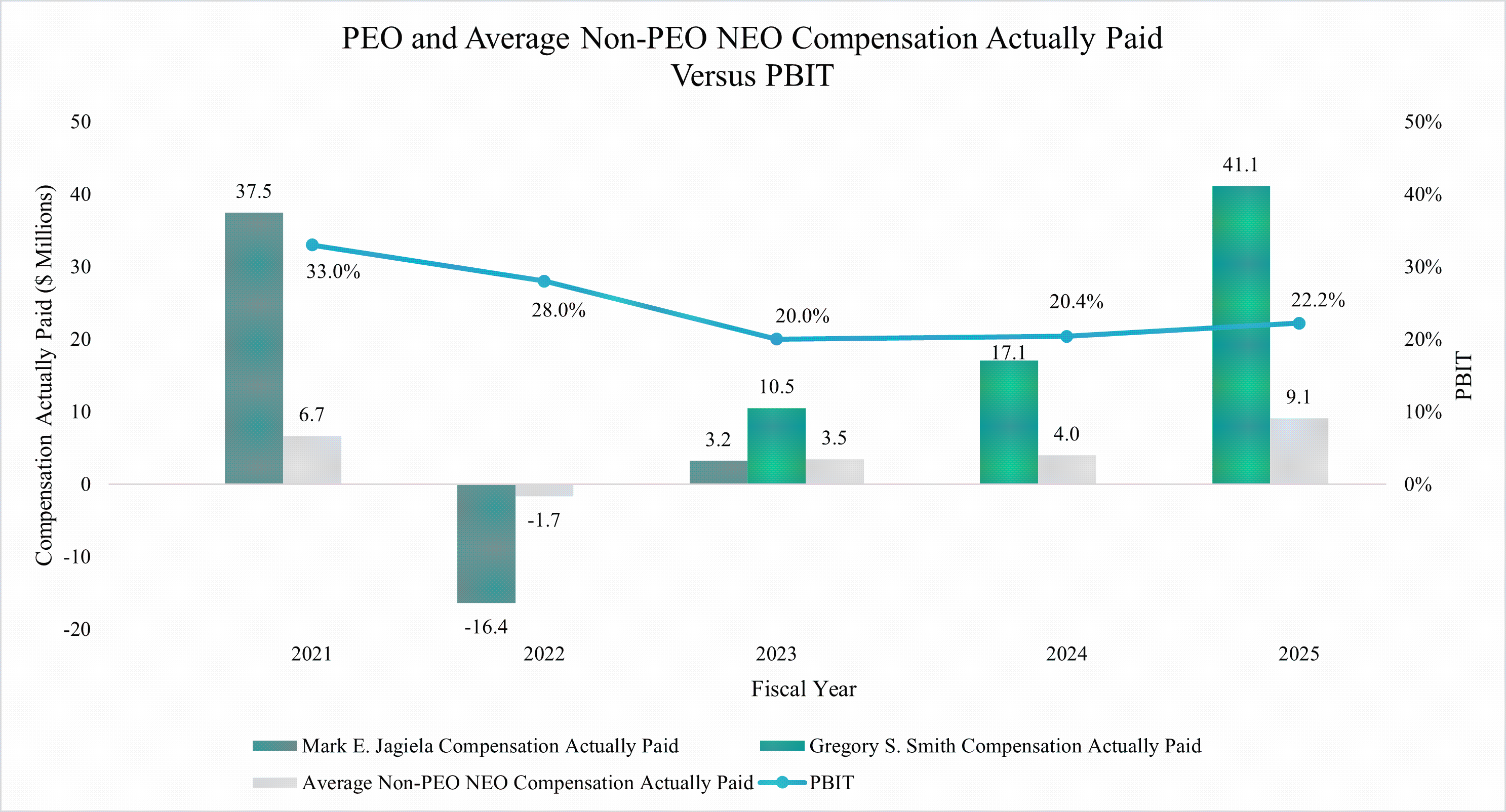
Tabular List of Most Important Financial Performance Measures
The following tabular list presents the financial performance measures that the Company considers to have been the most important in linking Compensation Actually Paid to our PEO and other Non-PEO NEOs for 2025 to Company performance. The measures in this list are not ranked.
Teradyne, Inc. | 2026 Notice of Annual Meeting & Proxy Statement | Page 81
Executive Compensation
Company Policies and Practices Related to the Grant of Certain Equity Awards Close in Time to the Release of Material Nonpublic Information.
During 2025, no named executive
Teradyne, Inc. | 2026 Notice of Annual Meeting & Proxy Statement | Page 82
PROPOSAL NO. 3: RATIFICATION OF APPOINTMENT OF INDEPENDENT REGISTERED PUBLIC ACCOUNTING FIRM
The Audit Committee is directly responsible for the appointment, compensation, retention (including the authority not to retain or to terminate), evaluation and oversight of any independent accounting firms engaged by the Company for the purpose of preparing or issuing an audit report or performing audit-related work. The Audit Committee has appointed PricewaterhouseCoopers LLP to serve as Teradyne’s independent registered public accounting firm for the fiscal year ending December 31, 2026. PwC, or its predecessor Coopers & Lybrand L.L.P., has served as Teradyne’s independent registered public accounting firm since 1968.
The Audit Committee’s decision to re-appoint our independent auditor was based on the following considerations:
Teradyne expects that a representative from PwC will be at the Annual Meeting, will have the opportunity to make a statement if so desired and will be available to respond to appropriate questions. The ratification of this selection is not required by the laws of the Commonwealth of Massachusetts, where Teradyne is incorporated, but the results of this vote will be considered by the Audit Committee in appointing an independent registered public accounting firm for future fiscal years.
Principal Accountant Fees and Services
Fees for Services Provided by PricewaterhouseCoopers LLP
The following table sets forth the aggregate fees for services provided by PwC, Teradyne’s independent registered public accounting firm, for the fiscal years ended December 31, 2025 and 2024, respectively.
|
|
2025 |
|
|
2024 |
|
||
Audit Fees |
|
$ |
3,656,000 |
|
|
$ |
3,341,800 |
|
Audit-Related Fees |
|
$ |
— |
|
|
$ |
500,801 |
|
Tax Fees |
|
$ |
1,529,351 |
|
|
$ |
1,234,199 |
|
All Other Fees |
|
$ |
4,994 |
|
|
$ |
302,000 |
|
Total: |
|
$ |
5,190,345 |
|
|
$ |
5,378,800 |
|
Audit Fees
Audit Fees are fees related to professional services rendered for the audit of Teradyne’s annual financial statements and internal control over financial reporting for the fiscal years ended December 31, 2025 and 2024, respectively. These fees include the review of Teradyne’s interim financial statements included in its quarterly reports on Form 10-Q and services that are normally provided by PwC in connection with other statutory and regulatory filings or engagements.
Audit-Related Fees
Audit-Related Fees in 2025 and 2024 were for professional services associated with acquisition and divestiture due diligence.
Tax Fees
Tax Fees in 2025 and 2024 were for professional services related to global tax planning, acquisition due diligence and compliance matters.
Teradyne, Inc. | 2026 Notice of Annual Meeting & Proxy Statement | Page 83
Proposal No. 3: Ratification of Appointment of Independent Registered Public Accounting Firm
All Other Fees
All Other Fees are fees for services other than audit fees, audit-related fees and tax fees. In 2025 and 2024, the fees were related to financial statement disclosure, technical accounting software licenses and training courses.
Audit Committee Pre-Approval of Audit and Permissible Non-Audit Services of Independent Registered Public Accounting Firm
All audit-related fees, tax fees and all other fees, as described in the table above, were approved by the Audit Committee.
The Audit Committee’s policy is to pre-approve all audit and permissible non-audit services provided by the Company’s independent registered public accounting firm in order to ensure that the provision of such services does not impair the independent registered public accounting firm’s independence. These services may include audit services, audit-related services, tax services and other services. In addition to generally pre-approving, on a case-by-case basis, services provided by the independent registered public accounting firm, the Audit Committee adopted a policy for the pre-approval of certain specified services that may be provided by the independent registered public accounting firm. The services set forth on the pre-approved list have been identified in a sufficient level of detail so that management will not be called upon to make a judgment as to whether a proposed service fits within the pre-approved service list. Pursuant to the policy, management informs the Audit Committee, at least annually or more frequently upon its request, if the Company uses any pre-approved service and the fees incurred in connection with that service.
Audit and Financial Accounting Oversight
Audit Committee Report
In 2026, the Audit Committee reviewed Teradyne’s audited financial statements for the fiscal year ended December 31, 2025 and met with both management and PwC, Teradyne’s independent registered public accounting firm, to discuss those financial statements.
The Audit Committee also reviewed the report of management contained in Teradyne’s 2025 Form 10-K, filed with the SEC, as well as PwC’s report included in the 2025 Form 10-K related to its audit of (i) the consolidated financial statements and financial statement schedule and (ii) the effectiveness of internal control over financial reporting.
The Audit Committee has discussed with PwC the matters required to be discussed under the applicable requirements of the Public Company Accounting Oversight Board (the “PCAOB”) and the SEC. The Audit Committee has received the written disclosures and the letter from PwC required by the PCAOB regarding PwC’s communications with the Audit Committee concerning independence and has discussed with PwC its independence.
Based on these reviews and discussions with management and PwC, the Audit Committee recommended to the Board (and the Board approved) that Teradyne’s audited financial statements be included in its 2025 Form 10-K.
AUDIT COMMITTEE
Mercedes Johnson (Chair)
Ernest E. Maddock
Paul J. Tufano
Necip Sayiner
The information contained in the report above shall not be deemed to be “soliciting material” or to be “filed” with the SEC, nor shall such information be incorporated by reference into any future filing under the Securities Act or the Exchange Act, except to the extent that Teradyne specifically incorporates it by reference in any such filing.
The Board recommends a vote FOR ratification of the appointment of PricewaterhouseCoopers LLP as the Company’s independent registered public accounting firm.
Teradyne, Inc. | 2026 Notice of Annual Meeting & Proxy Statement | Page 84
OWNERSHIP OF SECURITIES
The following tables set forth, as of March 13, 2026, information relating to the beneficial ownership of Teradyne’s common stock as calculated under SEC rules for each director, each named executive officer and all directors and executive officers as a group and beneficial owners of more than 5% of Teradyne’s common stock. All percentage ownership calculations are based on 156,559,428 shares of common stock outstanding as of March 13, 2026.
Name of Beneficial Owner(1) |
|
Amount and |
|
|
Percent of |
|
|
|
|
|
|
|
|
|
|
|
|
|
|
|
Ryan Driscoll |
|
|
4,378 |
|
|
* |
Drew Henry |
|
|
2,132 |
|
|
* |
Peter Herweck |
|
|
15,374 |
|
|
* |
Mercedes Johnson |
|
|
8,864 |
|
|
* |
Ernest E. Maddock |
|
|
9,597 |
|
|
* |
Marilyn Matz |
|
|
19,173 |
|
|
* |
Sanjay Mehta |
|
|
30,964 |
|
|
* |
Regan Mills |
|
|
5,062 |
|
|
* |
Shannon Poulin |
|
|
6,085 |
|
|
* |
Necip Sayiner |
|
|
2,132 |
|
|
* |
Gregory S. Smith |
|
|
118,581 |
|
|
* |
Paul J. Tufano |
|
|
64,886 |
|
|
* |
Michelle Turner |
|
116 |
|
|
* |
|
Bridget van Kralingen |
|
|
5,556 |
|
|
* |
All current directors and executive officers as a group (15)(3) |
|
|
292,900 |
|
|
*% |
* less than 1%
Teradyne, Inc. | 2026 Notice of Annual Meeting & Proxy Statement | Page 85
Ownership of Securities
Name and Address of Beneficial Owner |
|
Amount and |
|
|
Percent of |
|
||
|
|
|
|
|
|
|
||
|
|
|
|
|
|
|
||
The Vanguard Group, Inc.(1) |
|
|
20,972,755 |
|
|
|
13.4 |
% |
|
|
|
|
|
|
|
||
|
|
|
|
|
|
|
||
BlackRock, Inc.(2) |
|
|
14,337,126 |
|
|
|
9.2 |
% |
|
|
|
|
|
|
|
||
|
|
|
|
|
|
|
||
FMR LLC(3) |
|
|
7,910,777 |
|
|
|
5.1 |
% |
Teradyne, Inc. | 2026 Notice of Annual Meeting & Proxy Statement | Page 86
VOTING AND MEETING INFORMATION
Voting Standards and Board Recommendations
Proposals |
Board Recommendations |
Voting Standards |
Treatment of Abstentions & Broker Non-Votes |
Proposal No. 1: Election of Directors |
FOR each nominee |
Each nominee must receive a majority of votes cast |
Not treated as votes cast and therefore will have no effect on the vote |
Proposal No. 2: Advisory Vote on Compensation of NEOs |
FOR |
A majority of the stock present or represented and voting |
|
Proposal No. 3: Ratification of Appointment of Independent Registered Public Accounting Firm |
FOR |
Meeting InformationWhy am I Receiving these Materials? Since you owned shares of our common stock at the close of business on the Record Date, you are considered a shareholder entitled to vote at the Annual Meeting or any adjournments thereof. The Board is soliciting proxies in the form provided to you by Teradyne for the Annual Meeting. When and Where Is the Annual Meeting? The Annual Meeting will be held on Friday, May 8, 2026, at 10:00 A.M. Eastern Time, at the offices of Teradyne, Inc. at 600 Riverpark Drive, North Reading, Massachusetts 01864. You are encouraged to arrive early to allow sufficient time to secure parking and complete admission verification procedures. |
|
How Do I Attend the Annual Meeting? To be admitted, you must present a government-issued photo identification, such as a driver’s license, state-issued ID card or passport, and proof of share ownership as of the Record Date. To prove ownership, shareholders of record will be verified against our list of registered shareholders. Beneficial shareholders, those who own their shares through an intermediary such as a bank or broker or other nominee, must show: an account statement showing their share ownership as of the Record Date; a copy of the voting instruction form or a valid legal proxy from the broker, trustee, bank or nominee holding the shares; a letter from a broker, trustee, bank or nominee holding the shares confirming the beneficial owner’s ownership as of the Record Date; or other similar evidence of ownership. We reserve the right to deny admittance to anyone who does not comply with these requirements as determined in our sole discretion. If you hold shares in a joint account, both owners can be admitted to the meeting if proof of joint ownership is provided and you both provide identification. |
Teradyne, Inc. | 2026 Notice of Annual Meeting & Proxy Statement | Page 87
Voting Standards and Board Recommendations
The Presence of How Many Shares of Common Stock are Required to Transact Business at the Annual Meeting? A quorum is required to transact business at the Annual Meeting. A majority of the outstanding shares represented at the Annual Meeting in person or by proxy shall constitute a quorum. On the Record Date, 156,559,428 shares of common stock were outstanding. Abstentions and broker “non-votes” are counted as present or represented for purposes of determining the presence or absence of a quorum for the meeting. Can I Ask Questions at the Annual Meeting? Shareholders attending the Annual Meeting will be provided an opportunity to ask questions of the Board and management. Are There any Other Matters to Be Presented During the Annual Meeting? The Board knows of no other matters to be presented during the Annual Meeting. If any other matters properly come before the Annual Meeting, it is the intention of the proxyholders to vote the proxy in accordance with their judgment on such matters. Voting InformationWho Can Vote at the Annual Meeting? Each share outstanding as of the Record Date will be entitled to one vote, and shareholders may vote in person or by proxy. Delivery of a proxy will not in any way affect a shareholder’s right to attend the Annual Meeting and vote in person. You are entitled to direct the voting of your shares if you were a beneficial owner of shares held in street name on the Record Date. What is the Difference Between a Shareholder of Record and a Beneficial Owner of Shares Held in Street Name? If your shares of common stock are registered directly in your name with our transfer agent, Broadridge Corporate Issuer Solutions, Inc. (“Broadridge”), you are considered a shareholder of record or a “registered shareholder” of those shares. If your shares are held in an account at a bank, brokerage firm or other intermediary, you are a beneficial owner of shares held in street name. In that case, you will receive proxy materials, as well as a voting instruction form, from the intermediary holding your shares and, as a beneficial owner, you have the right to direct the intermediary as to how to vote them. Most individual shareholders are beneficial owners of shares held in street name. |
|
How Do I Vote? Depending on how you hold your shares, you have up to four ways to cast your vote: • By Internet. Go to www.proxyvote.com or scan the QR Barcode on your proxy card. To be valid, your vote must be received by 11:59 p.m., Eastern Time, on May 7, 2026. You will need your control number to access the website. • By Telephone. Call 1-800-690-6903 any time on a touch-tone telephone. There is no charge to you for the call in the U.S. or Canada. International calling charges apply outside the U.S. and Canada. You will need your control number to vote. To be valid, your vote must be received by 11:59 p.m., Eastern Time, on May 7, 2026. • By Mail. Mark your voting instruction form or proxy card, sign and date it, and return it in the prepaid envelope that has been provided or return it to Vote Processing, c/o Broadridge, 51 Mercedes Way, Edgewood, NY 11717. To be valid, your vote must be received by 11:59 p.m., Eastern Time, on May 7, 2026. • During the Annual Meeting. If you are a beneficial owner of shares of common stock held in street name, please refer to the voting instruction form provided by the intermediary holding your shares. The availability of telephone and internet voting will depend on the voting process of the intermediary. Shares held beneficially may be voted at the Annual Meeting only if you obtain a legal proxy from your intermediary giving you the right to vote the shares. If you attend the Annual Meeting, you may vote in person even if you have previously returned your vote in accordance with one of the foregoing methods. How Can I Revoke My Proxy or Change My Vote? Any shareholder delivering a proxy has the right to revoke it only by written notice to the Secretary or Assistant Secretary delivered at any time before it is exercised, including at the Annual Meeting. How Will My Shares Be Voted? Your shares will be voted in accordance with your instructions. In addition, if you grant a proxy to the Company’s proxy holders, the proxy holders will have, and intend to exercise, discretion to vote your shares in accordance with their best judgment on any matters not identified in this proxy statement that are brought to a vote at the Annual Meeting. If your shares are registered in your name and you sign and return a proxy card or vote by telephone or the internet but do not give voting instructions on a particular proposal, the proxy holders will be authorized to vote your shares on that matter in |
Teradyne, Inc. | 2026 Notice of Annual Meeting & Proxy Statement | Page 88
Voting Standards and Board Recommendations
accordance with the Board’s recommendation. If you hold your shares in street name and do not give voting instructions on a proposal, your broker or nominee is only permitted Nasdaq rules to vote your shares in its discretion on “routine” matters. Which Proposals in this Proxy Statement are Considered “Routine” or “Non-Routine”? The ratification of PricewaterhouseCoopers LLP as the Company’s independent registered public accounting firm for the fiscal year ending December 31, 2026 (Proposal No. 3) is a matter considered routine under Nasdaq rules and therefore a broker or nominee may vote on Proposal No. 3. No broker non-votes are expected to exist in connection with Proposal No. 3. The election of directors (Proposal No. 1), and the approval, on a non-binding, advisory basis of the 2025 compensation of our named executive officers (Proposal No. 2) are matters considered non-routine under Nasdaq rules. A broker or other nominee cannot vote without instructions on non-routine matters, and therefore there may be broker non-votes on Proposals 1 and 2. How are the Votes Counted? The vote on each matter submitted to shareholders is tabulated separately. An automated system administered by Teradyne’s transfer agent tabulates the votes. Other InformationWho Pays for the Expenses of this Proxy Solicitation? Teradyne will bear the cost of solicitation of proxies, and in addition to soliciting the shareholders by mail and by Teradyne’s regular employees, the Company may request banks and brokers to solicit their customers who have stock registered in the name of a nominee and, if so, will reimburse such banks and brokers for their reasonable out-of-pocket costs. Solicitation by Teradyne’s officers and employees, as well as certain outside proxy-solicitation services may also be made of some shareholders in person or by mail, telephone or facsimile following the original solicitation. Why Did I Receive a Notice in the Mail Regarding the Internet Availability of Proxy Materials Instead of a Full Set of Printed Proxy Materials? Under SEC rules, we are making this proxy statement available to our shareholders primarily through the Internet. If you received a notice by mail, you will not receive a printed copy of the proxy materials in the mail unless you request a copy. |
|
Instead, the notice instructs you on how to access and review all of the important information contained in the proxy statement and annual report. If you received a notice by mail and would like to receive a printed copy of the proxy materials, you should follow the instructions for requesting such materials included in the notice. What if I Share the Same Address as Another Teradyne Shareholder? Teradyne has adopted a procedure called “householding,” which has been approved by the SEC. Under householding, unless Teradyne has received contrary instructions from the shareholders, Teradyne delivers only one copy of the annual report and proxy statement to shareholders who share the same address and have the same last name. This helps Teradyne reduce printing costs, mailing costs and fees. Shareholders who participate in householding will continue to receive separate proxy cards. Upon request, Teradyne will promptly deliver another copy of the annual report and proxy statement or notice of internet availability of proxy materials, as applicable, to any shareholder at a shared address to which a single copy of such document was delivered. To receive a separate copy of the combined annual report and proxy statement or notice of internet availability of proxy materials, you may write or call us at Teradyne, Inc., 600 Riverpark Drive, North Reading, MA 01864, Attention: Investor Relations, telephone number (978) 370-3945. You may also access the annual report and proxy statement on the Company’s website at www.teradyne.com under the “SEC Filings” section of the “Investor Relations” link. If you are a holder of record and would like to revoke your householding consent and receive a separate copy of the annual report or proxy statement or notice in the future, please contact Broadridge, either by calling toll free at (866) 540-7095 or by writing to Broadridge, Householding Department, 51 Mercedes Way, Edgewood, New York 11717. You will be removed from the householding program within 30 days of receipt of the revocation of your consent. How Do I Obtain More Information About Teradyne? A copy of our annual report, which includes the 2025 Form 10-K, has been delivered or made available to shareholders. You also may obtain, free of charge, a copy of our annual report and 2025 Form 10-K by writing to Teradyne, Inc., 600 Riverpark Drive, North Reading, MA 01864, Attention: Investor Relations. These documents also are available on our website at www.teradyne.com under the “SEC Filings” section of the “Investor Relations” link. |
Teradyne, Inc. | 2026 Notice of Annual Meeting & Proxy Statement | Page 89
SHAREHOLDER PROPOSALS FOR 2027 ANNUAL MEETING
Teradyne’s bylaws set forth the procedures a shareholder must follow to nominate a director or to bring other business before a shareholder meeting. A complete list of the requirements for nominating a candidate for director or making a proposal may be found in Teradyne’s bylaws. The SEC has also adopted Rule 14a-8 under the Exchange Act (“Rule 14a-8”) that governs the inclusion of shareholder proposals in our annual proxy materials.
Shareholder Proposals for Inclusion in 2027 Proxy Statement
If a shareholder wishes to include a proposal in Teradyne’s proxy materials to be furnished to all shareholders entitled to vote at the 2027 Annual Meeting, Teradyne must receive notice pursuant to Rule 14a-8 no later than February 6, 2027. All such proposals must comply with the requirements of Rule 14a-8. It is suggested that shareholders submit their proposals either by courier or Certified Mail—Return Receipt Requested.
Shareholder Director Nominations for Inclusion in 2027 Proxy Statement
Teradyne’s bylaws, as amended in June 2025, provide proxy access pursuant to which shareholders may nominate a candidate for director at the 2027 Annual Meeting. Teradyne’s proxy access bylaw permits a shareholder, or a group of up to 20 shareholders, owning at least 3% of our outstanding common stock continuously for at least three years, to nominate and include in Teradyne’s proxy materials director nominees which shall not exceed the greater of two directors or 20% of the Board (rounded down to the nearest whole number), provided that the shareholders and nominees have complied with the requirements set forth in Teradyne’s bylaws. To be timely, shareholders who wish to include a nominee in Teradyne’s proxy materials must deliver a written notice of proxy access nomination (containing the information specified in our bylaws) to our Secretary at our principal executive offices no earlier than January 7, 2027, and no later than February 6, 2027. Our bylaws contain different notice date requirements in the event that we hold the 2027 Annual Meeting more than 30 days prior to, or more than 60 days after, the anniversary of the Annual Meeting.
Shareholder Director Nomination and Other Shareholder Proposals for Presentation at the 2027 Annual Meeting Not Included in 2027 Proxy Statement
Teradyne’s bylaws provide that, to be timely, shareholders who wish to nominate a candidate for director or make a proposal at the 2027 Annual Meeting (other than through proxy access) must deliver a written notice (containing the information specified in our bylaws) to our Secretary at our principal executive offices no earlier than January 8, 2027 and no later than February 7, 2027. Our bylaws contain different notice date requirements in the event that we hold the 2027 Annual Meeting more than 30 days from the anniversary of the Annual Meeting. Proposals or nominations must include the specified information concerning the shareholder and the proposal or nominee as described in our bylaws. In addition, shareholders who intend to solicit proxies in support of director nominees other than the Company’s nominees must comply with the additional requirements of Rule 14a-19 of the Exchange Act.
If a shareholder wishes to present a proposal but fails to notify Teradyne within the prescribed time periods or otherwise comply with the requirements in Teradyne’s bylaws, that shareholder will not be entitled to present the proposal at the meeting.
Teradyne Inc. | 2026 Notice of Annual Meeting & Proxy Statement | Page 90
OTHER MATTERS
Certain Relationships and Related Party Transactions
Our Board has adopted a written Related‑Party Transactions Policy that requires the Audit Committee to review and approve or ratify any transaction in which the Company participates and a “Related Person” has a direct or indirect material interest, as defined under Item 404(a) of Regulation S‑K (generally transactions exceeding $120,000). “Related Persons” include directors, executive officers, director nominees, beneficial owners of more than 5% of the Company’s voting securities, and their immediate family members.
Under the policy, the Audit Committee reviews material facts of each related‑party transaction, including the nature of the relationship, the purpose of the transaction, the benefits to the Company, the reasonableness of the terms compared to those available with unrelated third parties, and potential impacts on director independence, and approves only those transactions determined to be in, or not inconsistent with, the best interests of the Company and its shareholders.
The policy provides for advance approval or, if necessary, subsequent ratification of covered transactions and requires any Audit Committee member with an interest in a transaction to recuse themselves from deliberations. Certain categories of transactions are deemed pre‑approved, including specified executive and director compensation, certain ordinary‑course commercial transactions involving de minimis interests, and certain charitable contributions below defined thresholds.
The Company’s Legal Department administers the policy, maintains a master list of Related Persons, and coordinates quarterly reviews with business units to identify potential related‑party transactions for Audit Committee consideration. Since January 1, 2025, there have been no related person transactions that met the requirements for disclosure in this proxy statement.
Incorporation by Reference
To the extent that this proxy statement has been or will be specifically incorporated by reference into any of Teradyne’s filings with the SEC, the sections of the proxy statement entitled “Compensation Committee Report” and “Audit Committee Report” shall not be deemed to be so incorporated, unless specifically otherwise provided in any such filing. The content of the websites referred to in this proxy statement are not incorporated by reference into this proxy statement.
Teradyne Inc. | 2026 Notice of Annual Meeting & Proxy Statement | Page 91
FORWARD-LOOKING STATEMENTS
This proxy statement contains forward-looking statements within the meaning of Section 27A of the Securities Act and Section 21E of the Exchange Act. Words such as “anticipate,” “expect,” “plan,” “could,” “may,” “will,” “believe,” “estimate,” “goal,” or other comparable terms are intended to identify forward-looking statements although not all forward-looking statements contain these identifying words. Statements that refer to or are based on projections, forecasts, uncertain events or assumptions also identify forward-looking statements, including, among other things, statements made regarding our short-term and long-term financial and operational targets, expectations and objectives, business strategies and financial results, market trends, and expected benefits and enforcement of our compensation decisions.
These statements involve a number of risks, uncertainties and other factors that could cause actual results to differ materially from those expressed or implied. For a more detailed discussion of these factors, see the information under “Risk Factors,” “Management’s Discussion and Analysis of Financial Condition and Results of Operations” and “Quantitative and Qualitative Disclosures About Market Risk” in our 2025 Form 10-K and subsequent Quarterly Reports on Form 10-Q. While forward-looking statements are based on reasonable expectations of our management at the time that they are made, you should not rely on them. Our forward-looking statements speak only as of the date of this proxy statement or as of the date they are made, and we undertake no obligation to revise or update them, unless required by securities law, whether as a result of new information, future events or otherwise.
Teradyne Inc. | 2026 Notice of Annual Meeting & Proxy Statement | Page 92
APPENDIX A
Non-GAAP Financial Measures
Teradyne presents Non-GAAP net income per share (“Non-GAAP EPS”) in this proxy statement to provide investors with an additional tool to evaluate Teradyne’s operating results. Management believes this non-GAAP performance measure provides useful supplemental information for investors, allowing greater transparency to the information used by management in its operational decision making and in the review of Teradyne’s financial and operational performance, as well as facilitating meaningful comparisons of Teradyne’s results in the current period compared with those in prior and future periods. The Company’s executive compensation program also uses certain non-GAAP financial measures as performance goals, which we refer to in this proxy statement as Non-GAAP profit rate before interest and taxes, or PBIT, non-GAAP earnings per share, or EPS, and non-GAAP Free Cash Flow, or FCF. The non-GAAP performance measures discussed in this proxy statement may not be comparable to similarly titled measures used by other companies. The presentation of non-GAAP measures is not meant to be considered in isolation, as a substitute for, or superior to, financial measures or information provided in accordance with GAAP.
Non-GAAP Net Income per share or Non-GAAP EPS
Non-GAAP EPS is a non-GAAP performance measure presented to provide meaningful supplemental information regarding Teradyne’s baseline performance before gains, losses or other charges that may not be indicative of Teradyne’s current core business or future outlook. Non-GAAP EPS is derived by dividing Non-GAAP net income by weighted average common shares – diluted. Non-GAAP net income excludes acquired intangible assets amortization, restructuring and other, amortization of equity method investment, gains and losses on foreign exchange options in connection with acquisitions and divestitures, legal settlement, equity modification charge, pension actuarial gains and losses, gains and losses on sale of business, discrete income tax adjustments, and includes the related tax impact on non-GAAP adjustments. Non-GAAP EPS, among other of our non-GAAP performance measures, is used to make operational decisions, to determine employee compensation, to forecast future operational results, and for comparison with Teradyne’s business plan, historical operating results and the operating results of Teradyne’s competitors.
GAAP to Non-GAAP Reconciliation of EPS
|
|
|
|
|
|
|
|
Net Income per |
|
|
|
|
|
|
|
|
Net Income per |
|
||||||||||||||
|
|
December 31, |
|
|
% of Net |
|
|
Basic |
|
|
Diluted |
|
|
December 31, |
|
|
% of Net |
|
|
Basic |
|
|
Diluted |
|
||||||||
|
|
|
|
|
|
|
|
|
|
|
|
|
|
|
|
|
|
|
|
|
|
|
|
|
||||||||
Net income - GAAP |
|
|
554.0 |
|
|
|
17.4 |
% |
|
|
3.48 |
|
|
|
3.47 |
|
|
|
542.4 |
|
|
|
19.2 |
% |
|
|
3.39 |
|
|
|
3.32 |
|
Restructuring and other (2) |
|
|
38.6 |
|
|
|
1.2 |
% |
|
|
0.24 |
|
|
|
0.24 |
|
|
|
15.6 |
|
|
|
0.6 |
% |
|
|
0.10 |
|
|
|
0.10 |
|
Amortization of equity method investment |
|
|
30.1 |
|
|
|
0.9 |
% |
|
|
0.19 |
|
|
|
0.19 |
|
|
|
10.4 |
|
|
|
0.4 |
% |
|
|
0.07 |
|
|
|
0.06 |
|
Acquired intangible assets amortization |
|
|
15.3 |
|
|
|
0.5 |
% |
|
|
0.10 |
|
|
|
0.10 |
|
|
|
18.8 |
|
|
|
0.7 |
% |
|
|
0.12 |
|
|
|
0.11 |
|
ERP related expenses (3) |
|
|
4.8 |
|
|
|
0.2 |
% |
|
|
0.03 |
|
|
|
0.03 |
|
|
|
— |
|
|
|
— |
|
|
|
— |
|
|
|
— |
|
Pension mark-to-market adjustment (6) |
|
|
1.5 |
|
|
|
0.0 |
% |
|
|
0.01 |
|
|
|
0.01 |
|
|
|
(4.4 |
) |
|
|
-0.2 |
% |
|
|
(0.03 |
) |
|
|
(0.03 |
) |
Inventory step-up |
|
|
1.3 |
|
|
|
0.0 |
% |
|
|
0.01 |
|
|
|
0.01 |
|
|
|
— |
|
|
|
— |
|
|
|
— |
|
|
|
— |
|
Loss (gain) on foreign exchange contract |
|
|
(0.6 |
) |
|
|
0.0 |
% |
|
|
(0.00 |
) |
|
|
(0.00 |
) |
|
|
9.8 |
|
|
|
0.3 |
% |
|
|
0.06 |
|
|
|
0.06 |
|
Pension settlement loss (gain) |
|
|
(0.8 |
) |
|
|
0.0 |
% |
|
|
(0.01 |
) |
|
|
(0.01 |
) |
|
|
— |
|
|
|
— |
|
|
|
— |
|
|
|
— |
|
Legal settlement (1) |
|
|
— |
|
|
|
— |
|
|
|
— |
|
|
|
— |
|
|
|
3.6 |
|
|
|
0.1 |
% |
|
|
0.02 |
|
|
|
0.02 |
|
Equity modification charge (4) |
|
|
— |
|
|
|
— |
|
|
|
— |
|
|
|
— |
|
|
|
1.7 |
|
|
|
0.1 |
% |
|
|
0.01 |
|
|
|
0.01 |
|
Loss (gain) on sale of business (5) |
|
|
— |
|
|
|
— |
|
|
|
— |
|
|
|
— |
|
|
|
(57.1 |
) |
|
|
-2.0 |
% |
|
|
(0.36 |
) |
|
|
(0.35 |
) |
Exclude discrete tax adjustments |
|
|
0.5 |
|
|
|
0.0 |
% |
|
|
0.00 |
|
|
|
0.00 |
|
|
|
(8.7 |
) |
|
|
-0.3 |
% |
|
|
(0.05 |
) |
|
|
(0.05 |
) |
Non-GAAP tax adjustments |
|
|
(12.6 |
) |
|
|
-0.4 |
% |
|
|
(0.08 |
) |
|
|
(0.08 |
) |
|
|
(6.9 |
) |
|
|
-0.2 |
% |
|
|
(0.04 |
) |
|
|
(0.04 |
) |
Net income - non-GAAP |
|
|
632.1 |
|
|
|
19.8 |
% |
|
|
3.97 |
|
|
|
3.96 |
|
|
|
525.1 |
|
|
|
18.6 |
% |
|
|
3.29 |
|
|
|
3.22 |
|
|
|
|
|
|
|
|
|
|
|
|
|
|
|
|
|
|
|
|
|
|
|
|
|
|
||||||||
GAAP and non-GAAP weighted average common shares - basic |
|
|
159.1 |
|
|
|
|
|
|
|
|
|
|
|
|
159.8 |
|
|
|
|
|
|
|
|
|
|
||||||
GAAP and non-GAAP weighted average common shares - diluted (7) |
|
|
159.7 |
|
|
|
|
|
|
|
|
|
|
|
|
163.3 |
|
|
|
|
|
|
|
|
|
|
||||||
Teradyne Inc. | 2026 Notice of Annual Meeting & Proxy Statement | Page A-1
Appendix A
|
|
Twelve Months Ended |
|
|||||
|
|
December 31, |
|
|
December 31, |
|
||
|
|
|
|
|
|
|
||
Employee severance (a) |
|
$ |
29.4 |
|
|
$ |
5.2 |
|
Asset impairment |
|
|
4.9 |
|
|
|
1.3 |
|
Acquisition and divestiture related expenses |
|
|
2.3 |
|
|
|
2.2 |
|
Other |
|
|
2.1 |
|
|
|
6.8 |
|
|
|
$ |
38.6 |
|
|
$ |
15.6 |
|
(a) For the twelve months ended December 31, 2025, employee severance relates primarily to Robotics restructuring which impacted approximately 400 employees.
Non-GAAP profit rate before interest and taxes or PBIT
PBIT is a non-GAAP financial measure equal to GAAP income from operations excluding restructuring and other; amortization of acquired intangible assets; acquisition and divestiture related charges or credits; pension actuarial gains and losses; non-cash convertible debt interest expense; and certain other gains and charges. Such items are excluded as we believe they do not contribute to a meaningful evaluation of the Company’s future profitability or comparisons to the Company’s past profitability for purposes of determining executive compensation
|
|
Twelve Months Ended |
|
|||||||||||||
|
|
December 31, |
|
|
% of Net |
|
|
December 31, |
|
|
% of Net |
|
||||
|
|
|
|
|
|
|
|
|
|
|
|
|
||||
Net Revenues |
|
$ |
3,190.0 |
|
|
|
|
|
$ |
2,819.9 |
|
|
|
|
||
Gross profit - GAAP |
|
|
1,857.3 |
|
|
|
58.2 |
% |
|
|
1,648.9 |
|
|
|
58.5 |
% |
Inventory step-up |
|
|
1.3 |
|
|
|
0.0 |
% |
|
|
— |
|
|
|
— |
|
Legal settlement (1) |
|
|
— |
|
|
|
— |
|
|
|
3.6 |
|
|
|
0.1 |
% |
Gross profit - non-GAAP |
|
$ |
1,858.6 |
|
|
|
58.3 |
% |
|
$ |
1,652.5 |
|
|
|
58.6 |
% |
Inventory step-up |
|
|
650.1 |
|
|
|
20.4 |
% |
|
|
593.8 |
|
|
|
21.1 |
% |
Legal settlement (1) |
|
|
38.6 |
|
|
|
1.2 |
% |
|
|
15.6 |
|
|
|
0.6 |
% |
Gross profit - non-GAAP |
|
|
15.3 |
|
|
|
0.5 |
% |
|
|
18.8 |
|
|
|
0.7 |
% |
ERP related expenses (3) |
|
|
4.8 |
|
|
|
0.2 |
% |
|
|
— |
|
|
|
— |
|
Inventory step-up |
|
|
1.3 |
|
|
|
0.0 |
% |
|
|
— |
|
|
|
— |
|
Legal settlement (1) |
|
|
— |
|
|
|
— |
|
|
|
3.6 |
|
|
|
0.1 |
% |
Equity modification charge (4) |
|
|
— |
|
|
|
— |
|
|
|
1.7 |
|
|
|
0.1 |
% |
Loss (gain) on sale of business (5) |
|
|
— |
|
|
|
— |
|
|
|
(57.1 |
) |
|
|
-2.0 |
% |
Income from operations - non-GAAP |
|
$ |
710.1 |
|
|
|
22.3 |
% |
|
$ |
576.3 |
|
|
|
20.4 |
% |
The notes related to these numerical ticks can be found above.
Teradyne Inc. | 2026 Notice of Annual Meeting & Proxy Statement | Page A-2
Appendix A
Free Cash Flow
Free Cash Flow (in millions) |
|
FY2025 |
|
|
|
|
|
|
|
GAAP Cash Flow from Operations |
|
$ |
674 |
|
Plant, Property and Equipment |
|
$ |
(224 |
) |
Non-GAAP Cash Flow from Operations ("Free Cash Flow") |
|
$ |
450 |
|
Teradyne determines Free Cash Flow by adjusting GAAP cash flow from operations excluding discontinued operations, less property, plant and equipment additions. Free Cash Flow is considered a non-GAAP financial measure. Teradyne believes that Free Cash Flow, which measures our ability to generate cash from our business operations, is an important financial measure for use in evaluating Teradyne’s financial performance. Free Cash Flow should be considered in addition to, rather than as a substitute for, income (loss) from continuing operations or net income (loss) as a measure of our performance and net cash provided by operating activities as a measure of our liquidity.
Teradyne Inc. | 2026 Notice of Annual Meeting & Proxy Statement | Page A-3
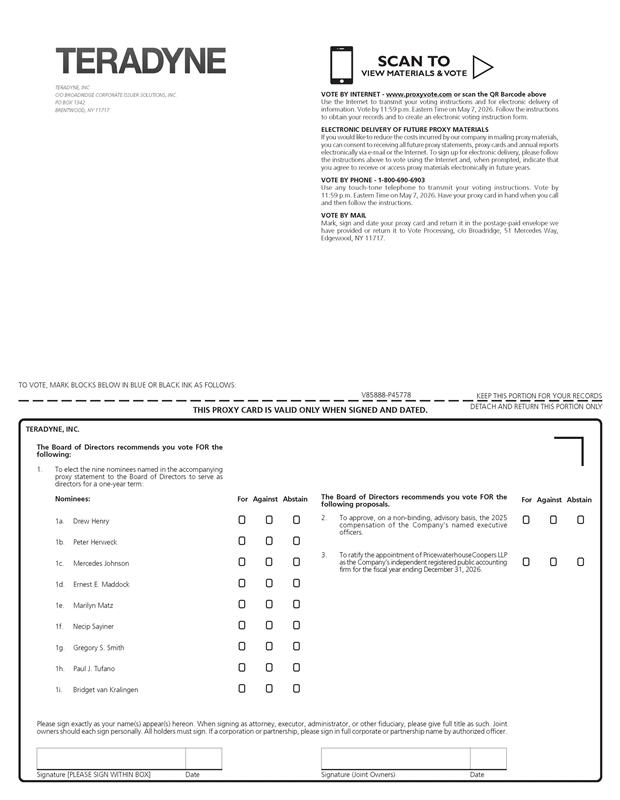
SCAN TO VIEW MATERIALS & VOTE TERADYNE, INC. C/O BROADRIDGE CORPORATE ISSUER SOLUTIONS, INC. PO BOX 1342 BRENTWOOD, NY 11717 VOTE BY INTERNET - www.proxyvote.com or scan the QR Barcode above Use the Internet to transmit your voting instructions and for electronic delivery of information. Vote by 11:59 p.m. Eastern Time on May 7, 2026. Follow the instructions to obtain your records and to create an electronic voting instruction form. ELECTRONIC DELIVERY OF FUTURE PROXY MATERIALS If you would like to reduce the costs incurred by our company in mailing proxy materials, you can consent to receiving all future proxy statements, proxy cards and annual reports electronically via e-mail or the Internet. To sign up for electronic delivery, please follow the instructions above to vote using the Internet and, when prompted, indicate that you agree to receive or access proxy materials electronically in future years. VOTE BY PHONE - 1-800-690-6903 Use any touch-tone telephone to transmit your voting instructions. Vote by 11:59 p.m. Eastern Time on May 7, 2026. Have your proxy card in hand when you call and then follow the instructions. VOTE BY MAIL Mark, sign and date your proxy card and return it in the postage-paid envelope we have provided or return it to Vote Processing, c/o Broadridge, 51 Mercedes Way, Edgewood, NY 11717. V85888-P45778 TERADYNE, INC. The Board of Directors recommends you vote FOR the following: 1. To elect the nine nominees named in the accompanying proxy statement to the Board of Directors to serve as directors for a one-year term: The Board of Directors recommends you vote FOR the following proposals. Nominees: For Against Abstain ! 2. To approve, on a non-binding, advisory basis, the 2025 compensation of the Company s named executive officers. 1a. Drew Henry 1b. Peter Herweck 1c. Mercedes Johnson 1d. Ernest E. Maddock 1e. Marilyn Matz 1f. Necip Sayiner 1g. Gregory S. Smith 1h. Paul J. Tufano 1i. Bridget van Kralingen 3. To ratify the appointment of PricewaterhouseCoopers LLP as the Company s independent registered public accounting firm for the fiscal year ending December 31, 2026. ! ! ! ! ! ! ! ! ! ! ! ! ! Please sign exactly as your name(s) appear(s) hereon. When signing as attorney, executor, administrator, or other fiduciary, please give full title as such. Joint owners should each sign personally. All holders must sign. If a corporation or partnership, please sign in full corporate or partnership name by authorized officer.
Important Notice Regarding the Availability of Proxy Materials for the Annual Meeting: The Notice and Proxy Statement, Shareholder Letter and Form 10-K are available at www.proxyvote.com V85889-P45778 TERADYNE, INC. Annual Meeting of Shareholders May 8, 2026 10:00 AM This proxy is solicited by the Board of Directors The shareholder(s) hereby appoint(s) GREGORY S. SMITH, RYAN E. DRISCOLL and GREGORY W. MCINTOSH, or any of them, as proxies, each with the power to appoint his substitute, and hereby authorize(s) them to represent and to vote, as designated on the reverse side of this ballot, all of the shares of Common stock of TERADYNE, INC. that the shareholder(s) is/are entitled to vote at the Annual Meeting of Shareholders to be held at 10:00 AM, ET on May 8, 2026, at Teradyne, Inc., 600 Riverpark Drive, North Reading, MA 01864, and any adjournment or postponement thereof. This proxy, when properly executed, will be voted in the manner directed herein. If no such direction is made, this proxy will be voted in accordance with the Board of Directors' recommendations. Continued and to be signed on reverse side