10-K: Annual report [Section 13 and 15(d), not S-K Item 405]
Published on February 19, 2026
UNITED STATES
SECURITIES AND EXCHANGE COMMISSION
WASHINGTON, D.C. 20549
FORM
(MARK ONE)
For the fiscal year ended
OR
Commission filer number
(Exact Name of Registrant as Specified in Its Charter)
(State or other jurisdiction of incorporation or organization) |
(I.R.S. Employer Identification Number) |
(Address of principal executive offices) |
(Zip Code) |
Registrant’s telephone number, including area code: (
Securities registered pursuant to Section 12(b) of the Act:
Title of each class |
|
Trading Symbol(s) |
|
Name of each exchange on which registered |
|
|
Indicate by check mark if the registrant is a well-known seasoned issuer, as defined in Rule 405 of the Securities Act.
Indicate by check mark if the registrant is not required to file reports pursuant to Section 13 or Section 15(d) of the Exchange Act. Yes ☐
Indicate by check mark whether the registrant (1) has filed all reports required to be filed by Section 13 or 15(d) of the Securities Exchange Act of 1934 during the preceding 12 months (or for such shorter period that the registrant was required to file such reports), and (2) has been subject to such filing requirements for the past 90 days.
Indicate by check mark whether the registrant has submitted electronically every Interactive Data File to be submitted pursuant to Rule 405 of Regulation S-T (§ 232.405 of this chapter) during the preceding 12 months (or for such shorter period that the registrant was required to submit such files).
If securities are registered pursuant to Section 12(b) of the Act, indicate by check mark whether the financial statements of the registrant included in the filing reflect the correction of an error to previously issued financial statements.
Indicate by check mark whether any of those error corrections are restatements that required a recovery analysis of incentive-based compensation received by any of the registrant’s executive officers during the relevant recovery period pursuant to § 240.10D-1(b). ☐
Indicate by check mark whether the registrant is a large accelerated filer, an accelerated filer, a non-accelerated filer, or a smaller reporting company. See the definitions of “large accelerated filer,” “accelerated filer” and “smaller reporting company” and “emerging growth company” in Rule 12b-2 of the Exchange Act:
☒ |
Accelerated filer |
☐ |
|
|
|
|
|
Non-accelerated filer |
☐ |
Smaller reporting company |
|
|
|
|
|
|
|
Emerging growth company |
If an emerging growth company, indicate by check mark if the registrant has elected not to use the extended transition period for complying with any new or revised financial accounting standards provided pursuant to Section 13(a) of the Exchange Act. ☐
Indicate by check mark whether the registrant has filed a report on and attestation to its management’s assessment of the effectiveness of its internal control over financial reporting under Section 404(b) of the Sarbanes-Oxley Act (15 U.S.C. 7262(b)) by the registered public accounting firm that prepared or issued its audit report.
If securities are registered pursuant to Section 12(b) of the Act, indicate by check mark whether the financial statements of the registrant included in the filing reflect the correction of an error to previously issued financial statements.
Indicate by check mark whether any of those error corrections are restatements that required a recovery analysis of incentive-based compensation received by any of the registrant's executive officers during the relevant recovery period pursuant to §240.10D-1(b). ☐
Indicate by check mark whether the registrant is a shell company (as defined in Rule 12b-2 of the Exchange Act). Yes ☐ No
The aggregate market value of the voting stock held by non-affiliates of the registrant as of June 29, 2025, was approximately $
The number of shares outstanding of the registrant’s only class of Common Stock as of February 16, 2026, was
DOCUMENTS INCORPORATED BY REFERENCE
Portions of the registrant’s proxy statement in connection with its 2025 annual meeting of shareholders are incorporated by reference into Part III of this Form 10-K.
TERADYNE, INC.
INDEX
|
|
Page No.
|
|
||
PART I. |
||
|
|
|
Item 1. |
2 |
|
Item 1A. |
9 |
|
Item 1B. |
20 |
|
Item 1C. |
20 |
|
Item 2. |
22 |
|
Item 3. |
22 |
|
Item 4. |
22 |
|
|
||
PART II. |
||
|
|
|
Item 5. |
23 |
|
Item 6. |
23 |
|
Item 7. |
Management’s Discussion and Analysis of Financial Condition and Results of Operation |
24 |
Item 7A. |
35 |
|
Item 8. |
37 |
|
Item 9. |
Changes in and Disagreements with Accountants on Accounting and Financial Disclosure |
90 |
Item 9A. |
90 |
|
Item 9B. |
90 |
|
Item 9C. |
Disclosure Regarding Foreign Jurisdictions that Prevent Inspections |
91 |
|
||
PART III. |
||
|
|
|
Item 10. |
92 |
|
Item 11. |
92 |
|
Item 12. |
Security Ownership of Certain Beneficial Owners and Management and Related Stockholder Matters |
92 |
Item 13. |
Certain Relationships and Related Transactions, and Director Independence |
92 |
Item 14. |
92 |
|
|
||
PART IV. |
||
|
|
|
Item 15. |
93 |
|
Item 16. |
94 |
|
|
100 |
|
TERADYNE, INC.
FORM 10-K
SPECIAL NOTE REGARDING FORWARD-LOOKING STATEMENTS
This Annual Report on Form 10-K contains “forward-looking statements” regarding Teradyne's future business prospects, financial performance or position and results of operations. When used herein, the words such as “anticipate,” “expect,” “plan,” “could,” “may,” “will,” “believe,” “estimate,” “goal,” or other comparable terms are intended to identify forward-looking statements although not all forward-looking statements contain these identifying words. Forward-looking statements involve risks and uncertainties, including, but not limited to, those discussed in the section entitled “Risk Factors” of this Annual Report on Form 10-K and elsewhere, and in our other filings with the Securities and Exchange Commission (“SEC”). Readers are cautioned not to place undue reliance on these forward-looking statements which reflect management’s analysis only as of the date hereof and are subject to risks and uncertainties that could cause actual results to differ materially from those stated or implied. Teradyne assumes no obligation to update these forward-looking statements for any reason, except as may be required by law.
1
PART I
Item 1: Business
Teradyne, Inc. (“Teradyne”) was founded in 1960 and is a leading global provider of automated test equipment and robotics solutions. Teradyne's automated test systems are used to test semiconductors, wireless products, data storage, silicon photonics, and complex electronics systems in many industries including consumer electronics, wireless, automotive, industrial, computing, communications, and aerospace and defense industries. Teradyne's robotics product offerings consist primarily of collaborative robotic arms and autonomous mobile robots used by global manufacturing, logistics and industrial customers to improve quality, increase manufacturing and material handling efficiency while reducing costs. In the first quarter of 2025, Teradyne identified opportunities for operational synergies amongst our production board test, defense and aerospace, and wireless test businesses leading to the creation of the Product Test division as a new segment effective March 2025. Teradyne’s automated test equipment and robotics products and services include:
The market for our test products is concentrated with a limited number of significant customers accounting for a substantial portion of the purchases of test equipment. A few customers drive sizable demand for our offerings both through direct sales and sales to the customer’s supply partners. We expect that sales of our test products will continue to be concentrated with a limited number of major customers for the foreseeable future.
In 2025, our Semiconductor Test segment achieved considerable growth driven by robust demand from Artificial Intelligence (“AI”) applications in networking and with vertically integrated producer (“VIP”) compute solutions. Memory test revenue remained stable despite a smaller overall market, supported by share gains in high bandwidth memory (“HBM”) and DRAM final test applications. The Semiconductor Test segment’s strategic shift toward AI-driven semiconductor testing resulted in AI related customer demand driving the majority of our revenue in the second half of 2025. Looking ahead to 2026, we expect AI related customer demand to continue to represent the bulk of our revenues in the first quarter. Our results reflect our focused investments in AI applications and VIP customers, with benefits from these initiatives materializing throughout 2025 and expected to continue in 2026. In the Product Test Group, we also achieved revenue growth in 2025, bolstered primarily by strength in defense and aerospace applications.
In our Robotics segment, the fourth quarter of 2025 represented the third consecutive quarter of sequential revenue growth. During the year, we aimed at strategic partnerships with original equipment manufacturers, systems integrators, and large enterprise accounts, concentrating on high-growth verticals such as ecommerce, logistics, semiconductor, and electronics. At the same time, we also reduced costs through restructuring activities designed to better position the Robotics organization for future success.
On January 29, 2026, we and MultiLane, a leading high-speed input/output (“I/O”) test and measurement company, announced an agreement to form a joint venture, MultiLane Test Products (“MLTP”). MLTP is being created to serve the growing demand from the AI Data Center equipment market by accelerating the development of test solutions for critical high speed data connections. Under the agreement, MultiLane will contribute all the assets related to its test and measurement business to the joint venture and we will invest approximately $157 million in exchange for 75% ownership of MLTP. This transaction is expected to close in the first half of 2026 and is subject to customary closing conditions.
On May 31, 2025, we acquired privately held Quantifi Photonics (“Quantifi”), a leader in PIC test solutions for a total purchase price of $127.2 million. This acquisition enables the delivery of scalable PIC test solutions and is included in our Product Test segment. Over time, we also intend to leverage Quantifi's engineering expertise and technology to enhance functionality and create additional differentiation in our Semiconductor Test business, specifically with integration into our UltraFlexplus platform.
On January 31, 2025, we acquired Infineon Technologies AG's (“Infineon”) automated test equipment technology and associated development team (“AET”) based in Regensburg, Germany for a total purchase price of 17.6 million Euros, equivalent to $18.3 million. AET adds resources and expertise to our company and strengthens the relationship between us and this key customer. AET is included in our Semiconductor Test segment.
Our financial statements are denominated in U.S. dollars. While revenues in our test businesses are predominantly in U.S. dollars, the majority of our Robotics revenue is denominated in foreign currencies. Strengthening of the U.S. dollar would negatively affect Robotics revenue in 2026.
2
Our corporate strategy is to profitably grow revenue and market share through the introduction of differentiated products targeting expanding markets and customer needs. Our capital allocation plan will continue to be balanced between investing in organic and inorganic growth and returning cash to shareholders through share repurchases and dividends.
We are subject to tariffs and restrictions from the dynamically changing global trade environment. While it is difficult to quantify the exact impact, current trade restrictions are limiting our ability to be competitive, particularly in certain markets, where some competitors are not subjected to the same restrictions. We continue to monitor developments in international trade policy, including potential changes to tariffs, further export controls, and other regulatory measures that could affect our supply chain, cost structure, or market access. For information regarding risks associated with import-export control regulations and similar applicable laws and regulations, see Part II - Item 1A “Risk Factors- Risks Related to Legal and Regulatory Compliance.”
Investor Information
We are a Massachusetts corporation incorporated on September 23, 1960. We are subject to the informational requirements of the Securities Exchange Act of 1934 (“Exchange Act”). We file periodic reports, proxy statements and other information with the SEC. The SEC maintains an internet site (http://www.sec.gov) that contains reports, proxy and information statements and other information regarding issuers that file documents electronically.
You can access financial and other information, including the charters of our Audit Committee, Compensation Committee and Nominating and Corporate Governance Committee, our Corporate Governance Guidelines and Code of Conduct, by clicking the Investors link on our web site at www.teradyne.com. We make available, free of charge, copies of our filings with the SEC, including our annual reports on Form 10-K, quarterly reports on Form 10-Q, current reports on Form 8-K and amendments to those reports filed or furnished pursuant to Section 13(a) or 15(d) of the Exchange Act through our web site as soon as reasonably practicable after filing such material electronically or otherwise furnishing it to the SEC.
Products
Semiconductor Test
We design, manufacture, sell and support Semiconductor, Hard Disk Drive (“HDD”), and Solid State Disk (“SSD”) test systems and related services on a worldwide basis. The test systems we provide are used for wafer level, device package testing, and system level testing. These devices are used in AI, automotive, industrial, communications, consumer, smartphones, cloud, computer and electronic game applications, among others. Semiconductor devices span a broad range of functionality, from very simple low-cost devices such as microcontrollers, operational amplifiers or voltage regulators to complex digital signal processors, Artificial Intelligence/Machine Learning (“AI/ML”) training ASICs, high performance computing and microprocessors as well as memory devices. Semiconductor Test products and services are sold to integrated device manufacturers (“IDMs”) that integrate the fabrication of silicon wafers into their business, “Fabless” companies that outsource the manufacturing of silicon wafers, “Foundries” that cater to the processing and manufacturing of silicon wafers, and semiconductor assembly and test providers (“OSATs”) that provide test and assembly services for the final packaged devices to both Fabless companies and IDMs. Fabless companies perform the design of integrated circuits and use Foundries for wafer manufacturing and OSATs for test and assembly. Our customers obtain the overall benefit of comprehensively testing devices and reducing the total costs associated with testing by using our Semiconductor Test systems to:
Our FLEX Test Platform architecture advances our core technologies to produce test equipment that is designed for high efficiency multi-site testing. Multi-site testing involves the simultaneous testing of many devices in parallel. Leading semiconductor manufacturers are using multi-site testing to significantly improve their “cost of test” economics. The FLEX Test Platform architecture addresses customer requirements through the following key capabilities:
3
FLEX Test Platform purchases are made by IDMs, OSATs, Foundries and Fabless customers. The FLEX Test Platform has become a widely used test solution at OSATs by providing versatile testers that can handle the widest range of devices, allowing OSATs to leverage their capital investments. The broad consumer, automotive and broadband markets have historically driven most of the device volume growth in the semiconductor industry. More recently data centers and AI are the drivers for the FLEX Test Platform and specifically the UltraFLEXplus tester, the newest member of the UltraFLEX family, which uses the new PACETM architecture to deliver superior economics and fast time to market for complex compute devices.
Our J750™ test system shares the IG-XL software environment with the family of FLEX Test Platform systems. The J750 is designed to handle high volume semiconductor devices, such as microcontrollers, that are central to the functionality of almost every consumer electronics product, from small appliances to automobiles. J750 test systems combine compact packaging, high throughput and ease of production test. We extended the J750 platform technology to create the IP750 Image Sensor™ test system. The IP750 is focused on testing image sensor devices used in smartphones, automobiles and other imaging products. We have continued to invest in the J750 platform with new instrument releases that bring new capabilities to existing market segments and expand the J750 platform to new devices that include high end microcontrollers and the latest generation of image sensors.
Our Magnum platform addresses the requirements of mass production test of memory devices for flash, DRAM, and HBM memory. Flash, DRAM and HBM memory are widely used core building blocks in modern electronic products finding wide application in consumer, industrial, and computing equipment. Our Magnum 7 solution is designed for parallel memory test in the flash, DRAM, HBM and multi-chip package markets while our Magnum EPIC platform, gives us full product coverage of the memory test market with final test capabilities.
Our ETS platform is used by semiconductor manufacturers and assembly and test subcontractors, primarily in the analog/mixed signal markets that cover cost sensitive applications. Our proprietary SmartPin™ technology enables high efficiency multi-site testing on an individual test system permitting greater test throughput. Semiconductors tested by ETS platform systems are incorporated into a wide range of products in historically high-growth markets including mobile devices, automotive electronics, computer peripherals, data center platforms, and notebook and desktop computers. The Eagle platform includes the ETS-88 which is a high performance multi-site production test system designed to test a wide variety of high volume power and precision devices including Silicon Carbide (“SiC”) and Gallium Nitride (“GaN”) power devices used in vehicle electrification and data center power delivery and conversion. The ETS-800, a high performance multi-site production test system, is used to test high complexity power devices in automotive, industrial and consumer applications.
The Integrated System Test group is comprised of our system level test (“SLT”) testers and our HDD and SSD testers. Our SLT testers for the semiconductor production market are used to test devices following wafer and package test. SLT testers address customer requirements related to factory density, throughput and thermal performance. HDD products address the high throughput and automated manufacturing test requirements of hard disk drive and semiconductor manufacturers. Our HDD products address the client and enterprise storage markets. The client market is driven by the needs of desktop, laptop, and external HDD storage products. The enterprise market is driven by the needs of data centers and cloud storage.
Robotics
Our Robotics segment is comprised of two product lines, our cobot arms under Universal Robots branding and our autonomous mobile robots under Mobile Industrial Robots branding.
Since introducing the world's first commercially viable cobot in 2008, Teradyne Robotics has sold over 110,000 cobots worldwide and has developed a product portfolio reflecting a range of reaches and payloads. All models, including the UR8 Long, UR15, UR18, UR20, UR30, UR3e, UR7e, UR12e, and UR16e are built to withstand a wide range of industrial environments, and can be easily integrated into existing production setups, providing a number of game-changing benefits:
4
An extensive ecosystem (“UR+”) has grown around the company's cobot technology, creating innovation and choice for customers and a wide range of components, kits and solutions to suit numerous applications.
Autonomous mobile robots (“AMRs”) are used in the manufacturing and logistics segments. Teradyne Robotics’ AMRs enhance productivity, offering a high return on investment by streamlining workforce efficiency, reducing lead times, and improving workplace safety. These AMRs, which include MiR250, MiR600, and MiR1350, as well as the MiR1200 Pallet Jack, operate autonomously, eliminating the need for traditional guidance infrastructure. Teradyne Robotics’ has sold over 11,000 AMRs globally.
All models can be easily integrated into existing production environments, differentiated by their:
Product Test
Our Product Test segment consists of test equipment and service offerings for high performance electronic and photonic assemblies, sub-assemblies, modules, and components. Customers are broad, including but not limited to, companies in the high performance computing and data center, automotive/industrial, defense/aerospace, and consumer electronics industries. Our offerings include high-performance test systems, subsystems, instruments, and services. In addition to support of high volume manufacturing test, the Product Test solutions aid customers in the development, verification, and scaling of next-generation technologies.
Sales and Distribution
In each of the years, 2025, 2024 and 2023, our five largest direct customers in aggregate accounted for 44%, 36%, and 32% of our consolidated revenues, respectively.
Teradyne typically has a specifying customer such as an OEM, IDM, or Fabless company, who chooses platforms and drives demand, and a purchasing customer who actually places the order and receives the equipment. In different cases, the specifying and purchasing customers have more influence in the purchase decision. In 2025, we had two customers who specified greater than 10% of our consolidated revenues and one additional customer who directly purchased more than 10% of our consolidated revenues. The two specifying customers were both customers of our Semiconductor Test and Product Test segments and drove 12% and 10% of consolidated revenues. The additional direct customer, a customer of our Semiconductor Test segment, accounted for 19% of consolidated revenues including certain revenues specified by other customers.
In 2024, we estimate one customer of our Semiconductor Test and Wireless Test segments, specified approximately 13% of our consolidated revenues. In 2023, one customer of our Semiconductor Test segment, accounted for approximately 10% of our consolidated revenues. The loss of, or significant decrease in demand from a significant OEM, IDM, or Fabless customer, or any of our five largest direct customers, could have a material adverse effect on our business, results of operations and financial condition.
We have sales and service offices located throughout North America, Central America, Asia and Europe. We sell in these areas predominantly through a direct sales force, except for Robotics products, which are sold principally through distributors and OEMs. Our manufacturing activities for our test businesses are primarily conducted through subcontractors and outsourced contract manufacturers with significant operations in Malaysia. The manufacturing activities for our Robotics businesses are done primarily in our production facilities in Denmark and the U.S.
5
Sales to customers outside the United States were 89%, 87%, and 84%, respectively, of our consolidated revenues in 2025, 2024 and 2023. Sales are attributed to geographic areas based on the location of the customer site.
See also “Item 1A: Risk Factors” and Note V: “Segment, Geographic, and Significant Customer Information” in Notes to Consolidated Financial Statements.
Competition
We face significant competition throughout the world in each of our reportable segments. Competitors in the Semiconductor Test segment include, among others, Advantest Corporation, SPEA S.p.A., and Cohu, Inc.
Competitors in our Robotics segment include manufacturers of traditional industrial robots such as KUKA Robotics Corporation, ABB, FANUC, Staubli and Yaskawa Electric Corporation, companies with emerging collaborative robot offerings such as Techman, Doosan, Jaka, and AUBO Robotics, and manufacturers of autonomous mobile robots in the material handling space such as Omron, Rockwell Automation, Junion, HikRobot, Agilox, and KION.
Competitors in our Product Test operating segment include, among others, Keysight Technologies, Test Research, Inc.,
Rohde & Schwarz GmbH & Co. KG, Anritsu Company, National Instruments Corporation, Welzek and iTest.
Some of our competitors may have greater financial and other resources to pursue engineering, manufacturing, marketing, and distribution of their products. We also face competition from emerging Asian companies and from internal supply at several of our customers. Some of our competitors have introduced or announced new products with certain performance characteristics which may be considered equal or superior to those we currently offer. We expect our competitors to continue to improve the performance of their current products and to introduce new products or new technologies that provide improved cost of ownership and performance characteristics. See also “Item 1A: Risk Factors.”
Backlog
Our backlog at any particular date is not necessarily indicative of the actual sales for any succeeding period because our customers may delay delivery of products or cancel orders without advanced notice, subject to possible cancellation penalties. Delays in delivery schedules or cancellations of backlog during any particular period could have a material adverse effect on our business, financial condition or results of operations.
Raw Materials
Our products contain electronic and mechanical components that are provided by a wide range of suppliers. Some of these components are standard products, while others are manufactured to our specifications. We have experienced delays in obtaining timely delivery of certain components. These delays have impacted and may continue to impact the manufacturing of certain products and the timing of delivery of those products to our customers. While the majority of our components are available from multiple suppliers, certain items are obtained from sole sources. We may experience a temporary adverse impact if any of our sole source suppliers delay or cease to deliver products.
Intellectual Property and Licenses
The development of our products, both hardware and software, is based in significant part on proprietary information, our brands and technology. We protect our rights in proprietary information, brands and technology through various methods, such as:
6
However, these protections might not be effective in all circumstances. Competitors might independently develop similar technology or exploit our proprietary information and our brands in countries where we lack enforceable intellectual property rights or where enforcement of such rights through the legal system provides an insufficient deterrent. Also, intellectual property protections can lapse or be invalidated through appropriate legal processes. We do not believe that any single piece of intellectual property or proprietary rights is essential to our business.
Human Capital
We believe that our future success depends upon our continued ability to attract, develop, and retain a high-performance workforce. As of December 31, 2025, we employed approximately 6,600 employees, of whom approximately 2,200 were employed in the United States. Our largest non-US employee populations are in the Philippines (19%), Denmark (10%), Costa Rica (7%), China (7%) and Taiwan (5%). We also leverage contractors to provide flexibility for our business and manufacturing needs. As of December 31, 2025, we worked with approximately 600 contractors globally. Since the inception of our business, we have experienced no work stoppages or other labor disturbances.
We are an equal opportunity employer committed to making employment decisions without regard to race, religion, ethnicity or national origin, gender, sexual orientation, gender identity or expression, age, disability, protected veteran status or any other characteristics protected by law.
Corporate Culture
Our core values are conducting business with honesty and integrity, collaborating with our colleagues as a company without doors, and partnering with our customers every step of the way, because customers count on us.
We strive to foster a positive work environment that helps employees thrive. It is a priority for us to ensure that our people feel inspired, supported, safe and able to achieve their personal best. We are committed to equality through nondiscrimination, harassment prevention and pay equity policies. We value a respectful work environment where all employees enjoy challenging assignments, development opportunities and a safe, positive culture.
We are committed to conducting business in a responsible manner, with strategic operational policies, procedures and values that support transparency, sustainability and legal compliance. We ensure ethical operations and business commitments through robust governance of the company’s code of conduct and global environmental, health and safety programs.
Competitive Pay and Benefits
The primary objective of our compensation program is to provide a compensation and benefits package that will continue to attract, retain, motivate and reward high performing employees who operate in a highly competitive environment. We seek to achieve this objective by linking a meaningful portion of compensation to company and business unit performance. We enable employees worldwide to share in the success of the company through various programs including a stock purchase program, equity compensation and bonus plans. We seek competitiveness and fairness in total compensation with reference to peer comparisons and internal equity.
In addition to providing our employees with competitive compensation packages, we offer benefits designed to meet the needs of employees and their families worldwide, including paid time off, parental leave, bereavement leave, health insurance coverage, flexible work arrangements, contributions to retirement savings, and access to employee assistance and work-life programs.
Employee Development and Training
We believe that employee development and training is a key factor in attracting, motivating, improving and retaining a strong, competitive global workforce. We provide continual development to our employees focused on developing their job skills and competencies. Examples include new manager competencies like giving feedback and coaching, and training in software development tools and project management. Our employees worldwide also receive annual performance reviews and are involved in setting goals for their own development and performance. Employees and managers look back on the previous year, review career development plans and create goals for the next year.
We are committed to recruiting and developing talent at the collegiate level to help advance Science, Technology, Engineering and Mathematics (“STEM”) education for the future workforce. For example, our paid internships and entry-level positions offer real-world experience, and our co-op program offers higher education students a unique learning opportunity as students alternate one semester in a work assignment and one semester in the classroom. Additionally, we offer reimbursement for educational courses
7
related to an employee’s work or as part of a degree program, including tuition, lab fees and books. We also offer a scholarship program for employees with college-age children, step-children and grandchildren.
Employee Engagement
We conduct regular employee surveys to check in with our global workforce and obtain input on a number of topics. The feedback we receive from these surveys helps us assess employee sentiment, identify areas of improvement and guides our decision-making as it relates to people management. In addition, our CEO and other executives meet with employees worldwide on a frequent basis through exchange meetings and quarterly webcasts. The exchange meetings allow the executives to directly interact with a small group of employees, while the global webcasts enable all employees to engage with senior leaders and ask questions in an open Q&A session.
We also offer employees worldwide an opportunity to network and connect with colleagues who share similar interests. This includes global groups such as New Employees to Teradyne, Woman’s Affinity Group, Veterans, Blue and Green (for team members that are committed to the environment), Runner’s affinity group and LGBTQ+ advocates. Each of these groups is open to any employee who is interested and would like to join.
Talent Communities
At Teradyne, we believe our success is deeply connected to the strength of the communities where we live and work. We are committed to building an organization by investing in talent development through education, philanthropy, and strategic partnerships. Our Talent Community initiatives are designed to foster opportunity and innovation across all stages of the educational and professional journey.
We have a tradition of amplifying the charitable actions of our employees and responding to the needs of the communities where we work. To make it easier for employees to support charitable activities and magnify the impact of support, we established a formal matching gift program, “Teradyne Gives.” The program matches up to $1,000 per year of an employee’s donations to charities of their choosing, selected from a wide range of qualified non-profit organizations.
Additionally, advancing education for future generations is a primary initiative at Teradyne. We seek to increase the number of STEM graduates worldwide through our support of STEM programs at the middle, high school and collegiate level. We also donate test equipment and robots to colleges, universities, and vocational programs.
Health and Safety
The health and safety of our employees worldwide is our highest priority. We are committed to complying with all applicable regulatory health and safety requirements wherever we operate. We conduct internal audits, regular reviews and monitoring of regulations to ensure compliance with laws and regulations at the local, state, province and country levels. We ensure workers are provided with the knowledge to perform their jobs safely by deploying mandatory environmental, health and safety training. We also require contractors to complete safety training prior to working at any Teradyne site. We monitor, track and report common safety metrics such as accidents, near misses and illness. Our injury and illness rate is below the industry average. We also provide our employees with a flexible and adjustable workspace, which includes reviewing ergonomics issues in the workplace, educating employees to self-identify risks and ensuring they have the work environment they need to do their jobs safely and effectively.
Regulatory Environment
We are subject to various federal, state, and local government laws and regulations relating to international trade, business conduct, the protection of employee health and safety and the environment.
We accrue for all known environmental liabilities when it becomes probable that we will incur cleanup costs and those costs can reasonably be estimated. Estimated environmental costs are not expected to materially affect the financial position or results of our operations in future periods. However, estimates of future costs are subject to change due to protracted cleanup periods and changing environmental remediation laws and regulations.
We are subject to U.S. and foreign laws and regulations that limit and restrict the export of some of our products and services and may restrict our transactions with certain customers, business partners and other persons. In certain circumstances, export control and economic sanctions or regulations prohibit the export of certain products, services, and technologies, and in other circumstances we are required to obtain an export license, which may not be approved, before exporting the controlled item. Additionally, these laws and regulations may impose restrictions on the end-use of our products, services, and technologies, including prohibitions on their use
8
in connection with nuclear, missile, chemical, or biological weapons activities, military applications, or other restricted purposes. For example, we must comply with current U.S. Department of Commerce export control regulations restricting transactions with certain customers in China. We must also comply with export restrictions and laws imposed by other countries affecting trade and investments. We maintain an export compliance program but there are risks that the compliance controls could be circumvented, exposing us to legal liabilities. Compliance with these laws has limited our sales and likely will continue to limit sales to certain customers in the future. Changes in, and responses to, U.S. trade policy could reduce the competitiveness of our products and cause our sales to drop, which could have a material adverse effect on our business, financial condition or results of operations.
Item 1A: Risk Factors
Descriptions of risks associated with our business are set forth below. Some of these risks are highlighted in the following discussion and in Management's Discussion and Analysis of Financial Condition and Results of Operations, Legal Proceedings, Controls and Procedures and Quantitative and Qualitative Disclosures About Market Risk of this Annual Report. The risks described below are not the only risks that we face. Additional risks and uncertainties not currently known to us or that we currently deem to be immaterial also may materially adversely affect our business, financial condition and/or operating results.
Risks Associated with Teradyne’s Markets
Our business is impacted by global and industry-specific economic cycles, which are difficult to predict, and actions we have taken or may take to offset these cycles may not be sufficient.
Capital equipment providers in the electronics, semiconductor industries and robotics, such as Teradyne, have, in the past, been negatively impacted by both sudden slowdowns in the global economies and recurring cyclicality within those industries. These cycles, which can be driven by broad changes to Semiconductor buying patterns, or to specific markets within the Semiconductor industry, have resulted in periods of over-supply; a trend we believe will continue to occur. Our business and results of operations depend, in significant part, upon capital expenditures of manufacturers of semiconductors, electronics, and other industrial products, which in turn depend upon the current and anticipated market demand for those products. Disruption or deterioration in global or industry-specific economic conditions may reduce customer purchases of our products, thereby reducing our revenues and earnings. In addition, such adverse changes in economic conditions, and resulting slowdowns in the market for our products, may, among other things, result in increased price competition for our products, increased risk of excess and obsolete inventories, increased risk in the collectability of our accounts receivable from our customers, potential reserves for credit losses and write-offs of accounts receivable, increased risk of restructuring charges, and higher operating costs as a percentage of revenues, which, in each case and together, adversely affect our operating results. We are unable to predict the likely duration, frequency and severity of disruptions in financial markets, credit availability, and adverse economic conditions throughout the world, and we cannot ensure that the level of revenues or new orders for a fiscal quarter will be sustained in subsequent quarters. We have taken actions to address the effects of general economic variability and recurring industry cyclicality, including implementing cost control and reduction measures. We cannot predict whether these measures will be sufficient to offset global or market-specific disruptions that might affect our businesses and we may need to take additional or different measures in the future.
We are subject to intense competition.
We face significant competition throughout the world in each of our reportable segments. Some of our competitors have substantial financial and other resources to pursue engineering, manufacturing, marketing and distribution of their products. In addition, we are subject to trade regulations imposed by the United States government, which may not impact some of our competitors. We also face competition from emerging Asian companies and internal development at several of our customers. Some of our competitors have introduced or announced new products with certain performance characteristics that may be considered equal or superior to those we currently offer. We expect our competitors to continue to improve the performance of their current products and to introduce new products or new technologies that provide improved cost of ownership and performance characteristics. In addition, the semiconductor industry has experienced significant consolidation over the past several years. Consolidation among our competitors or customers could lead to a changing competitive landscape, which could negatively impact our competitive position. If in the future we are unable to maintain our competitive position, we could experience downward pressure on prices, fewer customer orders, reduced margins, the inability to take advantage of new business opportunities and a loss of market acceptance of our products, any of which could have a material adverse effect on our revenues and results of operations.
9
The market for our products is concentrated, and our business depends, in part, on obtaining orders from a few significant customers.
The market for our products is concentrated with a limited number of significant global customers accounting for a substantial portion of the purchases of test equipment. In each of the years, 2025, 2024 and 2023, our five largest direct customers in aggregate accounted for 44%, 36% and 32% of consolidated revenues, respectively.
In 2025, we had two customers who specified greater than 10% of our consolidated revenues and one additional customer who directly purchased more than 10% of our consolidated revenues. The two specifying customers drove 12% and 10% of consolidated revenues. The additional direct customer accounted for 19% of consolidated revenues including certain revenues specified by our 10% specifiers.
If we were to lose any of our significant customers, if our products fail to meet changes in customers’ demands or if we suffer a material reduction in our customers’ purchase orders, our revenue could decline and our operating results and financial condition could be materially and adversely affected. We would have no or limited contractual recourse if our significant customers decided to stop buying and using our products with limited advance notice to us.
Customer consolidation could affect our operating results.
There has been a trend toward customer consolidation in the semiconductor industry through business combinations, including mergers, asset acquisitions and strategic partnerships. If this trend continues, it could make us more dependent on fewer customers who may be able to exert increased pressure on our prices and other contract terms and could increase the portion of our total sales concentration for any single customer. Customer consolidation activity could also reduce the demand for our products and services if such customers streamline research and development or operations, reduce purchases or delay purchasing decisions. These outcomes could negatively impact our operating results and financial condition.
If we fail to develop new technologies to adapt to our customers’ needs or if our customers fail to accept our new products, our revenues will be adversely affected.
We believe that our technological position depends primarily on the technical competence and creative ability of our engineers. In a rapidly evolving market, such as ours, the development or acquisition of new technologies, commercialization of those technologies into products and market acceptance and customer demand for those products are critical to our success. In the electronics, semiconductor, and robotics industries, products are often replaced by more technologically advanced substitutes and, as demand for older technology falls, the price at which such products can be sold drops. If we cannot advance new technologies to meet our customers’ demands, our revenues and financial condition may be adversely impacted. Successful product development or acquisition, introduction and acceptance depend upon a number of factors, including:
10
Risks Associated with Operating a Global Business
We are subject to risks of operating internationally.
A significant portion of our consolidated revenues is derived from customers outside the United States. Our international sales and operations are subject to significant risks and difficulties, including:
In addition, an increasing portion of our products and the products we purchase from our suppliers are sourced or manufactured in foreign locations, including Malaysia and Denmark, and a large portion of the devices our products test are fabricated and tested by foundries and subcontractors in Taiwan, China, Korea and other parts of Asia. As a result, we are subject to a number of economic and other risks, particularly during times of political, health or financial instability in these regions. Disruption of manufacturing or supply sources in these international locations could materially adversely impact our ability to fill customer orders and potentially result in lost business.
We are subject to risks associated with doing business in China.
In addition to the risks associated with the tariffs and trade regulations detailed below, we are subject to the following risks associated with doing business in China:
The foregoing risks and the ongoing geopolitical tensions and economic uncertainty between the United States and China and the unknown impact of current and future Chinese rules and regulations, may cause increased costs, as well as restrictions on our ability to sell, or a decreased demand from customers to purchase, our products, which could harm our business, financial condition and operating results.
11
Risks Related to Teradyne’s Finances
We may not fully realize the benefits of our acquisitions or strategic alliances.
Since 2015, we have completed the acquisitions of Universal Robots (2015), Energid and MiR (2018), Lemsys and AutoGuide (2019), and most recently, AET and Quantifi in 2025. Additionally, in May 2024, we closed on our strategic partnership agreement with Technoprobe which included our acquisition of 10% of the equity in Technoprobe. We may not be able to realize the benefits of acquiring or successfully growing these businesses. We may continue to acquire additional businesses, form strategic alliances, or create joint ventures with third parties that we believe will complement or augment our existing businesses. We may not be able to realize the expected synergies and cost savings from the integration with our existing operations of other businesses or technologies that we may acquire. In addition, the integration process for our acquisitions may be complex, costly and time consuming and include unanticipated issues, expenses, and liabilities. We may have difficulty in developing, manufacturing, and marketing the products of a newly acquired company in a manner that enhances the performance of our combined businesses or product lines and allows us to realize value from expected synergies.
Following an acquisition, we may not achieve the revenue or net income levels that justify the acquisition. Acquisitions may also result in one-time charges (such as acquisition-related expenses, write-offs or restructuring charges) or in the future, impairment of goodwill or acquired intangible assets, or adjustments to contingent consideration liabilities that adversely affect our operating results. We review our amortizable intangible assets for impairment at the reporting unit level when events or changes in circumstances indicate the carrying value may not be recoverable and we test goodwill for impairment at least annually. Factors that may be considered in assessing whether goodwill or intangible assets may be impaired include a decline in our stock price or market capitalization, reduced estimates of reporting unit future cash flows and slower growth rates in our industries. We have in the past recorded, and may in the future be required to record, a significant charge in our consolidated financial statements during the period in which any impairment of our goodwill or amortizable intangible assets is determined, negatively affecting our financial position and results of operations. Our valuation methodology for assessing impairment requires management to make judgments and assumptions based on experience and to rely heavily on projections of future operating performance. Because we operate in highly competitive environments, projections of our future operating results and cash flows may vary significantly from our actual results.
Additionally, we may fund acquisitions of new businesses, strategic alliances, or joint ventures by utilizing our cash, incurring debt, issuing shares of our common stock, or by other means. We may also face restrictions pursuant to the terms of an acquisition or strategic alliance agreement.
We may incur higher tax rates than we expect and may have exposure to additional international tax liabilities and costs.
We are subject to paying income taxes in the United States and other countries where we operate. Our effective tax rate is dependent on where our earnings are generated and the tax regulations and the interpretation and judgment of administrative tax or revenue authorities in the United States and other countries. We have pursued a global tax strategy that could be adversely affected by the mix of earnings and tax rates in the countries where we operate, changes to tax laws (including but not limited to Pillar Two), tax regulations or an adverse tax ruling by administrative authorities. Because of increasing focus by government taxing authorities on multinational corporations, the tax laws of certain countries in which we do business could change on a prospective or retroactive basis, and as a result our liabilities for taxes, interest and penalties, could significantly increase and adversely affect our financial results. We are also subject to tax audits in the countries where we operate. Any material change in our tax liability resulting from changes in tax laws, tax regulations, administrative rulings or audits from an administrative tax or revenue authority could negatively affect our financial results.
As a multinational corporation, we are subject to income taxes as well as non-income-based taxes, in both the United States and various foreign jurisdictions. In certain foreign jurisdictions, we qualify for tax incentives and tax holidays based on our ability to meet, on a continuing basis, various tests relating to our employment levels, research and development expenditures and other qualification requirements in a particular foreign jurisdiction. If we fail to qualify or fail to remain qualified for certain foreign tax incentives and tax holidays, we may be subject to further taxation or an increase in our effective tax rate which would adversely impact our financial results. In December 2025, we entered into an agreement with the Singapore Economic Development Board which extended our Singapore tax holiday under substantially similar terms to the agreement which expired on December 31, 2025. The new tax holiday is scheduled to expire on December 31, 2035.
The tax savings attributable to the Singapore tax holiday for the years ended December 31, 2025, 2024 and 2023 were $21.6 million or $0.14 per diluted share, $17.1 million or $0.10 per diluted share, and $1.4 million or $0.01 per diluted share, respectively. These tax savings may not be achievable in subsequent years due to changes in Singapore’s tax laws or the issuance of new global minimum tax laws.
12
We have significant guarantees, indemnification, and customer confidentiality obligations.
From time to time, we make guarantees to customers regarding the delivery, price and performance of our products and guarantee certain indebtedness, performance obligations or lease commitments of our subsidiary and affiliate companies. We also have agreed to provide indemnification to our officers, directors, employees and agents, to the extent permitted by law, arising from certain events or occurrences, while the officer, director, employee or agent, is or was serving at our request in such capacity. Additionally, we have confidentiality obligations to certain customers, which if breached would require the payment of significant penalties. If we become liable under any of these obligations, it could materially and adversely affect our business, financial condition or operating results. For additional information see Note O: “Commitments and Contingencies” in Notes to Consolidated Financial Statements.
We may discontinue or reduce our quarterly cash dividend or share repurchase program.
Future cash dividends and share repurchases are subject to the discretion of our Board of Directors and will depend, among other things, upon our earnings, capital requirements and financial condition. We are not required to do either and may reduce or eliminate our cash dividend or share repurchase program in the future. The amount and frequency of our share repurchases may fluctuate and the reduction or elimination of our cash dividend or our share repurchase program could adversely affect the market price of our common stock or reduce our cash reserves.
We have incurred indebtedness and may incur additional indebtedness.
On May 1, 2020, we entered into a three-year, senior secured revolving credit facility of up to $400.0 million (the “Credit Facility”). On December 10, 2021, the credit agreement was amended to extend the maturity date of the Credit Facility to December 10, 2026. On October 5, 2022, the credit agreement was amended to increase the amount of the Credit Facility to $750.0 million from $400.0 million. The amended credit agreement provides that, subject to customary conditions, we may seek to obtain from existing or new lenders the available incremental amount under the credit facility, not to exceed the greater of $200.0 million or 15% of consolidated EBIDTA. We could borrow funds under this Credit Facility at any time for general corporate purposes and working capital. On September 4, 2025, September 19, 2025, and October 7, 2025, Teradyne borrowed a combined $250.0 million under the Credit Facility to support the ramp-up in manufacturing capabilities for Semiconductor Test and the strategy to return cash to shareholders through share repurchases, dividends, and inorganic growth opportunities. On December 31, 2025, we repaid $50 million of the outstanding borrowings. Further, we may incur significant additional secured and unsecured indebtedness in the future.
Our outstanding and any additional indebtedness, among other things, could:
Restrictive covenants in the agreement governing our senior secured revolving credit facility may restrict our ability to pursue business strategies.
The agreement governing our Credit Facility limits our ability, among other things, to incur additional secured indebtedness; sell, transfer, license or dispose of assets; consolidate or merge; enter into transactions with our affiliates; and incur liens. In addition, our Credit Facility contains financial and other restrictive covenants that limit our ability to engage in activities that may be in our long-term best interest, such as, subject to permitted exceptions, making capital expenditures in excess of certain thresholds, making investments, loans and other advances, and prepaying any additional indebtedness while our indebtedness under our Credit Facility is outstanding. Our failure to comply with financial and other restrictive covenants could result in an event of default, which if not cured or waived, could result in the lenders requiring immediate payment of all outstanding borrowings or foreclosing on collateral pledged to them to secure the indebtedness.
13
We may not be able to pay our debt and other obligations.
If our cash flows are inadequate to meet our obligations, we could face substantial liquidity problems. If we are unable to generate sufficient cash flows or otherwise obtain funds necessary to make required payments on our Credit Facility or certain of our other obligations, we would be in default under the terms thereof, which would permit the holders of those obligations to accelerate their maturity and also could cause defaults under future indebtedness we may incur. Any such default could have a material adverse effect on our business, prospects, financial position and operating results.
Foreign currency exchange rates and fluctuations in those rates may affect the Company’s ability to realize projected growth rates in its sales and earnings.
Our financial statements are denominated in U.S. dollars. The majority of our Robotics revenue is denominated in foreign currencies, and the strengthening of the U.S. dollar would negatively affect Robotics revenue growth. In addition, many of our liabilities, including our outstanding indebtedness, and certain other cash payments, such as share repurchases, are payable in the United States in U.S. dollars, while a portion of our cash is generated outside the United States. As a result, currency fluctuations and changes in foreign exchange regulations can have a material adverse effect on our liquidity and financial condition.
Adverse developments affecting the financial services industry, including events or risks involving liquidity, defaults or non-performance by financial institutions, could have a material adverse effect on our business, financial condition or results of operations.
We hold cash balances in several large financial institutions significantly in excess of the Federal Deposit Insurance Corporation (“FDIC”) and global insurance limits. If banks and financial institutions with whom we have banking relationships enter receivership or become insolvent in the future, we may be unable to access, and we may lose some or all of our existing cash, cash equivalents and investments to the extent those funds are not insured or otherwise protected by the FDIC. There is no guarantee that the FDIC or any other global insurer will provide access to uninsured funds in the future in the event of the closure of any other banks or financial institutions in a timely fashion or at all. Any inability to access or delay in accessing these funds could adversely affect our business, financial position, and liquidity.
Our stock price has been subject to fluctuations, and will likely continue to be subject to fluctuations, which may be volatile and due to factors beyond our control.
The market price of our common stock is subject to wide fluctuations in response to various factors, some of which are beyond our control. In addition to the factors discussed in this “Risk Factors” section and elsewhere in this report, factors that could cause fluctuations in the market price of our common stock include the following:
14
In addition, the market for technology stocks and the stock markets in general have experienced extreme price and volume fluctuations. Stock prices of many technology companies have fluctuated in a manner unrelated or disproportionate to the operating performance of those companies. In the past, stockholders have instituted securities class action litigation following periods of market volatility. If we were to become involved in securities litigation, it could subject us to substantial costs, divert resources and the attention of management from our business, and adversely affect our business, results of operations, financial condition, and cash flows. A decline in the value of our common stock, including as a result of one or more factors set forth above, may result in substantial losses for our stockholders.
Risks Related to Operations
Our operating results are likely to fluctuate significantly.
Our operating results are affected by a wide variety of factors that could materially adversely affect revenues or profitability. The following factors could impact future operations:
15
As a result of the foregoing and other factors, we have experienced and may continue to experience material fluctuations in future operating results on a quarterly or annual basis which could materially and adversely affect our business, financial condition, operating results or stock price.
If our suppliers do not meet product or delivery requirements, we could have reduced revenues and earnings.
If any of our suppliers were to cancel contracts or commitments or fail to meet the quality or delivery requirements needed to satisfy customer orders for our products, we could lose time-sensitive customer orders, have significantly decreased revenues and earnings and be subject to contractual penalties, which would have a material adverse effect on our business, results of operations and financial condition. In addition, we rely on contract manufacturers for certain of our products, and our ability to meet customer orders for those products depends upon the timeliness and quality of the work performed by these subcontractors, over whom we do not exercise any control.
To a certain extent, we are dependent upon the ability of our suppliers and contract manufacturers to help meet increased product or delivery requirements. It may be difficult for certain suppliers to meet delivery requirements in a period of rapid growth, therefore impacting our ability to meet our customers’ demands.
Our suppliers are subject to trade regulations, including tariffs and export restrictions imposed by the United States Government and by the governments of other countries. These regulations could impact our suppliers’ ability to provide us with components for our products or could increase the price of those components.
We rely on the financial strength of our suppliers. The loss of suppliers either as a result of financial viability, bankruptcy or otherwise could have a material adverse effect on our business, results of operations or financial condition.
The global supply shortage of electrical components and inflationary cost increases impact our ability to meet customer demand and could adversely affect our business and financial results.
The global supply shortage of electrical components, including semiconductor chips, impacted our supply chain in 2023. As a result, we experienced and may experience in the future, increases in our lead times and costs for certain components for certain products. We may also experience delays in the delivery of some orders placed by our customers. In addition, inflationary pressures have in the past contributed to increased costs for product components along with wage inflation which yielded a minimal impact to the costs of our products, gross margin and profit for the year. In an effort to mitigate these risks, we may in some cases, incur higher costs due to investment in supply chain resiliency and to secure available inventory or have extended or non-cancellable purchase commitments with semiconductor suppliers, which introduces inventory risk if our forecasts prove inaccurate. We have also sourced components from additional suppliers and multi-sourced and pre-ordered components and finished goods inventory in some cases in an effort to reduce the impact of the adverse supply chain conditions we have experienced in the past. However, if we are unable to secure manufacturing capacities from our current or new suppliers and contract manufacturers, on acceptable terms or at all, or successfully manage our purchase commitments and inventory for components, our ability to deliver our products to our customers in the desired quantities, at competitive prices or in a timely manner may be negatively impacted. We may also not be fully able to pass additional costs on to our customers, which could have a negative impact on our results of operations and financial condition.
Our operations may be adversely impacted if our outsourced contract manufacturers or service providers fail to perform.
We depend on Flex Ltd. (“Flex”) to manufacture and test our FLEX and J750 family of products from its facility in Malaysia; Plexus Corp. (“Plexus”) to manufacture and test our FLEX and Magnum products from its facilities in Malaysia and Thailand and our ETS family of products from its facility in Malaysia; SAM Meerkat to manufacture and test our storage test family of products from its facilities in Malaysia and Thailand and on other contract manufacturers to manufacture other products. If for any reason these contract manufacturers cannot provide us with these products in a timely fashion, or at all, we may not be able to sell these products to our customers until we enter a similar arrangement with an alternative contract manufacturer.
If we experience a problem with our supply of products from Flex, Plexus, SAM Meerkat, or our other contract manufacturers, it may take us significant time to either manufacture the product or find an alternate contract manufacturer, which could result in substantial expense and disruption to our business. We have, however, significantly invested in our internal manufacturing for FLEX products in our Cebu site.
We have also outsourced certain general and administrative functions to reputable service providers, many of which are in foreign countries, sometimes impacting communication with them because of language and time differences. Their presence in foreign countries also increases the risk they could be exposed to political, conflict and cybersecurity risk. Additionally, there may be difficulties encountered in coordinating the outsourced operations with existing functions and operations. If we fail in successfully
16
coordinating and managing the outsourced service providers, it may cause an adverse effect on our operations, which could have a material adverse effect on our business, results of operations or financial condition.
Our business may suffer if we are unable to attract and retain key employees.
Competition for employees with skills we require is intense in the high technology industry. We expect intense competition for employees will continue in 2026. Our success will depend on our ability to attract and retain key technical employees. The loss of one or more key or other employees, a decrease in our ability to attract additional qualified employees, or the delay in hiring key personnel could each have a material adverse effect on our business, results of operations or financial condition. In addition, existing or new immigration laws, policies or regulations in the U.S. may limit the pool of available talent in the highly skilled technical labor market.
Our operations, and the operations of our customers and suppliers, are subject to risks of natural catastrophic events, severe weather, widespread health epidemics, acts of war, terrorist attacks and the threat of domestic and international terrorist attacks, any one of which could result in cancellation of orders, delays in deliveries or other business activities, or loss of customers and could negatively affect our business and results of operations. In certain cases, our insurance policy may be insufficient to cover losses.
Our business is international in nature, with our sales, service and administrative personnel and our customers and suppliers located in numerous countries throughout the world. Our operations, and those of our customers and suppliers, are subject to disruption for a variety of reasons, including work stoppages, acts of war and geopolitical conflict, terrorism, health epidemics, fires, earthquakes, hurricanes, typhoons, volcanic eruptions, energy shortages, telecommunication failures, tsunamis, flooding or other natural disasters, including as a result of global climate change. Any disruptions from these events could require substantial expenditures and recovery time to fully resume operations and could also have a material adverse effect on our operations and financial results to the extent that losses are uninsured or exceed insurance recoveries, and to the extent that such disruptions adversely impact our relationships with our customers. Additionally, any such disruption could materially increase our costs and expenses as well as cause delays in, among other things, shipments of products to our customers, our ability to perform services requested by our customers, or the installation and acceptance of our products at customer sites. Any of these conditions could have a material adverse effect on our business, financial condition or results of operations.
Risks Related to Intellectual Property (“IP”) and Cybersecurity
Third parties may claim we are infringing their intellectual property and we could suffer significant litigation costs, licensing expenses or be prevented from selling our products.
We have been sued for patent infringement in the past and receive notifications from time to time that we may be in violation of patents held by others. An assertion of patent infringement against us, if successful, could have a material adverse effect on our ability to sell our products or it could force us to seek a license to the intellectual property rights of others or alter such products so that they no longer infringe the intellectual property rights of others. A license could be very expensive to obtain or may not be available at all. Similarly, changing our products or processes to avoid infringing the rights of others may be costly or impractical. Additionally, patent litigation has in the past and could in the future require a significant use of management resources and involve a lengthy and expensive defense, even if we eventually prevail. If we do not prevail, we might be forced to pay significant damages, obtain licenses, modify our products, or stop making our products; each of which could have a material adverse effect on our financial condition, operating results or cash flows.
If we are unable to protect our IP, we may lose a valuable asset or may incur costly litigation to protect our rights.
We protect the technology that is incorporated in our products in several ways, including through patent, copyright, trademark and trade secret protection and by contractual agreement. However, even with these protections, our IP may still be challenged, invalidated or subject to other infringement actions. If a significant portion of our IP is invalidated or ineffective, our business could be materially adversely affected.
A breach of our operational or security systems could negatively affect our business and results of operations.
We rely on various information technology networks and systems to process, transmit and store electronic information, including proprietary and confidential data, and to carry out and support a variety of business activities, including manufacturing, research and development, supply chain management, sales and accounting. We have experienced several attempted cyber-attacks of our network. None of the attempted attacks have caused a disruption to our operations or had a material adverse effect on our business or financial results. As a result of the attempts, we have taken further preventive security measures to protect our systems. Despite the preventive security measures we have implemented, we may continue to be vulnerable to attempts by third parties to gain
17
unauthorized access to our networks or sabotage our systems. These attempts, which might be related to criminal hackers, industrial espionage or state-sponsored intrusions, include trying to covertly introduce malware to our computers, networks and systems and impersonating authorized users. Additionally, evolving geopolitical tensions or conflicts have created a heightened risk of cybersecurity attacks. In addition, third party suppliers and service providers that we rely on to manage our networks and systems and who process and store our proprietary and confidential data, including the data of our customers and suppliers, may also be subject to similar attacks. Employees and contractors may also attempt to gain unauthorized access to our systems and steal proprietary and confidential data. Such attempts could result in the misappropriation, theft, misuse, disclosure or loss or destruction of the intellectual property, or the proprietary, confidential or personal information, of Teradyne or our employees, customers, suppliers or other third parties, as well as damage to or disruptions in our information technology networks and systems. These threats are constantly evolving and expanding, such as through the increased use of artificial intelligence in our products and expanding remote work opportunities for our employees, thereby increasing the difficulty of defending against them or implementing adequate preventative measures. Attempts to gain unauthorized access to our information technology networks and systems may be successful, and in some cases, we might be unaware of an incident or its magnitude and effects. A failure in or a breach of our operational or security systems or infrastructure, or those of our suppliers and other service providers, including as a result of cyber-attacks, could have a material adverse effect on our business or financial results, disrupt our business, result in the disclosure or misuse of proprietary or confidential information, damage our reputation, cause losses and increase our costs. We expect to continue to devote significant resources to the security of our information technology networks and systems. Furthermore, our efforts to comply with evolving laws and regulations related to cybersecurity may be costly and any failure to comply could result in investigations, proceedings, investor lawsuits and reputational damage.
A breach of the security of our products could negatively affect our business and results of operations.
We may be subject to security breaches of certain of our products caused by viruses, illegal break-ins or hacking, sabotage, or acts of vandalism by third parties or our employees or contractors. A breach of our product security systems could have a material adverse effect on our business or financial results, disrupt our business, result in the disclosure or misuse of proprietary or confidential information, damage our reputation, cause losses, and increase our costs. We expect to continue to devote significant resources to the security of our products.
We are exposed to risks related to the use of AI tools by us and others.
Our use of AI tools may subject us to significant competitive, legal, regulatory and other risks, and there can be no assurance that our use of AI tools will enhance our products, business operations or result in a benefit to us. Our competitors may be more successful in their use of AI tools, including by developing superior products or improving their operations with the assistance of AI. Additionally, there could be adverse impacts from flawed algorithms, including related to incorporation of third-party copyrighted materials into large language models; data quality and bias, as well as challenges implementing and maintaining AI tools, such as the complications arising from integrating such tools with existing systems and practices, and from reliance on third-party AI vendors. Our use of AI tools, or our customers uses of our products that incorporate AI, could also result in the loss of confidential information or intellectual property or an inability to claim or enforce intellectual property rights, as well as subject us to risks related to intellectual property infringement or misappropriation, data privacy, cybersecurity, and the unauthorized use of our data. The jurisdictions in which we conduct business have and may adopt laws and regulations related to AI, which could cause us to incur greater compliance costs, limit our use of AI tools, or subject us to legal liabilities.
Risks Related to Legal and Regulatory Compliance
The implementation of tariffs on our products may have a material impact on our business.
Our business operations and supply chain are global and may be disrupted by the implementation of tariffs. In recent years, the United States has imposed significant tariffs on goods from some of our trading partners, and more significant tariffs continue to be threatened in light of rapidly evolving geopolitical tensions.
We cannot predict what further actions may ultimately be taken with respect to tariffs or what products or entities may be subject to such actions, or what reciprocation may be taken by other countries in response to U.S. actions. If we cannot find ways to mitigate the potential impacts from these tariffs successfully or in a timely manner, these additional tariffs and policies could have a significant impact on our business and operating results. The actual impact on any new tariffs is subject to a number of factors including the effective date, duration, amount, scope and nature of the tariffs. To date, recent tariff changes have not had a material adverse effect on our business, financial condition or results of operations, however, in the future, the implementation of additional tariffs by the United States or other countries could have a material adverse effect on our business, financial condition or results of operations.
18
In addition to the actions taken by the United States, China has implemented retaliatory tariffs on products made in the United States and imported into China. The retaliatory tariffs or other trade restrictions implemented by China and possible future retaliatory actions by China or other nations may in the future disrupt our business operations, sales and supply chain and, therefore, have a material adverse effect on our business, financial condition or results of operations.
Trade regulations and restrictions impact our ability to manufacture certain products and to sell products to and support certain customers, which may materially adversely affect our sales and results of operations.
We are subject to U.S. laws and regulations that limit and restrict the export of some of our products and services and may restrict our transactions with certain customers, business partners, suppliers and other persons. In certain circumstances, export control and economic sanctions regulations prohibit the export of certain products, services and technologies, and in other circumstances are required to obtain an export license. We must also comply with export restrictions and laws imposed by other countries affecting trade and investments. Our export compliance program may not be sufficient to prevent all inadvertent compliance violations and there are risks that the compliance controls could be circumvented, exposing us to legal liabilities. As further described below, we cannot quantify the impact that the export controls and economic sanctions has had on our sales, however, compliance with these laws has limited our ability to compete in certain regions, and could continue to limit them in the future. Changes in, and responses to, U.S. trade policy could reduce the competitiveness of our products and cause our sales to drop, which could have a material adverse effect on our business, financial condition or results of operations.
The U.S. government from time to time has issued export restrictions that prohibit U.S. companies from exporting U.S. manufactured products, foreign manufactured products with more than 25% controlled U.S. content, foreign made product which was produced using U.S. technology, as well as U.S. origin technology. For example, the U.S. Department of Commerce has restricted the access of U.S. origin technologies to certain Chinese semiconductor companies by adding those companies to the Entity List and the Foreign Direct Product Rule (“FDP”) under U.S. Export Administration Regulations (“EAR”). The addition of certain of these companies to the Entity List has had and will continue to have an adverse impact on our business with these customers. We cannot guarantee that we will be able to file for licenses with the U.S. Department of Commerce or otherwise take actions in the future to minimize the impact of the restrictions on our business.
The U.S. Department of Commerce issued and continues to update a list of companies in China and other countries that it considered to be military end users. Compliance with the military end user rule has impacted our ability to sell products to certain customers in China. We cannot be certain that the actions we take will address all of the risks associated with the export controls that may impact our business and our compliance controls could be circumvented, exposing us to legal liabilities.
We anticipate the U.S. Department of Commerce will continue to release new export control regulations. These regulations may continue to have an adverse impact on certain actual or potential customers and on the global semiconductor industry. To the extent the regulations impact actual and potential customers or disrupt the global semiconductor industry, our business and revenues will be adversely impacted.
In response to the regulations issued by the U.S. Department of Commerce, the Chinese government has passed new laws, including blocking legislation, which may impact our business activities in China. The Company is assessing the potential impact of these new Chinese laws and monitoring relevant laws and regulations issued by the Chinese government. The impact of these new Chinese laws on our business activities in China remains uncertain at this time.
We may be subject to product recalls and warranty and product liability claims.
We invest significant resources in the design, manufacturing and testing of our products. However, from time to time, we discover design or manufacturing defects in our products after they have been shipped and, as a result, we have incurred development and remediation costs and settled warranty and product liability claims. In addition, when our products contain defects or have reliability, quality or safety issues, in the past we have conducted a product recall which has resulted in significant repair or replacement costs and substantial delays in product shipments, which in the future could damage our reputation and could make it more difficult to sell our products. We may continue to have warranty and product liability claims or product recalls in the future. Any of these results could have a material adverse effect on our business, results of operations or financial condition.
We may incur significant costs of complying with present and future environmental regulations and may incur significant liabilities if we fail to comply with such environmental regulations.
We are subject to both domestic and international environmental regulations and statutory strict liability relating to the use, storage, discharge, site cleanup and disposal of hazardous chemicals used in our manufacturing processes. In addition, future regulations in response to global climate change may affect us, our suppliers, and our customers. Such regulations could cause us to
19
incur additional direct costs for compliance, as well as increased indirect costs resulting from our customers and/or suppliers. Future climate change regulations could result in decreased demand for our products. If we fail to comply with present and future regulations, or are required to perform site remediation, we could be subject to future liabilities or cost, including penalties or the suspension of production. Present and future regulations may also:
Pursuant to present U.S. federal regulations and agreements, we are conducting groundwater and subsurface assessment and monitoring and are implementing remediation and corrective action plans for facilities located in Massachusetts and New Hampshire which are no longer conducting manufacturing operations. As of December 31, 2025, we have not incurred material costs as a result of the monitoring and remediation steps taken at the Massachusetts and New Hampshire sites. We may in the future be subject to additional assessment and monitoring or other corrective action as a result of environmental liabilities and may incur significant future costs or disruptions to our operations resulting in a negative impact on our business or financial condition.
The directive on the Restriction of the Use of Certain Hazardous Substances in Electrical and Electronic Equipment (the “RoHS Directive”) and the directive on Waste Electrical and Electronic Equipment (the “WEEE Directive”) altered the form and manner in which electronic equipment is imported, sold and handled in the European Union. Other jurisdictions, such as China, have followed the European Union’s lead in enacting legislation with respect to hazardous substances and waste removal. Ensuring compliance with the RoHS Directive, the WEEE Directive and similar legislation in other jurisdictions, and integrating compliance activities with our suppliers and customers could result in additional costs and disruption to operations and logistics and thus, could have a negative impact on our business, operations or financial condition.
We currently are, and in the future may be, subject to litigation or regulatory proceedings that could have an adverse effect on our business.
From time to time, we may be subject to litigation or other administrative, regulatory or governmental proceedings, including tax audits and resulting claims that could require significant management time and resources and cause us to incur expenses and, in the event of an adverse decision, pay damages or incur costs in an amount that could have a material adverse effect on our financial position or results of operations. For information regarding litigation proceedings in which we are currently engaged, please refer to the discussion under Note O: “Commitments and Contingencies” in the Notes to Consolidated Financial Statements.
We may face risks associated with shareholder activism.
We may become subject to campaigns by shareholders advocating corporate actions such as financial restructuring, increased borrowing, special dividends, stock repurchases or divestitures, and changes in management. Such activities could interfere with our ability to execute our business plans, be costly and time-consuming, disrupt our operations, divert the attention of management, or result in our initiating borrowing or increasing our share repurchase plan or dividend, any of which could have an adverse effect on our business or stock price.
Item 1B: Unresolved Staff Comments
None.
Item 1C: Cybersecurity
We believe cybersecurity is critical to supporting our vision and enabling our strategy. As a producer of leading-edge electronic testing products and maker of advanced robotics, we face a multitude of cybersecurity threats that range from attacks common to most industries, such as vulnerability exploits, credential theft, and social engineering, to attacks from more advanced, persistent, and highly organized adversaries, including nation state actors, that may target us for our role in critical infrastructure sectors, all of which are becoming more sophisticated and effective by the use of AI. Our customers, suppliers, and partners face similar cybersecurity threats and, while we have
20
Our products and connected systems may be susceptible to cybersecurity threats such as hacking, malware, ransomware, or other unauthorized intrusions targeting data confidentiality, integrity or system availability. Threat actors — including third parties or malicious insiders — might exploit software vulnerabilities or misconfigurations to disrupt operations, exfiltrate confidential or personal data, or degrade system performance. A significant cybersecurity incident could expose us to regulatory enforcement, liability for damages, contractual penalties, remediation costs, and eroded customer trust. To date, we have not experienced any cybersecurity incidents that have materially affected our business, operations, or financial results. However, we continue to monitor and assess risks that could have a material impact in the future.
Governance
The Board of Directors oversees management’s processes for identifying and mitigating risks, including cybersecurity risks, to help align our risk exposure with our strategic objectives. Senior leadership, including our Chief Information Security Officer (“CISO”), brief the Audit Committee of the Board of Directors quarterly and the full Board of Directors at least annually on our cybersecurity and information security posture.
The corporate information security organization, under the CISO, has implemented a governance structure and processes to assess, identify, manage, and report cybersecurity risks. The cybersecurity program is aligned to the NIST Cybersecurity Framework and is
In the event of a significant incident, we intend to follow our detailed incident response playbooks, which outline the steps to be followed from incident detection through mitigation, recovery and notification, including escalation to functional areas (e.g., legal), and escalation to senior leadership via the Cybersecurity Steering Committee.
Risk management and strategy
Central to this organization is our global cyber operations team, which is responsible for the protection, detection, and response capabilities used in the defense of critical data and enterprise computing services. We also have a corporate-wide insider AI-enabled threat detection program to proactively identify external and internal threats and mitigate those threats in a timely manner. Our broader Teradyne employee community also has a key role in our cybersecurity defenses and is immersed in a comprehensive training and awareness curriculum to build and promote a corporate culture supportive of security. We conduct annual tabletop exercises and regular penetration testing to validate and improve our incident response capabilities.
Third parties also play a role in our cybersecurity.
We rely on contract manufacturing organizations and distributors to deliver our products to our customers, and a cybersecurity incident at one of these organizations or a key supplier could materially adversely impact us. We assess third party and supply chain cybersecurity controls through risk monitoring services tailored to align with our risk policy. Notwithstanding the extensive approach we take to cybersecurity, we may not be successful in preventing or mitigating a cybersecurity incident that could have a material adverse effect on us, either directly within our managed environment or indirectly via a third-party partner or supply chain vendor. Periodically we have a recognized independent security expert firm to assess our cyber security maturity along with risks and provide
21
feedback on where we should continue to improve to mitigate exposures. We share this review with our Board and develop a security roadmap which incorporates this feedback.
Additionally, for our business that supports the defense and aerospace sector, we must comply with extensive regulations, including requirements imposed by the Defense Federal Acquisition Regulation Supplement (“DFARS”) related to adequately safeguarding controlled unclassified information (“CUI”) and
Item 2: Properties
We conduct manufacturing, engineering, sales and marketing, service, corporate administration and other operations in various leased and owned facilities throughout the world. We own approximately 1,210,000 square feet of office space and lease approximately 1,416,000 square feet of office space. We own our corporate headquarters in North Reading, Massachusetts, which is approximately 422,000 square feet. We also own an approximately 200,000 square foot building in Odense, Denmark for our Robotics operations. In 2025, we completed the purchase of an approximately 290,000 square foot building in Cebu, Philippines for Semiconductor Test production and initiated our fit out of our leased 68,000 square foot Robotics U.S manufacturing site in the Metro Detroit area. We believe our existing and planned facilities are adequate to meet our current and reasonably foreseeable requirements. We regularly evaluate our expected facility needs and periodically make adjustments based on these evaluations.
Item 3: Legal Proceedings
We are subject to legal proceedings, claims and investigations that arise in the ordinary course of business such as, but not limited to, patent, employment, commercial and environmental matters. We believe that we have meritorious defenses against all pending claims and intend to vigorously contest them. While it is not possible to predict or determine the outcomes of any pending claims or to provide possible ranges of losses that may arise, we believe the potential losses associated with all these actions are unlikely to have a material adverse effect on our results of operations, financial condition or cash flows.
Item 4: Mine Safety Disclosure
Not Applicable.
22
PART II
Item 5: Market for Registrant’s Common Equity, Related Shareholder Matters and Issuer Purchases of Equity Securities
Our common stock is traded on the Nasdaq Global Select Market under the trading symbol “TER.” As of February 19, 2026, there were approximately 1,013 holders of record of shares of our common stock.
See “Item 7: Management’s Discussion and Analysis of Financial Condition and Results of Operations,” for information on the frequency and amounts of our quarterly cash dividends, equity compensation plans and performance graph.
The following table includes information with respect to repurchases we made of our common stock during the three months ended December 31, 2025 (in thousands except per share price):
Period |
|
(a) Total |
|
|
|
(b) Average |
|
|
|
(c) Total Number of |
|
|
(d) Maximum Number |
|
||||
September 29, 2025 – October 26, 2025 |
|
|
642 |
|
|
|
$ |
141.80 |
|
|
|
|
641 |
|
|
$ |
785,712 |
|
October 27, 2025 – November 23, 2025 |
|
|
451 |
|
|
|
|
172.43 |
|
|
|
|
451 |
|
|
|
708,911 |
|
November 24, 2025 – December 31, 2025 |
|
|
93 |
|
|
|
|
179.59 |
|
|
|
|
93 |
|
|
|
691,363 |
|
|
|
|
1,186 |
|
(1) |
|
|
156.42 |
|
(1) |
|
|
1,185 |
|
|
|
|
|
As of January 1, 2023, share repurchases net of share issuances are subject to a 1% excise tax under the Inflation Reduction Act. Excise tax incurred is included as part of the cost basis of shares repurchased in the Condensed Consolidated Statements of Stockholders' Equity.
In January 2023, the Board of Directors cancelled the 2021 repurchase program and approved a new $2.0 billion of common stock. Unless terminated by resolution of our Board of Directors, the repurchase program will expire when we have repurchased all shares authorized for repurchase under the share repurchase program.
We satisfy U.S. federal and state minimum withholding tax obligations due upon the vesting and the conversion of restricted stock units into shares of our common stock, by automatically withholding from the shares being issued, a number of shares with an aggregate fair market value on the date of such vesting and conversion that would satisfy the minimum withholding amount due.
Item 6: (Reserved)
23
Item 7: Management’s Discussion and Analysis of Financial Condition and Results of Operations
Overview
We are a leading global provider of automated test equipment and robotics products. Our automated test systems are used to test semiconductors, wireless products, data storage, silicon photonics, and complex electronics systems in many industries including consumer electronics, wireless, automotive, industrial, computing, communications, and aerospace and defense industries. Our robotics product offerings consist primarily of collaborative robotic arms and autonomous mobile robots used by global manufacturing, logistics and industrial customers to improve quality and increase manufacturing and material handling efficiency, while reducing costs. In the first quarter of 2025, we identified opportunities for operational synergies amongst our production board test, defense and aerospace, and wireless test businesses leading to the creation of the Product Test division as a new segment effective March 2025. Our automated test equipment and robotics products and services include:
The market for our test products is concentrated with a limited number of significant customers accounting for a substantial portion of the purchases of test equipment. A few customers drive sizable demand for our offerings both through direct sales and sales to the customer’s supply partners. We expect that sales of our test products will continue to be concentrated with a limited number of major customers for the foreseeable future.
In 2025, our Semiconductor Test segment achieved considerable growth driven by robust demand from Artificial Intelligence (“AI”) applications in networking and with vertically integrated producer (“VIP”) compute solutions. Memory test revenue remained stable despite a smaller overall market, supported by share gains in high bandwidth memory (“HBM”) and DRAM final test applications. The Semiconductor Test segment’s strategic shift toward AI-driven semiconductor testing resulted in AI related customer demand driving the majority of our revenue in the second half of 2025. Looking ahead to 2026, we expect AI related customer demand to continue to represent the bulk of our revenues in the first quarter. Our results reflect our focused investments in AI applications and VIP customers, with benefits from these initiatives materializing throughout 2025 and expected to continue in 2026. In the Product Test Group, we also achieved revenue growth in 2025, bolstered primarily by strength in defense and aerospace applications.
In our Robotics segment, the fourth quarter of 2025 represented the third consecutive quarter of sequential revenue growth. During the year, we aimed at strategic partnerships with original equipment manufacturers, systems integrators, and large enterprise accounts, concentrating on high-growth verticals such as ecommerce, logistics, semiconductor, and electronics. At the same time, we also reduced costs through restructuring activities designed to better position the Robotics organization for future success.
On January 29, 2026, we and MultiLane, a leading high-speed input/output (“I/O”) test and measurement company, announced an agreement to form a joint venture, MultiLane Test Products (“MLTP”). MLTP is being created to serve the growing demand from the AI Data Center equipment market by accelerating the development of test solutions for critical high speed data connections. Under the agreement, MultiLane will contribute all the assets related to its test and measurement business to the joint venture and we will invest approximately $157 million in exchange for 75% ownership of MLTP. This transaction is expected to close in the first half of 2026 and is subject to customary closing conditions.
On May 31, 2025, we acquired privately held Quantifi Photonics (“Quantifi”), a leader in PIC test solutions for a total purchase price of $127.2 million. This acquisition enables the delivery of scalable PIC test solutions and is included in our Product Test segment. Over time, we also intend to leverage the engineering expertise and technology to enhance functionality and create additional differentiation in our Semiconductor Test business, specifically with integration into our UltraFlexplus platform.
On January 31, 2025, we acquired Infineon Technologies AG's (“Infineon”) automated test equipment technology and associated development team (“AET”) based in Regensburg, Germany for a total purchase price of 17.6 million Euros, equivalent to $18.3 million. AET adds resources and expertise to our company and strengthens the relationship between us and this key customer. AET is included in our Semiconductor Test segment.
While revenues in our test businesses are predominantly in U.S. dollars, the majority of our Robotics revenue is denominated in foreign currencies. Strengthening of the U.S. dollar has, and will continue to, negatively affect Robotics revenue in 2025 and 2026, respectively.
24
Our capital allocation plan will continue to be focused on investing in organic and inorganic growth and returning cash to shareholders through share repurchases and dividends. During 2025, we completed the acquisitions of Quantifi and AET and additionally, we returned $778.4 million to shareholders through $702.1 million of share buybacks and $76.3 million of dividend payments.
Government Regulations
We are subject to numerous U.S. and foreign laws and regulations, including, without limitation, tariffs, trade sanctions, trade barriers, trade embargoes, regulations relating to import-export control, technology transfer restrictions, and other laws and regulations. Additionally, U.S. and foreign governmental authorities have taken, and may continue to take, administrative, legislative or regulatory action that could impact our operations. We believe that our operations are in material compliance with applicable trade regulations. The costs we incurred in complying with applicable trade regulations for the year ended December 31, 2025 were not material, however, compliance with these laws has limited our ability to compete in certain regions. It is possible that future developments, including changes in laws and regulations or government policies, could lead to material costs, and such costs may have an material adverse effect on our future business or prospects.
For information regarding risks associated with import-export control regulations and similar applicable laws and regulations, see Part II - Item 1A “Risk Factors- Risks Related to Legal and Regulatory Compliance” included elsewhere in this Form 10-K.
Critical Accounting Estimates
We have identified the policies and estimates discussed below as critical to understanding our business and our results of operations and financial condition. The impact and any associated risks related to these estimates on our business operations is discussed throughout Management’s Discussion and Analysis of Financial Condition and Results of Operations where such policies affect our reported and expected financial results. For a full description of our accounting policies related to the below items refer to Note B: “Accounting Policies”, included in the Notes to Consolidated Financial Statements in this Annual Report.
Critical accounting estimates are complex and may require significant judgment by management. Changes to the underlying assumptions may have a material impact on our financial condition and results of operations. These estimates may change, as new events occur, and additional information is obtained. Actual results could differ significantly from these estimates under different assumptions or conditions.
Revenue Recognition
In accordance with ASC 606, “Revenue from Contracts with Customers” (“ASC 606”), we recognize revenues, when or as control is transferred to a customer. Our determination of revenue requires judgment in the determination of performance obligations and allocation of the transaction price to performance obligations. We often sell bundled orders that include both product and services or multiple different products within the same order. We evaluate each of the deliverables to determine if it meets the definition of a performance obligation, which requires that it is capable of being distinct and distinct within the context of the contract. This determination is based on an assessment of contractual rights of the contract and the ability of the performance obligation to perform on its own or with readily available resources. In bundled transactions, we estimate the standalone selling price of each identified performance obligation and use that estimate to allocate the transaction price among said performance obligations. The estimated standalone selling price is determined using all information reasonably available to us, including standalone transactions, market information and other observable inputs.
Inventories
Inventories are stated at the lower of cost using a standard costing system which approximates cost based on a first-in, first-out basis or net realizable value. On a quarterly basis, we evaluate all inventories for net realizable value. This quarterly process identifies obsolete and excess inventory. Obsolete inventory, which represents items for which there is no demand, is fully reserved. Excess inventory, which represents inventory items that are not expected to be consumed within the forecasted demand window, is written down to estimated net realizable value. Forecasted demand information is obtained from the sales and marketing groups and incorporates factors such as backlog and future revenues. The demand forecast is based on assumptions around the product life and customer and market expectations.
Retirement and Postretirement Plans
We recognize net actuarial gains and losses and the change in the fair value of the plan assets in our operating results in the year in which they occur or upon any interim remeasurement of the plans. Discount rate and expected return on assets are two assumptions
25
which are important elements of pension plan expense and asset/liability measurement. We evaluate our discount rate and expected rate of return on assets assumptions annually on a plan and country specific basis. We evaluate other assumptions related to demographic factors, such as retirement age, mortality and turnover periodically, and update them to reflect our experience and expectations for the future.
In developing the expected return on U.S. Qualified Pension Plan (“U.S. Plan”) assets assumption, we evaluated input from our investment manager and pension consultants, including their forecast of asset class return expectations. We believe that 5.05% was an appropriate rate of return on assets to use for 2025. The December 31, 2025, asset allocation for our U.S. Plan was 94% invested in fixed income securities, 5% invested in equity securities, and 1% invested in other securities. Our investment manager regularly reviews the actual asset allocation and periodically rebalances the portfolio to ensure alignment with our target allocations.
The discount rate that we utilized for determining future pension obligations for the U.S. Plan is based on the FTSE Pension Index adjusted for the U.S. Plan’s expected cash flows and was 5.30% at December 31, 2025, down from 5.45% at December 31, 2024. We estimate that in 2026 we will recognize approximately $0.1 million of pension income for the U.S. Plan. The U.S. Plan pension income estimate for 2026 is based on a 5.30% discount rate and a 5.10% return on assets. Future pension expense or income will depend on future investment performance, changes in future discount rates and various other factors related to the employee population participating in our pension plans.
Goodwill, Intangible and Long-Lived Assets
Goodwill represents the excess of the purchase price in a business combination over the fair value of the net tangible and intangible assets acquired. Goodwill is assessed for impairment at the reporting unit level annually during the fourth quarter of each fiscal year, as of December 31, or more frequently if we believe indicators of impairment exist. Potential impairment is identified by comparing the fair value of a reporting unit to its carrying value, including goodwill. For our annual impairment assessment, we have the option to evaluate qualitative factors such as industry and market conditions, and entity specific financial performance and events, including changes in management, strategy and key customers. If based on our qualitative assessment it is more likely than not that the fair value of the reporting unit is less than its carry amount, we are required to perform quantitative impairment testing. If necessary, an impairment loss is recognized in an amount equal to the excess of the reporting unit’s carrying value over its fair value, up to the amount of goodwill allocated to the reporting unit.
Intangible assets acquired through a business combination typically consist of developed technologies, customer relationships, and trademarks and trade names. Long-lived assets primarily consist of property and equipment and operating lease right-of-use assets. We engage third-party valuation specialists to assist us with the initial measurement of the fair value of acquired intangible assets. We evaluate the recoverability of intangible assets and long-lived assets whenever events and changes in circumstances, such as reductions in demand or significant economic slowdowns, indicate that the carrying amount of an asset may not be fully recoverable. When indicators of impairment are present, the future undiscounted cash flows of the related asset group are compared to its carrying value. If necessary, the net book value of the underlying asset is adjusted to fair value as indicated by the sum of the expected discounted cash flows. Fair values are based on estimates of market prices and assumptions concerning the amount and timing of estimated future cash flows.
The impairment assessment of goodwill, intangible assets and long-lived assets involves critical estimates and assumptions, which may be unpredictable and inherently uncertain. These estimates and assumptions may include projected revenue growth rates, projected earnings before interest, taxes, depreciation, and amortization margins, discount rate, and comparable market multiples, specifically revenue multiples. Any changes in key assumptions could impact the result of the impairment assessment.
Income Taxes
Deferred tax assets and liabilities are determined based on differences between financial reporting and tax basis of assets and liabilities and are measured using the enacted tax rates and laws that will be in effect when the differences are expected to reverse. The measurement of deferred tax assets is reduced by a valuation allowance if it is more likely than not that some or all of the deferred tax assets will not be realized. Evaluating the positive and negative evidence regarding the realization of the net deferred tax assets in accordance with ASC 740, “Accounting for Income Taxes” is a key judgment in the valuation of income taxes. This assessment included the evaluation of scheduled reversals of deferred tax liabilities, estimates of projected future taxable income and tax-planning strategies. Although realization is not assured, based on our assessment, we concluded that it is more likely than not that such assets, net of the existing valuation allowance, will be realized.
26
Business Combinations
We recognize tangible and intangible assets acquired and liabilities assumed based on their estimated fair values at the date of acquisition. The fair value of identifiable intangible assets is based on detailed cash flow valuations that use information and assumptions provided by management, for example, revenue growth rates, customer attrition rates, and discount rate. We allocate any excess purchase price over the fair value of the net tangible and intangible assets acquired and liabilities assumed to goodwill. The assumptions used in the valuations for our acquisitions may differ materially from actual results depending on performance of the acquired businesses and other factors. While we believe the assumptions used were appropriate, different assumptions in the valuation of assets acquired and liabilities assumed could have a material impact on the timing and extent of impact on our statements of operations. Goodwill is assigned to reporting units as of the date of the related acquisition.
Results of Operations
Information pertaining to fiscal year 2023 results of operations, including a year-to-year comparison against fiscal year 2024, was included in our Annual Report on Form 10-K for the year ended December 31, 2024 under Part II, Item 7, “Management’s Discussion and Analysis of Financial Position and Results of Operations,” which was filed with the SEC on February 20, 2025. This information is incorporated by reference herein.
The following table sets forth the percentage of total net revenues included in our consolidated statements of operations:
|
|
Years Ended December 31, |
|
|||||
|
|
2025 |
|
|
2024 |
|
||
Percentage of revenues: |
|
|
|
|
|
|
||
Revenues: |
|
|
|
|
|
|
||
Products |
|
|
83.4 |
% |
|
|
81.4 |
% |
Services |
|
|
16.6 |
|
|
|
18.6 |
|
Total revenues |
|
|
100.0 |
|
|
|
100.0 |
|
Cost of revenues: |
|
|
|
|
|
|
||
Cost of products |
|
|
35.6 |
|
|
|
34.1 |
|
Cost of services |
|
|
6.2 |
|
|
|
7.4 |
|
Total cost of revenues (exclusive of acquired intangible |
|
|
41.8 |
|
|
|
41.5 |
|
Gross profit |
|
|
58.2 |
|
|
|
58.5 |
|
Operating expenses: |
|
|
|
|
|
|
||
Selling and administrative |
|
|
20.3 |
|
|
|
21.9 |
|
Engineering and development |
|
|
15.8 |
|
|
|
16.3 |
|
Acquired intangible assets amortization |
|
|
0.5 |
|
|
|
0.7 |
|
Restructuring and other |
|
|
1.2 |
|
|
|
0.6 |
|
Gain on sale of business |
|
|
— |
|
|
|
(2.0 |
) |
Total operating expenses |
|
|
37.8 |
|
|
|
37.4 |
|
Income from operations |
|
|
20.4 |
|
|
|
21.1 |
|
Non-operating (income) expenses: |
|
|
|
|
|
|
||
Interest income |
|
|
(0.5 |
) |
|
|
(0.9 |
) |
Interest expense |
|
|
0.2 |
|
|
|
0.1 |
|
Other (income) expense, net |
|
|
0.2 |
|
|
|
0.2 |
|
Income before income taxes and equity in net earnings of affiliate |
|
|
20.5 |
|
|
|
21.6 |
|
Income tax provision |
|
|
2.5 |
|
|
|
2.1 |
|
Income before equity in net earnings of affiliate |
|
|
18.0 |
|
|
|
19.5 |
|
Equity in net earnings of affiliate |
|
|
(0.6 |
) |
|
|
(0.3 |
) |
Net income |
|
|
17.4 |
% |
|
|
19.2 |
% |
27
Revenues
Revenues for our reportable segments were as follows:
|
|
2025 |
|
|
2024 |
|
|
Dollar |
|
|||
|
|
(in millions) |
|
|||||||||
Semiconductor Test |
|
$ |
2,523.7 |
|
|
$ |
2,123.9 |
|
|
$ |
399.8 |
|
Product Test |
|
|
358.0 |
|
|
|
331.1 |
|
|
|
26.9 |
|
Robotics |
|
|
308.3 |
|
|
|
364.8 |
|
|
|
(56.5 |
) |
|
|
$ |
3,190.0 |
|
|
$ |
2,819.9 |
|
|
$ |
370.1 |
|
The increase in Semiconductor Test revenues of $399.8 million, or 18.8%, was driven primarily by higher sales in compute related to artificial intelligence applications and in Integrated System Test primarily related to system level testers. The decrease in Robotics revenues of $56.5 million, or 15.5%, was primarily due to lower sales of collaborative robotic arms and autonomous mobile robots. The increase in Product Test revenues of $26.9 million, or 8.1%, was primarily due to higher sales of defense and aerospace testing systems.
Our reportable segments accounted for the following percentages of consolidated revenues:
|
|
2025 |
|
|
2024 |
|
||
Semiconductor Test |
|
|
79 |
% |
|
|
75 |
% |
Product Test |
|
|
11 |
|
|
|
12 |
|
Robotics |
|
|
10 |
|
|
|
13 |
|
|
|
|
100 |
% |
|
|
100 |
% |
Revenues by country as a percentage of total revenues were as follows (1):
|
|
2025 |
|
|
2024 |
|
||
Taiwan |
|
|
36 |
% |
|
|
21 |
% |
China |
|
|
14 |
|
|
|
13 |
|
Korea |
|
|
14 |
|
|
|
25 |
|
United States |
|
|
11 |
|
|
|
13 |
|
Europe |
|
|
7 |
|
|
|
9 |
|
Malaysia |
|
|
3 |
|
|
|
2 |
|
Singapore |
|
|
3 |
|
|
|
3 |
|
Philippines |
|
|
3 |
|
|
|
2 |
|
Thailand |
|
|
2 |
|
|
|
2 |
|
Japan |
|
|
2 |
|
|
|
6 |
|
Rest of the World |
|
|
4 |
|
|
|
4 |
|
|
|
|
100 |
% |
|
|
100 |
% |
The breakout of product and service revenues was as follows:
|
|
2025 |
|
|
2024 |
|
|
Dollar |
|
|||
|
|
(in millions) |
|
|||||||||
Product revenues |
|
$ |
2,660.2 |
|
|
$ |
2,294.9 |
|
|
$ |
365.3 |
|
Service revenues |
|
|
529.8 |
|
|
|
524.9 |
|
|
|
4.9 |
|
|
|
$ |
3,190.0 |
|
|
$ |
2,819.9 |
|
|
$ |
370.2 |
|
Our product revenues increased $365.3 million, or 15.9%, driven primarily by higher sales in compute related to artificial intelligence applications and in Integrated System Test primarily related to system level testers.
28
In 2025 and 2024, our five largest direct customers in aggregate accounted for 44% and 36% of our consolidated revenues, respectively. See Note V: “Segment, Geographic, and Significant Customer Information” for additional discussion of significant customer concentrations.
Gross Profit
|
|
2025 |
|
|
2024 |
|
|
2024-2025 |
|
|||
|
|
(in millions) |
|
|||||||||
Gross profit |
|
$ |
1,857.3 |
|
|
$ |
1,648.9 |
|
|
$ |
208.4 |
|
Percent of total revenues |
|
|
58.2 |
% |
|
|
58.5 |
% |
|
|
(0.3 |
) |
Gross profit as a percent of total revenues decreased by 0.3 points, primarily due to product mix.
The breakout of product and service gross profit was as follows:
|
|
2025 |
|
|
2024 |
|
|
2024-2025 |
|
|||
|
|
(in millions) |
|
|||||||||
Product gross profit |
|
$ |
1,524.2 |
|
|
$ |
1,334.0 |
|
|
$ |
190.2 |
|
Percent of product revenues |
|
|
57.3 |
% |
|
|
58.1 |
% |
|
|
(0.8 |
) |
Service gross profit |
|
$ |
333.2 |
|
|
$ |
314.9 |
|
|
$ |
18.3 |
|
Percent of service revenues |
|
|
62.9 |
% |
|
|
60.0 |
% |
|
|
2.9 |
|
Product revenues gross profit percentage decreased by 0.8 points primarily due to product mix. Service revenues gross profit percentage increased by 2.9 points primarily in Semiconductor Test as a result of the sale of the DIS business on May 27, 2024.
During the year ended December 31, 2025, we recorded an inventory provision of $25.8 million included in cost of revenues, primarily due to downward revisions to previously forecasted demand levels for certain products. Of the $25.8 million of total excess and obsolete provisions, $17.5 million was related to Semiconductor Test, $6.0 million was related to Robotics, and $2.2 million was related to Product Test.
During the year ended December 31, 2024, we recorded an inventory provision of $18.9 million included in cost of revenues, primarily due to downward revisions to previously forecasted demand levels for certain products. Of the $18.9 million of total excess and obsolete provisions, $13.6 million was related to Semiconductor Test, $2.3 million was related to Robotics, and $3.1 million was related to Product Test.
During the years ended December 31, 2025, and 2024, we scrapped $11.8 million and $10.6 million of inventory, respectively, and sold $3.6 million and $2.2 million of previously written-down or written-off inventory, respectively. As of December 31, 2025, we had inventory related reserves for amounts which had been written-down or written-off totaling $151.8 million. We have no pre-determined timeline to scrap the remaining inventory.
Selling and Administrative
Selling and administrative expenses were as follows:
|
|
2025 |
|
|
2024 |
|
|
2024-2025 |
|
|||
|
|
(in millions) |
|
|||||||||
Selling and administrative |
|
$ |
648.9 |
|
|
$ |
617.0 |
|
|
$ |
31.8 |
|
Percent of total revenues |
|
|
20.3 |
% |
|
|
21.9 |
% |
|
|
|
|
The increase of $31.8 million in selling and administrative expenses was primarily due to higher spending in Semiconductor Test partially offset by lower spending in Robotics.
29
Engineering and Development
Engineering and development expenses were as follows:
|
|
2025 |
|
|
2024 |
|
|
2024-2025 |
|
|||
|
|
(in millions) |
|
|||||||||
Engineering and development |
|
$ |
504.6 |
|
|
$ |
460.9 |
|
|
$ |
43.7 |
|
Percent of total revenues |
|
|
15.8 |
% |
|
|
16.3 |
% |
|
|
|
|
The increase of $43.7 million in engineering and development expenses was primarily due to higher spending in Semiconductor Test partially offset by lower spending in Robotics.
Restructuring and Other
During the year ended December 31, 2025, we recorded $29.4 million of severance charges, $24.3 million of which is related to the Robotics restructuring which impacted approximately 400 employees, $1.8 million of which was related to Product Test and $1.6 million of which was related to Semiconductor Test. During the year ended December 31, 2025, we made $15.3 million of Robotics severance payments. We expect all Robotics severance payments to be made prior to the end of the third quarter of 2026. Additionally, we recorded $4.9 million of asset impairment expenses and $2.3 million of acquisition and divestiture expenses.
During the year ended December 31, 2024, we recorded $5.2 million of severance charges related to headcount reductions of 98 people primarily in Robotics and Semiconductor Test, which included charges related to a voluntary early retirement program for employees meeting certain conditions, $3.6 million of acquisition and divestiture expenses, and $1.3 million of charges related to lease terminations.
Interest and Other
|
|
2025 |
|
|
2024 |
|
|
Dollar Change |
|
|||
|
|
(in millions) |
|
|||||||||
Interest income |
|
$ |
(15.7 |
) |
|
$ |
(24.8 |
) |
|
$ |
9.1 |
|
Interest expense |
|
|
6.8 |
|
|
|
3.6 |
|
|
|
3.2 |
|
Other (income) expense, net |
|
|
5.6 |
|
|
|
5.9 |
|
|
|
(0.3 |
) |
Interest income decreased by $9.1 million primarily due to lower interest rates and a reduced cash balance compared to 2024. Interest expense increased by $3.2 million primarily due to borrowing from the credit facility during 2025.
Income Before Income Taxes and Equity in Net Earnings of Affiliate
|
|
2025 |
|
|
2024 |
|
|
2024-2025 |
|
|||
|
|
(in millions) |
|
|||||||||
Semiconductor Test |
|
$ |
700.7 |
|
|
$ |
558.2 |
|
|
$ |
142.5 |
|
Product Test |
|
|
60.7 |
|
|
|
65.7 |
|
|
|
(5.0 |
) |
Robotics |
|
|
(99.4 |
) |
|
|
(77.6 |
) |
|
|
(21.8 |
) |
Corporate and Eliminations (1) |
|
|
(8.8 |
) |
|
|
62.7 |
|
|
|
(71.5 |
) |
|
|
$ |
653.3 |
|
|
$ |
609.1 |
|
|
$ |
44.2 |
|
The increase in income before income taxes and equity in net earnings of affiliate in Semiconductor Test was driven primarily by higher sales in compute related to artificial intelligence applications and in Integrated System Test primarily related to system level testers, partially offset by higher spending in selling and administrative and engineering and development. The decrease in income before income taxes and equity in net earnings of affiliate in Robotics was primarily due to lower sales of collaborative robotic arms, partially offset by lower operating expenses. The change in income before income taxes and equity in net earnings of affiliate in Corporate and Eliminations was primarily due to the sale of the DIS business on May 27, 2024.
30
Income Taxes
Income tax expense for 2025 and 2024 totaled $79.3 million and $59.5 million, respectively. The effective tax rate for 2025 and 2024 was 12.1% and 9.8%, respectively. The increase in the effective tax rate from the year ended December 31, 2024, to the year ended December 31, 2025, is primarily attributable to decreases in benefits related to reserves for uncertain tax positions, foreign tax credits and U.S. research and development tax credits. This increase was partially offset by a shift in the geographic distribution of income which resulted in a reduction of income in higher tax rate jurisdictions.
We qualify for a tax holiday in Singapore by fulfilling the requirements of an agreement with the Singapore Economic Development Board under which certain headcount and spending requirements must be met. The tax savings attributable to the Singapore tax holiday for the years ended December 31, 2025, and 2024 were $21.6 million or $0.14 per diluted share and $17.1 million or $0.10 per diluted share, respectively. In December 2025, we entered into an agreement with the Singapore Economic Development Board which extended our Singapore tax holiday under substantially similar terms to the agreement which expired on December 31, 2025. The new tax holiday is scheduled to expire on December 31, 2035.
On July 4, 2025, the One Big Beautiful Bill Act (OBBBA, P.L. 119-21) was enacted, introducing significant changes to U.S. federal income tax law. Key provisions include the permanent extension of 100% bonus depreciation, immediate expensing of research and experimental expenditures, and modifications to the deduction for business interest expense. The OBBBA also reduces the deduction rates for taxation of foreign income and taxation of income from export sales. The OBBBA did not have a material impact on the consolidated financial statements for the year ended December 31, 2025.
On January 5, 2026, the Organisation for Economic Co-operation and Development (OECD/G20) Inclusive Framework released a 'side-by-side' arrangement that provides a safe harbor for U.S.-headquartered multinationals, effectively recognizing the U.S. tax system as complying with the Pillar Two GloBE rules for fiscal years beginning on or after January 1, 2026. Under this agreement, we expect our U.S. parented group and our foreign subsidiaries to be exempt from the Income Inclusion Rule (IIR) and the Undertaxed Profits Rule (UTPR) in foreign jurisdictions that adopt this safe harbor. While we do not anticipate material top-up taxes under the IIR and UTPR due to this agreement, we continue to monitor the implementation of Qualified Domestic Minimum Top-up Taxes (QDMTTs) in foreign jurisdictions, which remain unaffected by the side-by-side agreement.
Capital Resources and Material Cash Requirement
Sources of Liquidity
|
|
2025 |
|
|
2024 |
|
|
2024-2025 |
|
|||
. |
|
(in millions) |
|
|||||||||
Cash, cash equivalents and marketable securities: |
|
|
|
|
|
|
|
|
|
|||
Cash and cash equivalents |
|
|
293.8 |
|
|
|
553.4 |
|
|
|
(259.6 |
) |
Short-term marketable securities |
|
|
28.2 |
|
|
|
46.3 |
|
|
|
(18.1 |
) |
Long-term marketable securities |
|
|
126.3 |
|
|
|
124.1 |
|
|
|
2.1 |
|
Total cash, cash equivalents and marketable securities: |
|
$ |
448.3 |
|
|
$ |
723.8 |
|
|
$ |
(275.5 |
) |
|
|
|
|
|
|
|
|
|
|
|||
Short-term debt |
|
$ |
200.0 |
|
|
$ |
— |
|
|
$ |
200.0 |
|
Our cash, cash equivalents and marketable securities balance decreased by $275.5 million in 2025 to $448.3 million. Cash decreased primarily due to stock repurchases in the amount of $702.1 million and acquisitions of businesses in the amount of $144.4 million, partially offset by operating cash proceeds.
Our Third Amended and Restated Revolving Credit Agreement, amended as of November 7, 2023 (the “Credit Agreement”) provides a six-year, senior secured revolving credit facility of $750.0 million (the “Credit Facility”). During 2025, we borrowed a combined $250.0 million under the Credit Agreement to fund our capital allocation strategy, of which $200.0 million was outstanding as of year-end. The Credit Agreement is set to expire on December 10, 2026. See Note L: “Debt” for more information regarding our Credit Agreement. As of February 19, 2026, we were in compliance with all covenants under the Credit Agreement.
31
Cash Flows
|
|
December 31, 2025 |
|
|
December 31, 2024 |
|
|
2024-2025 |
|
|||
|
|
(in millions) |
|
|||||||||
Net cash (used for) provided by: |
|
|
|
|
|
|
|
|
|
|||
Operating activities |
|
|
674,415 |
|
|
|
672,176 |
|
|
|
2,239 |
|
Investing activities |
|
|
(368,617 |
) |
|
|
(622,342 |
) |
|
|
253,725 |
|
Financing activities |
|
|
(562,250 |
) |
|
|
(251,767 |
) |
|
|
(310,483 |
) |
Effects of exchange rate changes on cash and cash equivalents |
|
|
(3,151 |
) |
|
|
(2,284 |
) |
|
|
(867 |
) |
Net increase (decrease) in cash and cash equivalents |
|
$ |
(259,603 |
) |
|
$ |
(204,217 |
) |
|
$ |
(55,386 |
) |
|
|
|
|
|
|
|
|
|
|
|||
Net change in operating assets and liabilities, net of businesses acquired |
|
|
(72,509 |
) |
|
|
23,876 |
|
|
|
(96,385 |
) |
Operating Activities
Operating activities during 2025 provided cash of $674.4 million. Changes in operating assets and liabilities, net of businesses acquired used $72.5 million due to a $340.6 million increase in operating assets and a $268.1 million increase in operating liabilities. The increase in operating assets was primarily due to increases in accounts receivable of $305.6 million. The increase in operating liabilities was primarily due to increases in accounts payable and other liabilities of $208.8 million.
Operating activities during 2024 provided cash of $672.2 million. Changes in operating assets and liabilities used cash of $23.9 million. This was due to a $75.5 million decrease in operating assets and a $51.6 million decrease in operating liabilities. The decrease in operating assets was primarily due to a decrease in other assets of $119.5 million, partially offset by a $52.7 million increase in accounts receivable. The decrease in operating liabilities was primarily due to a $48.2 million decrease in accounts payable.
Investing Activities
Investing activities during 2025 included $224.0 million used for purchases of property, plant, and equipment, $144.4 million used for acquisition of businesses, net of cash and cash equivalents acquired, $33.0 million used for purchases of marketable securities, and $25.5 million used for purchase of investment in a business, partially offset by $49.0 million provided by proceeds from maturities of marketable securities and $9.3 million provided by proceeds from sales of marketable securities.
Investing activities during 2024 included $532.1 million used for investments in businesses, $198.1 million used for purchases of property, plant and equipment, and $45.8 million used for purchases of marketable securities, partially offset by $90.3 million in proceeds from the sale of a business, $38.4 million and $24.0 million in proceeds from the maturities and sales of marketable securities, respectively, and $0.9 million in proceeds from life insurance.
Financing Activities
Financing activities during 2025 included $702.1 million used for repurchase of common stock, $76.3 million used for dividend payments, and $15.7 million used for payments related to net settlement of employee stock compensation awards, partially offset by net proceeds from borrowings on revolving credit facility of $200.0 million and $31.9 million from issuance of common stock under stock purchase and stock option plans.
Financing activities during 2024 included $198.6 million used for the repurchase of common stock, $76.4 million used for dividend payments, and $14.1 million used for payments related to net settlement of employee stock compensation awards, partially offset by $37.3 million from the issuance of common stock under employee stock purchase and stock option plans.
Material Cash Requirements
In January 2025, May 2025, August 2025 and November 2025, our Board of Directors declared a quarterly cash dividend of $0.12 per share. Total dividend payments in 2025 were $76.3 million. In January 2024, May 2024, August 2024 and November 2024, our Board of Directors declared a quarterly cash dividend of $0.12 per share. Total dividend payments in 2024 were $76.4 million.
In January 2023, our Board of Directors approved a repurchase program for up to $2.0 billion of common stock. In 2025, we repurchased 6.3 million shares of common stock for $702.1 million, which excludes related excise tax, at an average price of $112.21
32
per share. In 2024, we repurchased 1.7 million shares of common stock for $198.6 million, which excludes related excise tax, at an average price of $114.63 per share. The cumulative repurchases as of December 31, 2025, under the 2023 repurchase program, were 12.0 million shares of common stock for $1,297.3 million, which excludes related excise tax, at an average price per share of $109.38.
In January 2026, our Board of Directors declared a quarterly cash dividend of $0.13 per share to be paid on March 13, 2026 to shareholders of record as of February 13, 2026.
While we declared a quarterly cash dividend and authorized a share repurchase program, we may reduce or eliminate the cash dividend or share repurchase program in the future. Future cash dividends and stock repurchases are subject to the discretion of our Board of Directors, which will consider, among other things, our earnings, capital requirements and financial condition.
At December 31, 2025, our future contractual obligations were related to debt, leases, retirement plan liabilities, deferred tax benefits, and purchase obligations. See Note L: “Debt,” Note K: “Leases,” Note R: “Retirement Plans,” and Note U: “Income Taxes” of Notes to Consolidated Financial Statements in this Annual Report for information about those obligations, which Notes are incorporated by reference into this section. Our purchase obligations were approximately $1,473.0 million, with $1,415.1 million expected to be paid within twelve months.
We believe our cash, cash equivalents, marketable securities and senior secured revolving credit facility will be sufficient to pay our quarterly dividend and meet our working capital and expenditure needs for at least the next twelve months. Inflation has not had a significant long-term impact on earnings.
Retirement Plans
ASC 715-20, “Compensation—Retirement Benefits—Defined Benefit Plans,” requires an employer with defined benefit plans or other postretirement benefit plans to recognize an asset or a liability on its balance sheet for the overfunded or underfunded status of the plans as defined by ASC 715-20. The pension asset or liability represents the difference between the fair value of the pension plans’ assets and the projected benefit obligation as of December 31. For other postretirement benefit plans, the liability is the difference between the fair value of the plan’s assets and the accumulated postretirement benefit obligation as of December 31.
For the year ended December 31, 2025, our pension expense, which includes the U.S. Qualified Pension Plan (“U.S. Plan”), certain qualified plans for non-U.S. subsidiaries, and a U.S. Supplemental Executive Defined Benefit Plan, was approximately $4.3 million. Pension expense is calculated based upon a number of actuarial assumptions. Discount rate and expected return on assets are two assumptions which are important elements of pension plan expense and asset/liability measurement. We evaluate our discount rate and expected rate of return on assets assumptions annually on a plan and country specific basis. We evaluate other assumptions related to demographic factors, such as retirement age, mortality and turnover periodically, and update them to reflect our experience and expectations for the future.
In developing the expected return on U.S. Plan assets assumption, we evaluated input from our investment manager and pension consultants, including their forecast of asset class return expectations. We believe that 5.05% was an appropriate rate of return on assets to use for 2025. The December 31, 2025, asset allocation for our U.S. Plan was 94.0% invested in fixed income securities, 5% invested in equity securities, and 1% invested in other securities. Our investment manager regularly reviews the actual asset allocation and periodically rebalances the portfolio to ensure alignment with our target allocations.
We recognize net actuarial gains and losses and the change in the fair value of plan assets in our operating results in the year in which they occur or upon any interim remeasurement of the plans. We calculate the expected return on plan assets using the fair value of the plan assets. Actuarial gains and losses are generally measured annually as of December 31 and, accordingly, recorded during the fourth quarter of each year or upon any interim remeasurement of the plans.
The discount rate that we utilized for determining future pension obligations for the U.S. Plan is based on the FTSE Pension Index adjusted for the U.S. Plan’s expected cash flows and was 5.30% at December 31, 2025, down from 5.45% at December 31, 2024. We estimate that in 2026 we will recognize approximately $0.1 million of pension income for the U.S. Plan. The U.S. Plan pension income estimate for 2026 is based on a 5.30% discount rate and a 5.10% return on assets. Future pension expense or income will depend on future investment performance, changes in future discount rates and various other factors related to the employee population participating in our pension plans.
As of December 31, 2025, our pension plans had no unrecognized pension prior service cost.
33
The assets of the U.S. Plan consist substantially of fixed income securities. U.S. Plan assets have decreased from $81.4 million at December 31, 2024 to $80.6 million at December 31, 2025, while the U.S. Plan’s liability decreased from $69.4 million at December 31, 2024 to $68.6 million at December 31, 2025.
Our funding policy is to make contributions to our pension plans in accordance with local laws and to the extent that such contributions are tax deductible. During 2025, we made contributions of $3.3 million to the U.S. supplemental executive defined benefit pension plan, and $1.2 million to certain qualified plans for non-U.S. subsidiaries. In 2026, we expect to contribute approximately $3.6 million to the U.S. supplemental executive defined benefit pension plan. Contributions to be made in 2026 to certain qualified plans for non-U.S. subsidiaries are based on local statutory requirements and are estimated at approximately $1.7 million.
Equity Compensation Plans
As of December 31, 2025, our stockholders have approved two equity compensations plans under which equity securities are authorized for issuance: our 1996 Employee Stock Purchase Plan (the “ESPP”), as discussed in Note S: “Stock-Based Compensation” in Notes to Consolidated Financial Statements, as well as our Equity and Cash Compensation Incentive Plan (the “Equity Plan”). The plans were initially approved by our stockholders on March 19, 1996 and May 12, 2006, respectively, and most recently approved as amended on May 7, 2021, and May 12, 2025, respectively.
Under the ESPP and the Equity Plan, as amended, our stockholders have approved an aggregate of 33.4 million and 32.0 million shares, respectively, issuable thereunder. At our annual meeting of stockholders held May 9, 2025, our stockholders approved an amendment and restatement of the Equity Plan. The amendments, among other changes, renamed the plan to the “Equity and Cash Compensation Incentive Plan,” eliminated the then-current term end date of May 12, 2025, and added a provision that incentive stock options may not be granted without shareholder approval following the ten-year anniversary of the Board’s approval of the amended Equity Plan, which is March 24, 2035.
The following table presents information about these plans as of December 31, 2025 (share numbers in thousands):
Plan category |
|
Number of securities |
|
|
Weighted-average |
|
|
Number of securities remaining |
|
|||
Equity plans approved by shareholders |
|
|
1,798 |
|
|
$ |
108.00 |
|
|
|
6,227 |
|
The purpose of the 2006 Equity Plan is to motivate employees, officers and directors by providing equity ownership and compensation opportunities in Teradyne. The aggregate number of shares available under the 2006 Equity Plan as of December 31, 2025, was 3,050,235 shares of our common stock. The 2006 Equity Plan authorizes the grant of stock-based awards in the form of (1) non-qualified and incentive stock options, (2) stock appreciation rights, (3) restricted stock awards and restricted stock unit awards, (4) phantom stock, and (5) other stock-based awards. Awards may be tied to time-based vesting schedules and/or performance-based vesting measured by reference to performance criteria chosen by the Compensation Committee of the Board of Directors, which administers the 2006 Equity Plan. Awards may be made to any employee, officer, consultant and advisor of Teradyne and our subsidiaries, as well as to our directors. The maximum number of shares of stock-based awards that may be granted to one participant during any one fiscal year is 2,000,000 shares of common stock.
As of December 31, 2025, total unrecognized compensation expense related to non-vested restricted stock units and options was $97.3 million and is expected to be recognized over a weighted average period of 2.6 years.
34
Comparative Stock Performance Graph
The following graph compares the change in our cumulative total shareholder return in our common stock with (i) the Standard & Poor’s 500 Index and (ii) the Morningstar Global Semiconductor Equipment & Materials GR USD Industry Group. The comparison assumes $100.00 was invested on December 31, 2020 in our common stock and in each of the foregoing indices and assumes reinvestment of dividends, if any. Historic stock price performance is not necessarily indicative of future price performance.
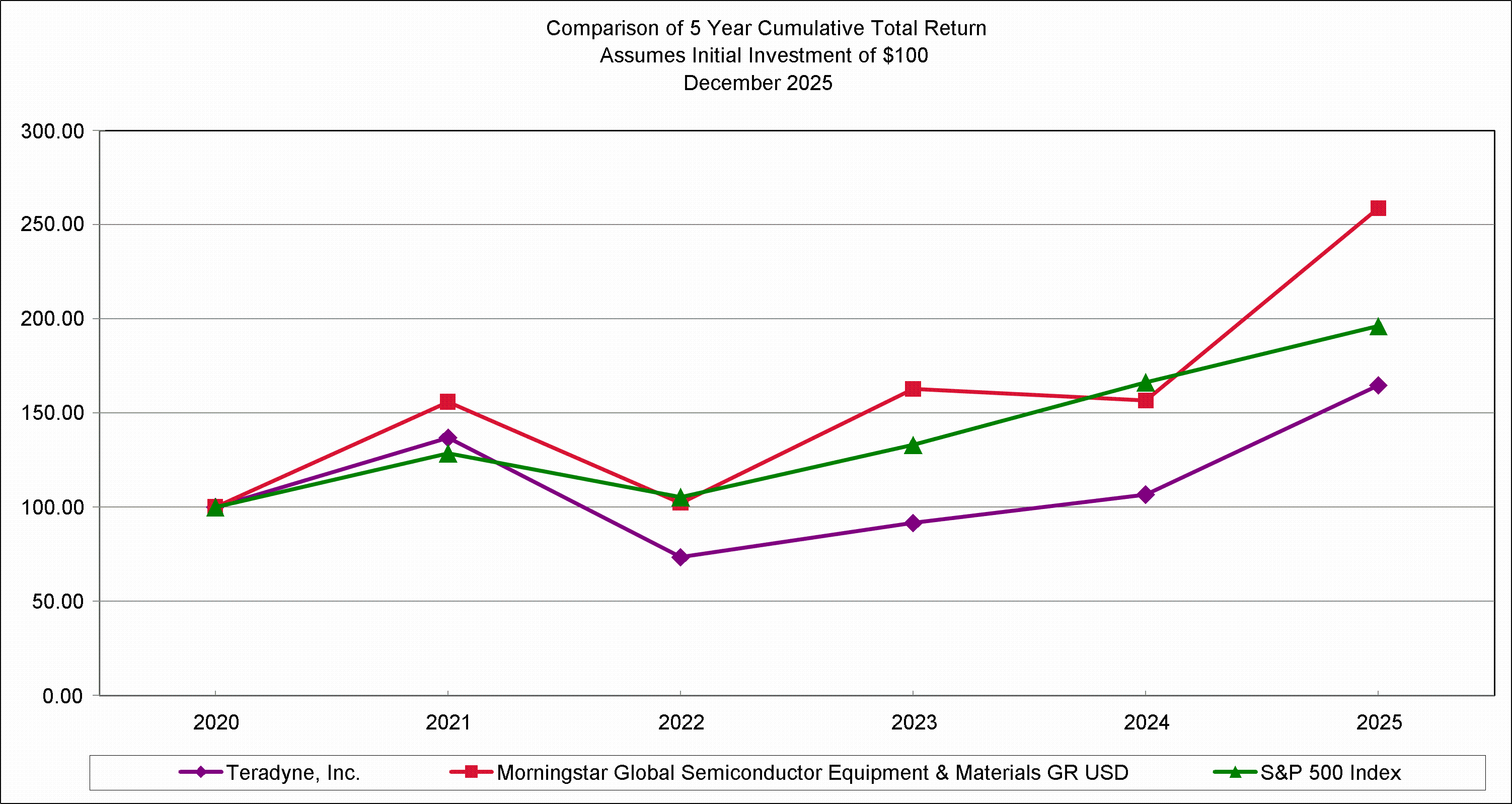
Recently Issued Accounting Pronouncements
For a description of accounting changes and recent accounting pronouncements, including the expected dates of adoption and estimated effects, if any, on our consolidated financial statements, see Note C: “Recently Issued Accounting Pronouncements,” of this Form 10-K.
Item 7A: Quantitative and Qualitative Disclosures about Market Risks
Concentration of Credit Risk
Financial instruments which potentially subject us to concentrations of credit risk consist principally of cash equivalents, marketable securities, forward currency contracts and accounts receivable. Our cash equivalents consist primarily of money market funds invested in U.S. Treasuries and government agencies. Our fixed income available-for-sale marketable securities have a minimum rating of AA by one or more of the major credit rating agencies. We place forward currency contracts with high credit-quality financial institutions in order to minimize credit risk exposure. Concentrations of credit risk with respect to accounts receivable are limited due to the large number of geographically dispersed customers. We perform ongoing credit evaluations of our customers’ financial condition and from time to time may require customers to provide a letter of credit from a bank to secure accounts receivable. As of December 31, 2025, two customers primarily of our Semiconductor Test segment accounted for approximately 22% and 20%, respectively, of our accounts receivable balance. As of December 31, 2024, two customers of our Semiconductor Test segment each accounted for 10% of our accounts receivable balance.
Exchange Rate Risk Management
We regularly enter into foreign currency forward contracts to hedge the value of our monetary assets and liabilities in Japanese Yen, British Pound, Korean Won, Taiwan Dollar, Singapore Dollar, Euro, Philippine Peso, Chinese Yuan, and Danish Krone. These foreign currency forward contracts have maturities of approximately one month. These contracts are used to minimize the effect of exchange rate fluctuations associated with the remeasurement of monetary assets and liabilities.
35
We also enter into foreign currency forward contracts to hedge the impact of exchange rates on our revenues in Japanese Yen. These contracts have maturities of less than one year. We do not engage in currency speculation.
On January 13, 2025, we entered into a forward to buy 23.7 million Euros which expired on February 3, 2025. On November 7, 2023, in connection with our agreement to acquire 10% investment in Technoprobe S.p.A, we purchased a call option to buy 481.0 million Euros, which expired in April 2024. On April 12, 2024, we entered into a forward to buy 481.0 million Euros, which expired on May 23, 2024.
We performed a sensitivity analysis assuming a hypothetical 10% fluctuation in foreign exchange rates to the hedging contracts and the underlying exposures described above. As of December 31, 2025, and 2024, the analysis indicated that these hypothetical market movements would not have a material effect on our consolidated financial position, results of operations or cash flows.
Interest Rate Risk Management
We are exposed to potential losses due to changes in interest rates. Our interest rate exposure is primarily related to short-term and long-term marketable securities.
In order to estimate the potential loss due to interest rate risk, a fluctuation in interest rates of 25 basis points was assumed. Market risk for the short and long-term marketable securities was estimated as the potential change in the fair value resulting from a hypothetical change in interest rates for securities contained in the investment portfolio. The potential change in the fair value from changes in interest rates is immaterial as of December 31, 2025, and 2024.
36
Item 8: Financial Statements and Supplementary Data
Report of Independent Registered Public Accounting Firm
To the Board of Directors and Shareholders of Teradyne, Inc.
Opinions on the Financial Statements and Internal Control over Financial Reporting
We have audited the accompanying consolidated balance sheets of Teradyne, Inc. and its subsidiaries (the “Company”) as of December 31, 2025 and 2024, and the related consolidated statements of operations, of comprehensive income, of convertible common shares and shareholders’ equity and of cash flows for each of the three years in the period ended December 31, 2025, including the related notes and schedule of valuation and qualifying accounts for each of the three years in the period ended December 31, 2025 appearing under Item 15(c) (collectively referred to as the “consolidated financial statements”). We also have audited the Company's internal control over financial reporting as of December 31, 2025, based on criteria established in Internal Control - Integrated Framework (2013) issued by the Committee of Sponsoring Organizations of the Treadway Commission (COSO).
In our opinion, the consolidated financial statements referred to above present fairly, in all material respects, the financial position of the Company as of December 31, 2025 and 2024, and the results of its operations and its cash flows for each of the three years in the period ended December 31, 2025 in conformity with accounting principles generally accepted in the United States of America. Also in our opinion, the Company maintained, in all material respects, effective internal control over financial reporting as of December 31, 2025, based on criteria established in Internal Control - Integrated Framework (2013) issued by the COSO.
Basis for Opinions
The Company's management is responsible for these consolidated financial statements, for maintaining effective internal control over financial reporting, and for its assessment of the effectiveness of internal control over financial reporting, included in Management’s Annual Report on Internal Control over Financial Reporting appearing under Item 9A. Our responsibility is to express opinions on the Company’s consolidated financial statements and on the Company’s internal control over financial reporting based on our audits. We are a public accounting firm registered with the Public Company Accounting Oversight Board (United States) (PCAOB) and are required to be independent with respect to the Company in accordance with the U.S. federal securities laws and the applicable rules and regulations of the Securities and Exchange Commission and the PCAOB.
We conducted our audits in accordance with the standards of the PCAOB. Those standards require that we plan and perform the audits to obtain reasonable assurance about whether the consolidated financial statements are free of material misstatement, whether due to error or fraud, and whether effective internal control over financial reporting was maintained in all material respects.
Our audits of the consolidated financial statements included performing procedures to assess the risks of material misstatement of the consolidated financial statements, whether due to error or fraud, and performing procedures that respond to those risks. Such procedures included examining, on a test basis, evidence regarding the amounts and disclosures in the consolidated financial statements. Our audits also included evaluating the accounting principles used and significant estimates made by management, as well as evaluating the overall presentation of the consolidated financial statements. Our audit of internal control over financial reporting included obtaining an understanding of internal control over financial reporting, assessing the risk that a material weakness exists, and testing and evaluating the design and operating effectiveness of internal control based on the assessed risk. Our audits also included performing such other procedures as we considered necessary in the circumstances. We believe that our audits provide a reasonable basis for our opinions.
Definition and Limitations of Internal Control over Financial Reporting
A company’s internal control over financial reporting is a process designed to provide reasonable assurance regarding the reliability of financial reporting and the preparation of financial statements for external purposes in accordance with generally accepted accounting principles. A company’s internal control over financial reporting includes those policies and procedures that (i) pertain to the maintenance of records that, in reasonable detail, accurately and fairly reflect the transactions and dispositions of the assets of the company; (ii) provide reasonable assurance that transactions are recorded as necessary to permit preparation of financial statements in accordance with generally accepted accounting principles, and that receipts and expenditures of the company are being made only in accordance with authorizations of management and directors of the company; and (iii) provide reasonable assurance regarding prevention or timely detection of unauthorized acquisition, use, or disposition of the company’s assets that could have a material effect on the financial statements.
37
Because of its inherent limitations, internal control over financial reporting may not prevent or detect misstatements. Also, projections of any evaluation of effectiveness to future periods are subject to the risk that controls may become inadequate because of changes in conditions, or that the degree of compliance with the policies or procedures may deteriorate.
Critical Audit Matters
The critical audit matters communicated below are matters arising from the current period audit of the consolidated financial statements that were communicated or required to be communicated to the audit committee and that (i) relate to accounts or disclosures that are material to the consolidated financial statements and (ii) involved our especially challenging, subjective, or complex judgments. The communication of critical audit matters does not alter in any way our opinion on the consolidated financial statements, taken as a whole, and we are not, by communicating the critical audit matters below, providing a separate opinion on the critical audit matters or on the accounts or disclosures to which they relate.
Revenue Recognition - Certain Products Revenue
As described in Note B to the consolidated financial statements, for transactions that do not meet the criteria for over time recognition, the Company recognizes revenue for products at a point in time when shipped or delivered based on contractual terms. The transaction price is the amount of consideration the Company expects to be entitled to in exchange for such products, which is generally at contractually stated prices. The Company’s total products revenue was $2.7 billion for the year ended December 31, 2025, of which a majority relates to certain products revenue.
The principal consideration for our determination that performing procedures relating to revenue recognition for certain products revenue is a critical audit matter is a high degree of auditor effort in performing procedures related to revenue recognition for certain of the Company’s products revenue.
Addressing the matter involved performing procedures and evaluating audit evidence in connection with forming our overall opinion on the consolidated financial statements. These procedures included testing the effectiveness of controls relating to the recognition process for certain products revenue. These procedures also included, among others (i) testing the revenue recognized for a sample of certain products revenue transactions by obtaining and inspecting source documents, such as purchase orders, invoices, and proof of shipment or delivery; (ii) testing the timing of revenue recognized for a sample of certain products revenue transactions that occurred near period end by obtaining and inspecting source documents, such as purchase orders, invoices, and proof of shipment or delivery; and (iii) confirming a sample of outstanding customer invoice balances as of December 31, 2025 and, for confirmations not returned, obtaining and inspecting source documents, such as purchase orders, invoices, proof of shipment or delivery, and subsequent cash receipts.
Annual Goodwill Impairment Assessment – Robotics Reporting Unit
As described in Notes B and N to the consolidated financial statements, the Company’s goodwill balance was $521.0 million as of December 31, 2025, and the goodwill associated with the Robotics reporting unit was $416.4 million. Management assesses goodwill for impairment at least annually in the fourth quarter, as of December 31, on a reporting unit basis, or more frequently when events and circumstances occur indicating that the recorded goodwill may be impaired. As disclosed by management, potential impairment is identified by comparing the fair value of a reporting unit to its carrying value, including goodwill. In performing the quantitative goodwill impairment test, management determines the fair value of a reporting unit using the results derived from an income approach and a market approach, equally weighting the fair value determined under each approach. Under the income approach, determining fair value for the Robotics reporting unit required the use of significant judgment by management and included assumptions relating to projected revenue growth rates, projected earnings before interest, taxes, depreciation, and amortization (“EBITDA”) margins, and discount rates. Under the market approach, management estimated the fair value of the Robotics reporting unit by utilizing the market comparable method which is based on revenue multiples from comparable companies.
The principal considerations for our determination that performing procedures relating to the annual goodwill impairment assessment of the Robotics reporting unit is a critical audit matter are (i) the significant judgment by management when developing the fair value estimate of the Robotics reporting unit; (ii) a high degree of auditor judgment, subjectivity, and effort in performing procedures and evaluating management’s significant assumptions related to projected revenue growth rates, projected EBITDA margins, and the discount rate used in the income approach and revenue multiples from comparable companies used in the market approach; and (iii) the audit effort involved the use of professionals with specialized skill and knowledge.
Addressing the matter involved performing procedures and evaluating audit evidence in connection with forming our overall opinion on the consolidated financial statements. These procedures included testing the effectiveness of controls relating to management’s goodwill impairment assessment, including controls over the valuation of the Robotics reporting unit. These procedures also included, among others (i) testing management’s process for developing the fair value estimate of the Robotics reporting unit; (ii) evaluating the
38
appropriateness of the income and market approaches used by management; (iii) testing the completeness and accuracy of underlying data used in the income and market approaches; and (iv) evaluating the reasonableness of the significant assumptions used by management related to projected revenue growth rates, projected EBITDA margins, and the discount rate used in the income approach and revenue multiples from comparable companies used in the market approach. Evaluating management’s assumptions related to projected revenue growth rates and projected EBITDA margins involved evaluating whether the assumptions used by management were reasonable considering (i) the current and past performance of the Robotics reporting unit; (ii) the consistency with external market and industry data; and (iii) whether the assumptions were consistent with evidence obtained in other areas of the audit. Professionals with specialized skill and knowledge were used to assist in evaluating (i) the appropriateness of the income and market approaches and (ii) the reasonableness of the discount rate and revenue multiples from comparable companies assumptions.
/s/
February 19, 2026
We have served as the Company’s auditor since 1968.
39
TERADYNE, INC.
CONSOLIDATED BALANCE SHEETS
|
|
December 31, |
|
|||||
|
|
2025 |
|
|
2024 |
|
||
|
|
(in thousands, except per share amount) |
|
|||||
ASSETS |
|
|
|
|
|
|
||
Current assets: |
|
|
|
|
|
|
||
Cash and cash equivalents |
|
$ |
|
|
$ |
|
||
Marketable securities |
|
|
|
|
|
|
||
Accounts receivable, less allowance for credit losses of $ |
|
|
|
|
|
|
||
Inventories, net |
|
|
|
|
|
|
||
Prepayments |
|
|
|
|
|
|
||
Other current assets |
|
|
|
|
|
|
||
Total current assets |
|
|
|
|
|
|
||
Property, plant and equipment, net |
|
|
|
|
|
|
||
Operating lease right-of-use assets, net |
|
|
|
|
|
|
||
Marketable securities |
|
|
|
|
|
|
||
Deferred tax assets |
|
|
|
|
|
|
||
Retirement plans assets |
|
|
|
|
|
|
||
Equity method investment |
|
|
|
|
|
|
||
Other assets |
|
|
|
|
|
|
||
Acquired intangible assets, net |
|
|
|
|
|
|
||
Goodwill |
|
|
|
|
|
|
||
Total assets |
|
$ |
|
|
$ |
|
||
LIABILITIES |
|
|
|
|
|
|
||
Current liabilities: |
|
|
|
|
|
|
||
Accounts payable |
|
$ |
|
|
$ |
|
||
Accrued employees’ compensation and withholdings |
|
|
|
|
|
|
||
Deferred revenue and customer advances |
|
|
|
|
|
|
||
Other accrued liabilities |
|
|
|
|
|
|
||
Operating lease liabilities |
|
|
|
|
|
|
||
Short-term debt |
|
|
|
|
|
— |
|
|
Income taxes payable |
|
|
|
|
|
|
||
Total current liabilities |
|
|
|
|
|
|
||
Retirement plans liabilities |
|
|
|
|
|
|
||
Long-term deferred revenue and customer advances |
|
|
|
|
|
|
||
Deferred tax liabilities |
|
|
|
|
|
|
||
Long-term other accrued liabilities |
|
|
|
|
|
|
||
Long-term operating lease liabilities |
|
|
|
|
|
|
||
Long-term income taxes payable |
|
|
|
|
|
|
||
Total liabilities |
|
|
|
|
|
|
||
|
|
|
|
|
|
|||
SHAREHOLDERS’ EQUITY |
|
|
|
|
|
|
||
Common stock, $ |
|
|
|
|
|
|
||
Additional paid-in capital |
|
|
|
|
|
|
||
Accumulated other comprehensive loss |
|
|
|
|
|
( |
) |
|
Retained earnings |
|
|
|
|
|
|
||
Total shareholders’ equity |
|
|
|
|
|
|
||
Total liabilities and shareholders’ equity |
|
$ |
|
|
$ |
|
||
The accompanying notes are an integral part of the consolidated financial statements.
40
TERADYNE, INC.
CONSOLIDATED STATEMENTS OF OPERATIONS
|
|
Years Ended December 31, |
|
|||||||||
|
|
2025 |
|
|
2024 |
|
|
2023 |
|
|||
|
|
(in thousands, except per share amount) |
|
|||||||||
Revenues: |
|
|
|
|
|
|
|
|
|
|||
Products |
|
$ |
|
|
$ |
|
|
$ |
|
|||
Services |
|
|
|
|
|
|
|
|
|
|||
Total revenues |
|
|
|
|
|
|
|
|
|
|||
Cost of revenues: |
|
|
|
|
|
|
|
|
|
|||
Cost of products |
|
|
|
|
|
|
|
|
|
|||
Cost of services |
|
|
|
|
|
|
|
|
|
|||
Total cost of revenues (exclusive of acquired intangible |
|
|
|
|
|
|
|
|
|
|||
Gross profit |
|
|
|
|
|
|
|
|
|
|||
Operating expenses: |
|
|
|
|
|
|
|
|
|
|||
Selling and administrative |
|
|
|
|
|
|
|
|
|
|||
Engineering and development |
|
|
|
|
|
|
|
|
|
|||
Acquired intangible assets amortization |
|
|
|
|
|
|
|
|
|
|||
Restructuring and other |
|
|
|
|
|
|
|
|
|
|||
Gain on sale of business |
|
|
|
|
|
( |
) |
|
|
|
||
Total operating expenses |
|
|
|
|
|
|
|
|
|
|||
Income from operations |
|
|
|
|
|
|
|
|
|
|||
Non-operating (income) expenses: |
|
|
|
|
|
|
|
|
|
|||
Interest income |
|
|
( |
) |
|
|
( |
) |
|
|
( |
) |
Interest expense |
|
|
|
|
|
|
|
|
|
|||
Other (income) expense, net |
|
|
|
|
|
|
|
|
( |
) |
||
Income before income taxes and equity in net earnings of affiliate |
|
|
|
|
|
|
|
|
|
|||
Income tax provision |
|
|
|
|
|
|
|
|
|
|||
Income before equity in net earnings of affiliate |
|
|
|
|
|
|
|
|
|
|||
Equity in net earnings of affiliate |
|
|
( |
) |
|
|
( |
) |
|
|
|
|
Net income |
|
$ |
|
|
$ |
|
|
$ |
|
|||
Net income per common share: |
|
|
|
|
|
|
|
|
|
|||
Basic |
|
$ |
|
|
$ |
|
|
$ |
|
|||
Diluted |
|
$ |
|
|
$ |
|
|
$ |
|
|||
Weighted average common shares—basic |
|
|
|
|
|
|
|
|
|
|||
Weighted average common shares—diluted |
|
|
|
|
|
|
|
|
|
|||
The accompanying notes are an integral part of the consolidated financial statements.
41
TERADYNE, INC.
CONSOLIDATED STATEMENTS OF COMPREHENSIVE INCOME
|
|
Years Ended December 31, |
|
|||||||||
|
|
2025 |
|
|
2024 |
|
|
2023 |
|
|||
|
|
(in thousands) |
|
|||||||||
Net income |
|
$ |
|
|
$ |
|
|
$ |
|
|||
Other comprehensive income (loss), net of tax: |
|
|
|
|
|
|
|
|
|
|||
Foreign currency translation adjustment, net of tax of $ |
|
|
|
|
|
( |
) |
|
|
|
||
Available-for-sale marketable securities: |
|
|
|
|
|
|
|
|
|
|||
Unrealized (losses) gains on marketable securities arising during |
|
|
|
|
|
( |
) |
|
|
|
||
Less: Reclassification adjustment for (gains) losses included in net income, |
|
|
|
|
|
|
|
|
|
|||
|
|
|
|
|
|
( |
) |
|
|
|
||
Cash flow hedges: |
|
|
|
|
|
|
|
|
|
|||
Unrealized (losses) gains arising during period, net of tax of $( |
|
|
( |
) |
|
|
|
|
|
|
||
Less: Reclassification adjustment for losses (gains) included in |
|
|
( |
) |
|
|
( |
) |
|
|
( |
) |
|
|
|
( |
) |
|
|
|
|
|
|
||
Defined benefit post-retirement plan: |
|
|
|
|
|
|
|
|
|
|||
Amortization of prior service credit, net of tax of $( |
|
|
( |
) |
|
|
( |
) |
|
|
( |
) |
Other comprehensive income (loss) |
|
|
|
|
|
( |
) |
|
|
|
||
Comprehensive income |
|
$ |
|
|
$ |
|
|
$ |
|
|||
The accompanying notes are an integral part of the consolidated financial statements.
42
TERADYNE, INC.
CONSOLIDATED STATEMENTS OF CONVERTIBLE COMMON SHARES AND SHAREHOLDERS' EQUITY
|
|
Shareholders’ Equity |
|
|||||||||||||||||||||
|
|
Common |
|
|
Common |
|
|
Additional |
|
|
Accumulated |
|
|
Retained |
|
|
Total |
|
||||||
|
|
|
||||||||||||||||||||||
Year Ended December 31, 2022 |
|
|
|
|
$ |
|
|
$ |
|
|
$ |
( |
) |
|
$ |
|
|
|
|
|||||
Net issuance of common stock under stock-based plans |
|
|
|
|
|
|
|
|
|
|
|
|
|
|
|
|
|
|
||||||
Stock-based compensation expense |
|
|
|
|
|
|
|
|
|
|
|
|
|
|
|
|
|
|
||||||
Repurchase of common stock |
|
|
( |
) |
|
|
( |
) |
|
|
|
|
|
|
|
|
( |
) |
|
|
( |
) |
||
Cash dividends ($ |
|
|
|
|
|
|
|
|
|
|
|
|
|
|
( |
) |
|
|
( |
) |
||||
Settlements of convertible notes |
|
|
|
|
|
|
|
|
( |
) |
|
|
|
|
|
|
|
|
|
|||||
Exercise of convertible notes hedge call options |
|
|
( |
) |
|
|
( |
) |
|
|
|
|
|
|
|
|
|
|
|
|
||||
Net income |
|
|
|
|
|
|
|
|
|
|
|
|
|
|
|
|
|
|
||||||
Other comprehensive income (loss) |
|
|
|
|
|
|
|
|
|
|
|
|
|
|
|
|
|
|
||||||
Year Ended December 31, 2023 |
|
|
|
|
$ |
|
|
$ |
|
|
$ |
( |
) |
|
$ |
|
|
$ |
|
|||||
Net issuance of common stock under stock-based plans |
|
|
|
|
|
|
|
|
|
|
|
|
|
|
|
|
|
|
||||||
Stock-based compensation expense |
|
|
|
|
|
|
|
|
|
|
|
|
|
|
|
|
|
|
||||||
Warrant exercises |
|
|
|
|
|
|
|
|
( |
) |
|
|
|
|
|
|
|
|
( |
) |
||||
Repurchase of common stock |
|
|
( |
) |
|
|
( |
) |
|
|
|
|
|
|
|
|
( |
) |
|
|
( |
) |
||
Cash dividends ($ |
|
|
|
|
|
|
|
|
|
|
|
|
|
|
( |
) |
|
|
( |
) |
||||
Net income |
|
|
|
|
|
|
|
|
|
|
|
|
|
|
|
|
|
|
||||||
Other comprehensive income (loss) |
|
|
|
|
|
|
|
|
|
|
|
( |
) |
|
|
|
|
|
( |
) |
||||
Year Ended December 31, 2024 |
|
|
|
|
$ |
|
|
$ |
|
|
$ |
( |
) |
|
$ |
|
|
$ |
|
|||||
Net issuance of common stock under stock-based plans |
|
|
|
|
|
|
|
|
|
|
|
|
|
|
|
|
|
|
||||||
Stock-based compensation expense |
|
|
|
|
|
|
|
|
|
|
|
|
|
|
|
|
|
|
||||||
Repurchase of common stock |
|
|
( |
) |
|
|
( |
) |
|
|
|
|
|
|
|
|
( |
) |
|
|
( |
) |
||
Cash dividends ($ |
|
|
|
|
|
|
|
|
|
|
|
|
|
|
( |
) |
|
|
( |
) |
||||
Net income |
|
|
|
|
|
|
|
|
|
|
|
|
|
|
|
|
|
|
||||||
Other comprehensive income (loss) |
|
|
|
|
|
|
|
|
|
|
|
|
|
|
|
|
|
|
||||||
Year Ended December 31, 2025 |
|
|
|
|
$ |
|
|
$ |
|
|
$ |
|
|
$ |
|
|
$ |
|
||||||
The accompanying notes are an integral part of the consolidated financial statements.
43
TERADYNE, INC.
CONSOLIDATED STATEMENTS OF CASH FLOWS
|
|
Years Ended December 31, |
|
|||||||||
|
|
2025 |
|
|
2024 |
|
|
2023 |
|
|||
|
|
(in thousands) |
|
|||||||||
Cash flows from operating activities: |
|
|
|
|
|
|
|
|
|
|||
Net income |
|
$ |
|
|
$ |
|
|
$ |
|
|||
Adjustments to reconcile net income from operations to net cash provided by operating activities: |
|
|
|
|
|
|
|
|
|
|||
Depreciation |
|
|
|
|
|
|
|
|
|
|||
Stock-based compensation |
|
|
|
|
|
|
|
|
|
|||
Equity in net earnings of affiliate |
|
|
|
|
|
|
|
|
|
|||
Losses (gains) on investments |
|
|
( |
) |
|
|
|
|
|
( |
) |
|
Provision for excess and obsolete inventory |
|
|
|
|
|
|
|
|
|
|||
Amortization |
|
|
|
|
|
|
|
|
|
|||
Loss (gain) on sale of business |
|
|
|
|
|
( |
) |
|
|
|
||
Deferred taxes |
|
|
( |
) |
|
|
( |
) |
|
|
( |
) |
Retirement plan actuarial losses (gains) |
|
|
|
|
|
( |
) |
|
|
|
||
Other |
|
|
|
|
|
( |
) |
|
|
( |
) |
|
Changes in operating assets and liabilities, net of businesses acquired: |
|
|
|
|
|
|
|
|
|
|||
Accounts receivable |
|
|
( |
) |
|
|
( |
) |
|
|
|
|
Inventories |
|
|
( |
) |
|
|
|
|
|
|
||
Prepayments and other assets |
|
|
( |
) |
|
|
|
|
|
( |
) |
|
Accounts payable and other liabilities |
|
|
|
|
|
( |
) |
|
|
|
||
Deferred revenue and customer advances |
|
|
|
|
|
|
|
|
( |
) |
||
Retirement plans contributions |
|
|
( |
) |
|
|
( |
) |
|
|
( |
) |
Income taxes |
|
|
|
|
|
( |
) |
|
|
( |
) |
|
Net cash provided by operating activities |
|
|
|
|
|
|
|
|
|
|||
Cash flows from investing activities: |
|
|
|
|
|
|
|
|
|
|||
Purchases of property, plant and equipment |
|
|
( |
) |
|
|
( |
) |
|
|
( |
) |
Acquisition of businesses, net of cash and cash equivalents acquired |
|
|
( |
) |
|
|
|
|
|
|
||
Purchase of investment in a business |
|
|
( |
) |
|
|
( |
) |
|
|
|
|
Purchases of marketable securities |
|
|
( |
) |
|
|
( |
) |
|
|
( |
) |
Issuance of convertible loan |
|
|
|
|
|
|
|
|
( |
) |
||
Proceeds from the sale of a business, net of cash and cash equivalents sold |
|
|
|
|
|
|
|
|
|
|||
Proceeds from maturities of marketable securities |
|
|
|
|
|
|
|
|
|
|||
Proceeds from sales of marketable securities |
|
|
|
|
|
|
|
|
|
|||
Proceeds from insurance |
|
|
|
|
|
|
|
|
|
|||
Net cash used for investing activities |
|
|
( |
) |
|
|
( |
) |
|
|
( |
) |
Cash flows from financing activities: |
|
|
|
|
|
|
|
|
|
|||
Proceeds from borrowings on revolving credit facility |
|
|
|
|
|
|
|
|
|
|||
Repayments of borrowings on revolving credit facility |
|
|
( |
) |
|
|
( |
) |
|
|
|
|
Dividend payments |
|
|
( |
) |
|
|
( |
) |
|
|
( |
) |
Repurchase of common stock |
|
|
( |
) |
|
|
( |
) |
|
|
( |
) |
Payments related to net settlement of employee stock compensation awards |
|
|
( |
) |
|
|
( |
) |
|
|
( |
) |
Payments of convertible debt principal |
|
|
|
|
|
|
|
|
( |
) |
||
Issuance of common stock under stock purchase and stock option plans |
|
|
|
|
|
|
|
|
|
|||
Net cash used for financing activities |
|
|
( |
) |
|
|
( |
) |
|
|
( |
) |
Effects of exchange rate changes on cash and cash equivalents |
|
|
( |
) |
|
|
( |
) |
|
|
( |
) |
Decrease increase in cash and cash equivalents |
|
|
( |
) |
|
|
( |
) |
|
|
( |
) |
Cash and cash equivalents at beginning of year |
|
|
|
|
|
|
|
|
|
|||
Cash and cash equivalents at end of year |
|
$ |
|
|
$ |
|
|
$ |
|
|||
Supplementary disclosure of cash flow information: |
|
|
|
|
|
|
|
|
|
|||
Cash paid for: |
|
|
|
|
|
|
|
|
|
|||
Interest |
|
$ |
|
|
$ |
|
|
$ |
|
|||
Non-cash investing activities: |
|
|
|
|
|
|
|
|
|
|||
Capital expenditures incurred but not yet paid: |
|
$ |
|
|
$ |
|
|
$ |
|
|||
The accompanying notes are an integral part of the consolidated financial statements.
44
TERADYNE, INC.
NOTES TO CONSOLIDATED FINANCIAL STATEMENTS
A. THE COMPANY
Teradyne, Inc. (“Teradyne”) is a leading global provider of automated test equipment and robotics solutions. Teradyne’s automated test systems are used to test semiconductors, wireless products, data storage, silicon photonics, and complex electronics systems in many industries including consumer electronics, wireless, automotive, industrial, computing, communications, and aerospace and defense industries. Teradyne’s robotics product offerings consist primarily of collaborative robotic arms and autonomous mobile robots used by global manufacturing, logistics and industrial customers to improve quality and increase manufacturing and material handling efficiency while reducing costs. In the first quarter of 2025, Teradyne identified opportunities for operational synergies amongst our production board test, defense and aerospace, and wireless test businesses leading to the creation of the Product Test division as a new segment effective March 2025. Teradyne’s automated test equipment and robotics products and services include:
B. ACCOUNTING POLICIES
The consolidated financial statements include the accounts of Teradyne and its wholly owned subsidiaries. All significant intercompany balances and transactions are eliminated. Certain prior years’ amounts were reclassified to conform to the current year presentation.
Preparation of Financial Statements and Use of Estimates
The preparation of consolidated financial statements requires management to make estimates and judgments that affect the reported amounts of assets, liabilities, revenues and expenses, and related disclosure of contingent liabilities. On an on-going basis, management evaluates its estimates, including those related to revenue, inventories, investments, goodwill, intangible and other long-lived assets, accounts receivable, income taxes, deferred tax assets and liabilities, pensions, warranties, and loss contingencies. Management bases its estimates on historical experience and on appropriate and customary assumptions that are believed to be reasonable under the circumstances, the results of which form the basis for making judgments about the carrying values of assets and liabilities that are not readily apparent from other sources. Management is not aware of any specific event or circumstance that would require an update to its estimates or judgments or a revision of the carrying value of its assets or liabilities as of the date of issuance of this Annual Report on Form 10-K. These estimates may change, as new events occur and additional information is obtained. Actual results may differ significantly from these estimates under different assumptions or conditions.
Revenue Recognition
Revenue from Contracts with Customers
In accordance with Accounting Standards Codification (“ASC”) 606, Teradyne recognizes revenues, when or as control is transferred to a customer. Teradyne’s determination of revenue is dependent upon a five-step process outlined below.
45
Performance Obligations
Products
Teradyne products consist primarily of test systems and instruments and robotics products. Teradyne’s hardware is typically recognized at a point in time upon transfer of control to the customer.
Services
Teradyne services consist of extended warranties, training and application support, service agreements, post contract customer support (“PCS”) and replacement parts. Each service is recognized based on relative standalone selling price. Extended warranty, training and support, service agreements and PCS are recognized over time based on the period of service. Replacement parts are recognized at a point in time upon transfer of control to the customer.
Teradyne does not allow customer returns or provide refunds to customers for any products or services. Teradyne products include a standard
As of December 31, 2025, and 2024, deferred revenue and customer advances consisted of the following and are included in the short and long-term deferred revenue and customer advances:
|
|
2025 |
|
|
2024 |
|
||
|
|
(in thousands) |
|
|||||
Maintenance, service and training |
|
$ |
|
|
$ |
|
||
Customer advances, undelivered elements and other |
|
|
|
|
|
|
||
Extended warranty |
|
|
|
|
|
|
||
Total deferred revenue and customer advances |
|
$ |
|
|
$ |
|
||
46
Product Warranty
Teradyne generally provides a one-year warranty on its products, commencing upon installation, acceptance or shipment. A provision is recorded upon revenue recognition to cost of revenues for estimated warranty expense based on historical experience. Related costs are charged to the warranty accrual as incurred. The balance below is included in other accrued liabilities:
|
|
Amount |
|
|
|
|
(in thousands) |
|
|
Balance at December 31, 2022 |
|
$ |
|
|
Accruals for warranties issued during the period |
|
|
|
|
Accruals related to pre-existing warranties |
|
|
( |
) |
Settlements made during the period |
|
|
( |
) |
Balance at December 31, 2023 |
|
|
|
|
Accruals for warranties issued during the period |
|
|
|
|
Accruals related to pre-existing warranties |
|
|
( |
) |
Settlements made during the period |
|
|
( |
) |
Balance at December 31, 2024 |
|
|
|
|
Accruals for warranties issued during the period |
|
|
|
|
Accruals related to pre-existing warranties |
|
|
( |
) |
Settlements made during the period |
|
|
( |
) |
Balance at December 31, 2025 |
|
$ |
|
|
When Teradyne receives revenue for extended warranties, beyond one year, it is deferred and recognized on a straight-line basis over the contract period. Related costs are expensed as incurred. The balance below is included in short and long-term deferred revenue and customer advances:
|
|
Amount |
|
|
|
|
(in thousands) |
|
|
Balance at December 31, 2022 |
|
$ |
|
|
Deferral of new extended warranty revenue |
|
|
|
|
Recognition of extended warranty deferred revenue |
|
|
( |
) |
Balance at December 31, 2023 |
|
|
|
|
Deferral of new extended warranty revenue |
|
|
|
|
Recognition of extended warranty deferred revenue |
|
|
( |
) |
Balance at December 31, 2024 |
|
|
|
|
Deferral of new extended warranty revenue |
|
|
|
|
Recognition of extended warranty deferred revenue |
|
|
( |
) |
Balance at December 31, 2025 |
|
$ |
|
|
Accounts Receivable and Allowance for Credit Losses
Trade accounts receivable are recorded at the invoiced amount and do not bear interest. Teradyne maintains allowances for estimated losses resulting from the inability of its customers to make required payments. Estimated allowances for credit losses are reviewed periodically taking into account the customer’s recent payment history, the customer’s current financial statements and other information regarding the customer’s creditworthiness. Account balances are written off against the allowance when it is determined the receivable will not be recovered.
Teradyne sells certain trade accounts receivables on a non-recourse basis to third-party financial institutions pursuant to factoring agreements. Teradyne accounts for these transactions as sales of receivables and presents cash proceeds as a cash provided by operating activities in the consolidated statements of cash flows. Total trade accounts receivable sold under the factoring agreements were $
Equity Method Investments
Teradyne accounts for investments using the equity method of accounting when it has significant influence over the financial and operating policies, but not control, of the investee. The equity method investments are initially recorded at cost and included in
47
‘Equity method investment’ in the consolidated balance sheet. Teradyne records its share of investee's net income or loss and other comprehensive income, and the amortization of equity method basis difference, calculated as the difference between the investment and the amount of underlying equity in net assets acquired, on a 3-month lag, which is applied consistently from period to period. Teradyne's share of investee's net income and the amortization of equity method basis difference are reported in ‘Equity in net earnings of affiliate’ in the consolidated statement of operations. Teradyne includes its share of investee's other comprehensive income and a cumulative translation adjustment in the consolidated statements of comprehensive income. Teradyne monitors on an ongoing basis its equity method investments for indicators of other-than-temporary declines in fair value below carrying value.
Inventories
Inventories are stated at the lower of cost (first-in, first-out basis) or net realizable value. On a quarterly basis, Teradyne uses consistent methodologies to evaluate all inventories for net realizable value. Teradyne records a provision for both excess and obsolete inventory when such write-downs or write-offs are identified through the quarterly review process. The inventory valuation is based upon assumptions about future demand, product mix and possible alternative uses.
Investments
Teradyne accounts for its investments in debt and equity securities in accordance with the provisions of ASC 320-10, “Investments—Debt and Equity Securities.” ASC 320-10 requires that certain debt and equity securities be classified into one of three categories; trading, available-for-sale or held-to-maturity securities. On a quarterly basis, Teradyne reviews its investments to identify and evaluate those that have an indication of a potential other-than-temporary impairment. Factors considered in determining whether a loss is other-than-temporary include:
Teradyne uses the market and income approach techniques to value its financial instruments and there were no changes in valuation techniques during the twelve months ended December 31, 2025, and 2024.
Teradyne measures its debt and equity investments at fair value, in accordance with ASC 820-10, “Fair Value Measurements and Disclosures.” ASC 820-10 defines fair value as the price that would be received from the sale of an asset or paid to transfer a liability in an orderly transaction between market participants and requires that assets and liabilities carried at fair value be classified and disclosed in one of the following three categories:
Level 1: Quoted prices in active markets for identical assets as of the reporting date;
Level 2: Inputs other than Level 1, that are observable either directly or indirectly as of the reporting date. For example, a common approach for valuing fixed income securities is the use of matrix pricing. Matrix pricing is a mathematical technique used to value securities by relying on the securities’ relationship to other benchmark quoted prices, and is considered a Level 2 input; or
Level 3: Unobservable inputs that are not supported by market data. Unobservable inputs are developed based on the best information available, which might include Teradyne’s own data.
Teradyne’s debt investments are classified as Level 2, and equity investments are classified as Level 1.
Financial Assets and Financial Liabilities
Teradyne records changes in fair value of equity securities directly in earnings and unrealized gains and losses in other (income) expense, net, in accordance with ASU 2016-01, “Financial Instruments—Overall (Subtopic 825-10): Recognition and Measurement of Financial Assets and Financial Liabilities.”
48
Prepayments
Prepayments consist of the following:
|
|
2025 |
|
|
2024 |
|
||
|
|
(in thousands) |
|
|||||
Contract manufacturer and supplier prepayments |
|
$ |
|
|
$ |
|
||
Prepaid maintenance and other services |
|
|
|
|
|
|
||
Prepaid taxes |
|
|
|
|
|
|
||
Other prepayments |
|
|
|
|
|
|
||
Total prepayments |
|
$ |
|
|
$ |
|
||
Retirement and Postretirement Plans
Teradyne recognizes net actuarial gains and losses and the change in the fair value of the plan assets in its operating results in the year in which they occur or upon any interim remeasurement of the plans. Teradyne calculates the expected return on plan assets using the fair value of the plan assets. Actuarial gains and losses are generally measured annually as of December 31 and, accordingly, recorded during the fourth quarter of each year or upon any interim remeasurement of the plans.
Teradyne reports net periodic pension cost and net periodic postretirement benefit costs in accordance with ASU 2017-07, “Compensation—Retirement Benefits (Topic 715): Improving the Presentation of Net Periodic Pension Cost and Net Periodic Postretirement Benefit Cost.” The service cost component of net benefit costs is reported in the same line item in the consolidated statement of operations as other employee compensation costs. The non-service components of net benefit costs such as interest cost, expected return on assets, amortization of prior service cost, and actuarial gains or losses, are reported within other (income) expense, net.
Goodwill, Intangible and Long-Lived Assets
Teradyne accounts for goodwill and intangible assets in accordance with ASC 350-10, “Intangibles-Goodwill and Other.” Intangible assets are amortized over their estimated useful economic life and are carried at cost less accumulated amortization. Goodwill is assessed for impairment at least annually in the fourth quarter, as of December 31, on a reporting unit basis, or more frequently when events and circumstances occur indicating that the recorded goodwill may be impaired.
In accordance with ASC 350-10, Teradyne has the option to perform a qualitative assessment to determine whether it is more likely than not that the fair value of a reporting unit is less than its carrying amount. If Teradyne determines this is the case, Teradyne is required to perform a quantitative goodwill impairment test to identify potential goodwill impairment and measure the amount of goodwill impairment loss to be recognized. If Teradyne determines that it is more likely than not that the fair value of the reporting unit is greater than its carrying amounts, a quantitative goodwill impairment test is not required.
In accordance with ASC 360-10, “Impairment or Disposal of Long-Lived Assets,” Teradyne reviews long-lived assets for impairment whenever events or changes in business circumstances indicate that the carrying amount of the assets may not be fully recoverable or that the useful lives of these assets are no longer appropriate. Each impairment test is based on a comparison of the estimated undiscounted cash flows to the recorded value of the asset. If impairment is indicated, the asset is written down to its estimated fair value based on a discounted cash flows analysis. The cash flows estimates used to determine the impairment, if any, contain management’s best estimates using appropriate assumptions and projections at that time.
Business Combinations
Teradyne recognizes the tangible and intangible assets acquired and liabilities assumed based on their estimated fair values at the date of acquisition. The fair value of identifiable intangible assets is based on detailed cash flows valuations that use information and assumptions provided by management. Teradyne uses all pertinent information known at the time of acquisition to estimate the fair value of contingent consideration at the time of the acquisition using all pertinent information known to us at the time to assess the probability of payment of contingent amounts or through the use of a Monte Carlo simulation model. Teradyne allocates any excess purchase price over the fair value of the net tangible and intangible assets acquired and liabilities assumed to goodwill. The assumptions used in the valuations for our acquisitions may differ materially from actual results depending on performance of the acquired businesses and other factors. While Teradyne believes the assumptions used were appropriate, different assumptions in the valuation of assets acquired and liabilities assumed could have a material impact on the timing and extent of impact on our statements of operations. Goodwill is assigned to reporting units as of the date of the related acquisition.
49
Property, Plant and Equipment
Property, plant and equipment are stated at cost and depreciated over the estimated useful lives of the assets. Leasehold improvements and major renewals are capitalized and included in property, plant and equipment accounts, while expenditures for maintenance and repairs and minor renewals are charged to expense. When assets are retired, the assets and related accumulated depreciation are removed from the accounts and any resulting gain or loss is reflected in the consolidated statements of operations.
Teradyne provides for depreciation of its assets principally on the straight-line method with the cost of the assets being charged to expense over their useful lives as follows:
Buildings |
|
|
Building improvements |
|
|
Leasehold improvements |
|
Lesser of lease term or |
Furniture and fixtures |
|
|
Test systems manufactured internally |
|
|
Machinery, equipment and software |
|
Test systems manufactured internally are used by Teradyne for customer evaluations and manufacturing and support of its customers. Teradyne depreciates the test systems manufactured internally over a
Debt
Under ASC 470 Debt, Teradyne records all borrowings as short-term or long-term debt in the condensed consolidated balance sheet in accordance with Teradyne's ability and intent to repay the debt, as well as the contractual due date. When amounts are drawn on the revolver, interest is accrued and recognized within other accrued liabilities in the condensed consolidated balance sheet and expensed within Other (income) expense, net within the condensed consolidated statement of operations.
Teradyne accounts for a convertible debt instrument as a single liability measured at its amortized cost, as long as no other features require bifurcation and recognition as derivatives. Unsettled shares are recorded in current debt, and there is no recognition of a debt discount, which was previously amortized to interest expense. Settled shares reduce the outstanding debt balance in an amount equal to the cash paid, but do not result in any gain or loss on extinguishment. Teradyne uses the if-converted method in the diluted EPS calculation for convertible instruments.
Leases
Under ASC 842, a contract is or contains a lease when Teradyne has the right to control the use of an identified asset. Teradyne determines if an arrangement is a lease at inception of the contract, which is the date on which the terms of the contract are agreed to and the agreement creates enforceable rights and obligations. The commencement date of the lease is the date that the lessor makes an underlying asset available for use by Teradyne. As of December 31, 2025, Teradyne does not have material leases that have not yet commenced.
Teradyne determines if the lease is an operating or finance lease at the lease commencement date based upon the terms of the lease and the nature of the asset. The lease term used to calculate the lease liability includes options to extend or terminate the lease when it is reasonably certain that the option will be exercised.
The lease liability is measured at the present value of future lease payments, discounted using the discount rate for the lease at the commencement date. As Teradyne is typically unable to determine the implicit rate, Teradyne uses an incremental borrowing rate based on the lease term and economic environment at commencement date. Teradyne initially measures payments based on an index by using the applicable rate at lease commencement. Variable payments that do not depend on an index are not included in the lease liability and are recognized as they are incurred. The right-of-use (“ROU”) asset is initially measured as the amount of lease liability, adjusted for any initial lease costs, prepaid lease payments, and reduced by any lease incentives.
50
Teradyne’s contracts often include non-lease components such as common area maintenance. Teradyne elected the practical expedient to account for the lease and non-lease components as a single lease component. For leases with a term of one year or less, Teradyne has elected not to record the lease asset or liability. Rent is recognized in the consolidated statement of earnings on a straight-line basis over the lease term. Teradyne includes lease costs within cost of revenues and operating expenses. See Note K: “Leases”.
Engineering and Development Costs
Teradyne’s products are highly technical and require a large and continuing engineering and development effort. Software development costs incurred prior to the establishment of technological feasibility are charged to expense. Software development costs incurred subsequent to the establishment of technological feasibility are capitalized until the product is available for release to customers. To date, the period between achieving technological feasibility and general availability of the product has been short and software development costs eligible for capitalization have not been material. Engineering and development costs are expensed as incurred and consist primarily of salaries, contractor fees including non-recurring engineering charges related to product design, allocated facility costs, depreciation, and tooling costs.
Stock Compensation Plans and Employee Stock Purchase Plan
Stock-based compensation expense is based on the grant-date fair value estimated in accordance with the provisions of ASC 718-10, “Compensation-Stock Compensation.” Teradyne elects to account for forfeitures by applying an estimated forfeiture rate and recognizes compensation costs only for those stock-based compensation awards expected to vest. Under its stock compensation plans, Teradyne has granted stock options, restricted stock units and performance-based restricted stock units, and employees are eligible to purchase Teradyne’s common stock through its Employee Stock Purchase Plan (“ESPP”).
Excess tax benefits or tax deficiencies are recognized as a discrete tax benefit or discrete tax expense to the current income tax provision in Teradyne’s consolidated statements of operations, all excess tax benefits related to share-based payments are reported as cash flows from operating activities, and all cash payments made to taxing authorities on the employees’ behalf for withheld shares are presented as financing activities on the statement of cash flows.
Income Taxes
Deferred tax assets and liabilities are determined based on differences between financial reporting and tax basis of assets and liabilities and are measured using the enacted tax rates and laws that will be in effect when the differences are expected to reverse. The measurement of deferred tax assets is reduced by a valuation allowance if it is more likely than not that some or all of the deferred tax assets will not be realized. Teradyne performed the required assessment of positive and negative evidence regarding the realization of the net deferred tax assets in accordance with ASC 740, “Accounting for Income Taxes.” This assessment included the evaluation of scheduled reversals of deferred tax liabilities, estimates of projected future taxable income and tax-planning strategies. Although realization is not assured, based on its assessment, Teradyne concluded that it is more likely than not that such assets, net of the existing valuation allowance, will be realized.
Advertising Costs
Teradyne expenses all advertising costs as incurred. Advertising costs were $
Translation of Non-U.S. Currencies
The functional currency for all non-U.S. subsidiaries is the U.S. dollar, except for Robotics for which the local currency is its functional currency. All foreign currency denominated monetary assets and liabilities are remeasured on a monthly basis into the functional currency using exchange rates in effect at the end of the period. All foreign currency denominated non-monetary assets and liabilities are remeasured into the functional currency using historical exchange rates. Net foreign exchange gains and losses resulting from remeasurement are included in other (income) expense, net. For Robotics, assets and liabilities are translated into U.S. dollars using exchange rates in effect at the end of the period. Revenues and expense amounts are translated using an average of exchange rates in effect during the period. Translation adjustments are recorded within accumulated other comprehensive income (loss) on the balance sheet.
Net foreign exchange gains and losses resulting from remeasurement are included in other (income) expense, net. For the years ended December 31, 2025, 2024 and 2023, losses (gains) from the remeasurement of the monetary assets and liabilities denominated in foreign currencies were $
51
These amounts do not reflect the corresponding (gains) losses from foreign exchange contracts. See Note J: “Financial Instruments” regarding foreign exchange contracts.
Net Income per Common Share
Basic net income per common share is calculated by dividing net income by the weighted average number of common shares outstanding during the period. Except where the result would be anti-dilutive, diluted net income per common share is calculated by dividing net income by the sum of the weighted average number of common shares plus common stock equivalents, if applicable.
Comprehensive Income
Comprehensive income includes net income, unrealized pension and postretirement prior service costs and benefits, unrealized gains and losses on investments in debt marketable securities, unrealized gains and losses on cash flow hedge and foreign currency translation adjustment.
C. RECENTLY ISSUED ACCOUNTING PRONOUNCEMENTS
In December 2023, the Financial Accounting Standards Board (“FASB”) issued ASU 2023-09 –“Income Taxes (Topic 740): Improvements to Income Tax Disclosures,” which requires expanded disclosures relating to the tax rate reconciliation, income taxes paid, income (loss) before income tax expense (benefit) and income tax expense (benefit), requiring a greater disaggregation of information for each. The provisions of ASU 2023-09 are effective for fiscal years beginning after December 15, 2024. Teradyne adopted this guidance on a prospective basis and included the required disclosures in Note U: “Income Taxes.” This ASU has no impact on the results of operations, cash flows, or financial condition.
In November 2024, the FASB issued ASU 2024-03 – “Income Statement - Reporting Comprehensive Income -Expense Disaggregation Disclosures (Subtopic 220-40): Disaggregation of Income Statement Expenses”, which requires disclosure of additional expense information on an annual and interim basis, including the amounts of inventory purchases, employee compensation, depreciation and intangible amortization included within each income statement expense caption. This standard is effective for fiscal years beginning after December 15, 2026, and interim periods within fiscal years beginning after December 15, 2027, with early adoption permitted. Teradyne is currently evaluating the impact of this new standard.
In July 2025, the FASB issued ASU 2025-05 – “Financial Instruments—Credit Losses (Topic 326): Measurement of Credit Losses for Accounts Receivable and Contract Assets,” which introduces a practical expedient related to the estimation of expected credit losses for current accounts receivable and current contract assets that arise from transactions accounted for under ASC 606. The practical expedient permits all entities to assume that current conditions as of the balance sheet date do not change for the remaining life of the asset. This standard is effective for fiscal years beginning after December 15, 2025, with early adoption permitted. Teradyne is currently evaluating the impact of this new standard and does not expect a material impact on its financial statements and related disclosures.
D. ACQUISITIONS
Quantifi Photonics
On
52
The total purchase price was allocated as follows:
|
|
Purchase Price Allocation |
|
|
|
|
(in thousands) |
|
|
Goodwill |
|
$ |
|
|
Intangible Assets |
|
|
|
|
Tangible assets acquired and liabilities assumed: |
|
|
|
|
Current assets |
|
|
|
|
Long-term deferred tax assets |
|
|
|
|
Other non-current assets |
|
|
|
|
Accounts payable and current liabilities |
|
|
( |
) |
Long-term deferred tax liabilities |
|
|
( |
) |
Other long-term liabilities |
|
|
( |
) |
Total purchase price |
|
$ |
|
|
Teradyne estimated the fair value of intangible assets using the income and cost approaches. The fair value of Developed technology was estimated using the Multi-Period Excess Earnings Method. Acquired intangible assets are amortized on a straight-line basis over their estimated useful lives.
|
|
Fair Value |
|
|
Estimated Useful Life |
|
||
|
|
(in thousands) |
|
|
(in years) |
|
||
Developed technology |
|
$ |
|
|
|
|
||
Trademarks and tradenames |
|
|
|
|
|
|
||
Customer relationships |
|
|
|
|
|
|
||
Total Intangible Assets |
|
$ |
|
|
|
|
||
Teradyne has not separately disclosed Quantifi's standalone contribution to total company revenue or income from operations before income taxes or pro forma financial information because the impact of the acquisition on the condensed consolidated financial statements is not material.
Automated Test Equipment Technology
On
53
E. REVENUE
Disaggregation of Revenue
The following table provides information about disaggregated revenue by timing of revenue recognition, primary geographical market, and major product lines.
|
|
Semiconductor |
|
|
Robotics |
|
|
Product Test |
|
|
Total |
|
||||||||||||
|
|
System-on-a-chip |
|
|
Memory |
|
|
IST |
|
|
|
|
|
|
|
|
|
|
||||||
|
(in thousands) |
|
||||||||||||||||||||||
For the Year Ended December 31, 2025 |
|
|
|
|
|
|
|
|
|
|
|
|
|
|
|
|
|
|
||||||
Timing of Revenue Recognition |
|
|
|
|
|
|
|
|
|
|
|
|
|
|
|
|
|
|
||||||
Point in Time |
|
$ |
|
|
$ |
|
|
$ |
|
|
$ |
|
|
$ |
|
|
$ |
|
||||||
Over Time |
|
|
|
|
|
|
|
|
|
|
$ |
|
|
|
|
|
|
|
||||||
Total |
|
$ |
|
|
$ |
|
|
$ |
|
|
$ |
|
|
$ |
|
|
$ |
|
||||||
Geographical Market |
|
|
|
|
|
|
|
|
|
|
|
|
|
|
|
|
|
|
||||||
Asia Pacific |
|
$ |
|
|
$ |
|
|
$ |
|
|
$ |
|
|
$ |
|
|
$ |
|
||||||
Americas |
|
|
|
|
|
|
|
|
|
|
$ |
|
|
|
|
|
|
|
||||||
Europe, Middle East and Africa |
|
|
|
|
|
|
|
|
|
|
$ |
|
|
|
|
|
|
|
||||||
Total |
|
$ |
|
|
$ |
|
|
$ |
|
|
$ |
|
|
$ |
|
|
$ |
|
||||||
|
|
|
|
|
|
|
|
|
|
|
|
|
|
|
|
|
|
|
||||||
For the Year Ended December 31, 2024 |
|
|
|
|
|
|
|
|
|
|
|
|
|
|
|
|
|
|
||||||
Timing of Revenue Recognition |
|
|
|
|
|
|
|
|
|
|
|
|
|
|
|
|
|
|
||||||
Point in Time |
|
$ |
|
|
$ |
|
|
$ |
|
|
$ |
|
|
$ |
|
|
$ |
|
||||||
Over Time |
|
|
|
|
|
|
|
|
|
|
$ |
|
|
|
|
|
|
|
||||||
Total |
|
$ |
|
|
$ |
|
|
$ |
|
|
$ |
|
|
$ |
|
|
$ |
|
||||||
Geographical Market |
|
|
|
|
|
|
|
|
|
|
|
|
|
|
|
|
|
|
||||||
Asia Pacific |
|
$ |
|
|
$ |
|
|
$ |
|
|
$ |
|
|
$ |
|
|
|
|
||||||
Americas |
|
|
|
|
|
|
|
|
|
|
$ |
|
|
|
|
|
|
|
||||||
Europe, Middle East and Africa |
|
|
|
|
|
|
|
|
|
|
$ |
|
|
|
|
|
|
|
||||||
Total |
|
$ |
|
|
$ |
|
|
$ |
|
|
$ |
|
|
$ |
|
|
$ |
|
||||||
|
|
|
|
|
|
|
|
|
|
|
|
|
|
|
|
|
|
|
||||||
For the Year Ended December 31, 2023 |
|
|
|
|
|
|
|
|
|
|
|
|
|
|
|
|
|
|
||||||
Timing of Revenue Recognition |
|
|
|
|
|
|
|
|
|
|
|
|
|
|
|
|
|
|
||||||
Point in Time |
|
$ |
|
|
$ |
|
|
$ |
|
|
$ |
|
|
$ |
|
|
$ |
|
||||||
Over Time |
|
|
|
|
|
|
|
|
|
|
$ |
|
|
|
|
|
|
|
||||||
Total |
|
$ |
|
|
$ |
|
|
$ |
|
|
$ |
|
|
$ |
|
|
$ |
|
||||||
Geographical Market |
|
|
|
|
|
|
|
|
|
|
|
|
|
|
|
|
|
|
||||||
Asia Pacific |
|
$ |
|
|
$ |
|
|
$ |
|
|
$ |
|
|
$ |
|
|
$ |
|
||||||
Americas |
|
|
|
|
|
|
|
|
|
|
$ |
|
|
|
|
|
|
|
||||||
Europe, Middle East and Africa |
|
|
|
|
|
|
|
|
|
|
$ |
|
|
|
|
|
|
|
||||||
Total |
|
$ |
|
|
$ |
|
|
$ |
|
|
$ |
|
|
$ |
|
|
$ |
|
||||||
Contract Balances
F. DISPOSITIONS
On May 27, 2024, Teradyne completed the sale of the Device Interface Solutions (“DIS”) business, a component of the Semiconductor Test segment, to Technoprobe S.p.A. (“Technoprobe”) for $
54
G. EQUITY METHOD INVESTMENT
On May 27, 2024, Teradyne paid
The carrying value of this equity method investment as of December 31, 2025, and December 31, 2024, was $
Based on the quoted closing price of Technoprobe stock as of December 31, 2025, and December 31, 2024, the fair value of the publicly traded investment was $
Teradyne's equity method basis difference was calculated as the difference between the investment and the amount of underlying equity in net assets acquired. The basis differences, net of tax, will be amortized over their estimated useful lives.
Teradyne made an accounting policy election to report its share of Technoprobe's results on a 3-month lag, which is applied consistently from period to period. Teradyne records its share of Technoprobe's net income or loss and the amortization of equity method basis difference, as 'Equity in net earnings of affiliate' in the consolidated statements of operations. Teradyne includes its share of Technoprobe's other comprehensive income and a cumulative translation adjustment in the consolidated statements of comprehensive income.
H. INVENTORIES
Inventories, net consisted of the following at December 31, 2025, and 2024:
|
|
2025 |
|
|
2024 |
|
||
|
|
(in thousands) |
|
|||||
Raw material |
|
$ |
|
|
$ |
|
||
Work-in-process |
|
|
|
|
|
|
||
Finished goods |
|
|
|
|
|
|
||
|
|
$ |
|
|
$ |
|
||
I. PROPERTY, PLANT AND EQUIPMENT
Property, plant and equipment, net consisted of the following at December 31, 2025, and 2024:
|
|
2025 |
|
|
2024 |
|
||
|
|
(in thousands) |
|
|||||
Land |
|
$ |
|
|
$ |
|
||
Buildings |
|
|
|
|
|
|
||
Machinery, equipment and software |
|
|
|
|
|
|
||
Furniture and fixtures |
|
|
|
|
|
|
||
Leasehold improvements |
|
|
|
|
|
|
||
Construction in progress |
|
|
|
|
|
|
||
|
|
|
|
|
|
|
||
Less: accumulated depreciation |
|
|
|
|
|
|
||
|
|
$ |
|
|
$ |
|
||
Depreciation of property, plant and equipment for the years ended December 31, 2025, 2024, and 2023, was $
55
equipment for internally manufactured test systems being leased by customers was $
J.
Cash Equivalents
Teradyne considers all highly liquid investments with original maturities of three months or less at the date of acquisition to be cash equivalents.
Marketable Securities
Teradyne’s equity and debt mutual funds are classified as Level 1 and available-for-sale debt securities are classified as Level 2. The vast majority of Level 2 securities are fixed income securities priced by third party pricing vendors. These pricing vendors utilize the most recent observable market information in pricing these securities or, if specific prices are not available, use other observable inputs like market transactions involving identical or comparable securities.
During the years ended December 31, 2025, and 2024, there were no transfers in or out of Level 1, Level 2, or Level 3 financial instruments.
|
|
December 31, 2025 |
|
|
December 31, 2024 |
|
|
December 31, 2023 |
|
|||
|
|
(in millions) |
|
|||||||||
Realized gains and losses included in 'Other (income) expense, net' in the condensed consolidated statement of operations |
|
|
|
|
|
|
|
|
|
|||
Realized gains |
|
$ |
|
|
$ |
|
|
$ |
|
|||
Realized losses |
|
|
|
|
|
|
|
|
|
|||
|
|
|
|
|
|
|
|
|
|
|||
Unrealized gains and losses on equity securities included in 'Other (income) expense, net' in the condensed consolidated statement of operations |
|
|
|
|
|
|
|
|
|
|||
Unrealized gains on equity securities |
|
|
|
|
|
|
|
|
|
|||
Unrealized losses on equity securities |
|
|
|
|
|
|
|
|
|
|||
Unrealized gains and losses on available-for-sale debt securities are included in 'Accumulated other comprehensive income (loss)' in the condensed consolidated balance sheet.
The cost of securities sold is based on average cost.
56
|
|
December 31, 2025 |
|
|||||||||||||
|
|
Quoted Prices |
|
|
Significant |
|
|
Significant |
|
|
Total |
|
||||
|
|
(in thousands) |
|
|||||||||||||
Assets |
|
|
|
|
|
|
|
|
|
|
|
|
||||
Cash |
|
$ |
|
|
$ |
|
|
$ |
|
|
$ |
|
||||
Cash equivalents |
|
|
|
|
|
|
|
|
|
|
|
|
||||
Available for sale securities: |
|
|
|
|
|
|
|
|
|
|
|
|
||||
U.S. Treasury securities |
|
|
|
|
|
|
|
|
|
|
|
|
||||
Corporate debt securities |
|
|
|
|
|
|
|
|
|
|
|
|
||||
Debt mutual funds |
|
|
|
|
|
|
|
|
|
|
|
|
||||
Certificates of deposit and time deposits |
|
|
|
|
|
|
|
|
|
|
|
|
||||
Non-U.S. government securities |
|
|
|
|
|
|
|
|
|
|
|
|
||||
Equity securities: |
|
|
|
|
|
|
|
|
|
|
|
|
||||
Mutual funds |
|
|
|
|
|
|
|
|
|
|
|
|
||||
Total |
|
$ |
|
|
$ |
|
|
$ |
|
|
$ |
|
||||
Derivative assets |
|
|
|
|
|
|
|
|
|
|
|
|
||||
Total |
|
$ |
|
|
$ |
|
|
$ |
|
|
$ |
|
||||
Liabilities |
|
|
|
|
|
|
|
|
|
|
|
|
||||
Derivative liabilities |
|
|
|
|
|
|
|
|
|
|
|
|
||||
Total |
|
$ |
|
|
$ |
|
|
$ |
|
|
$ |
|
||||
|
|
|
|
|
|
|
|
|
|
|
|
|
||||
Reported as follows: |
|
|
|
|
|
|
|
|
|
|
|
|
||||
|
|
(Level 1) |
|
|
(Level 2) |
|
|
(Level 3) |
|
|
Total |
|
||||
|
|
(in thousands) |
|
|||||||||||||
Assets |
|
|
|
|
|
|
|
|
|
|
|
|
||||
Cash and cash equivalents |
|
$ |
|
|
$ |
|
|
$ |
|
|
$ |
|
||||
Long-term marketable securities |
|
|
|
|
|
|
|
|
|
|
|
|
||||
Marketable securities |
|
|
|
|
|
|
|
|
|
|
|
|
||||
Other current assets |
|
|
|
|
|
|
|
|
|
|
|
|
||||
Total |
|
$ |
|
|
$ |
|
|
$ |
|
|
$ |
|
||||
Liabilities |
|
|
|
|
|
|
|
|
|
|
|
|
||||
Other current liabilities |
|
$ |
|
|
$ |
|
|
$ |
|
|
$ |
|
||||
Total |
|
$ |
|
|
$ |
|
|
$ |
|
|
$ |
|
||||
57
|
|
December 31, 2024 |
|
|||||||||||||
|
|
Quoted Prices |
|
|
Significant |
|
|
Significant |
|
|
Total |
|
||||
|
|
(in thousands) |
|
|||||||||||||
Assets |
|
|
|
|
|
|
|
|
|
|
|
|
||||
Cash |
|
$ |
|
|
$ |
|
|
$ |
|
|
$ |
|
||||
Cash equivalents |
|
|
|
|
|
|
|
|
|
|
|
|
||||
Available for sale securities: |
|
|
|
|
|
|
|
|
|
|
|
|
||||
U.S. Treasury securities |
|
|
|
|
|
|
|
|
|
|
|
|
||||
Corporate debt securities |
|
|
|
|
|
|
|
|
|
|
|
|
||||
Certificates of deposit and time deposits |
|
|
|
|
|
|
|
|
|
|
|
|
||||
Debt mutual funds |
|
|
|
|
|
|
|
|
|
|
|
|
||||
U.S. government agency securities |
|
|
|
|
|
|
|
|
|
|
|
|
||||
Non-U.S. government securities |
|
|
|
|
|
|
|
|
|
|
|
|
||||
Equity securities: |
|
|
|
|
|
|
|
|
|
|
|
|
||||
Mutual funds |
|
|
|
|
|
|
|
|
|
|
|
|
||||
Total |
|
$ |
|
|
$ |
|
|
$ |
|
|
$ |
|
||||
Derivative assets |
|
|
|
|
|
|
|
|
|
|
|
|
||||
Total |
|
$ |
|
|
$ |
|
|
$ |
|
|
$ |
|
||||
Liabilities |
|
|
|
|
|
|
|
|
|
|
|
|
||||
Derivative liabilities |
|
|
|
|
|
|
|
|
|
|
|
|
||||
Total |
|
$ |
|
|
$ |
|
|
$ |
|
|
$ |
|
||||
|
|
|
|
|
|
|
|
|
|
|
|
|
||||
Reported as follows: |
|
|
|
|
|
|
|
|
|
|
|
|
||||
|
|
(Level 1) |
|
|
(Level 2) |
|
|
(Level 3) |
|
|
Total |
|
||||
|
|
(in thousands) |
|
|||||||||||||
Assets |
|
|
|
|
|
|
|
|
|
|
|
|
||||
Cash and cash equivalents |
|
$ |
|
|
$ |
|
|
$ |
|
|
$ |
|
||||
Marketable securities |
|
|
|
|
|
|
|
|
|
|
|
|
||||
Long-term marketable securities |
|
|
|
|
|
|
|
|
|
|
|
|
||||
Other current assets |
|
|
|
|
|
|
|
|
|
|
|
|
||||
Total |
|
$ |
|
|
$ |
|
|
$ |
|
|
$ |
|
||||
Liabilities |
|
|
|
|
|
|
|
|
|
|
|
|
||||
Other current liabilities |
|
$ |
|
|
$ |
|
|
$ |
|
|
$ |
|
||||
Total |
|
$ |
|
|
$ |
|
|
$ |
|
|
$ |
|
||||
The carrying amounts and fair values of Teradyne’s financial instruments at December 31, 2025, and 2024 were as follows:
|
|
December 31, 2025 |
|
|
December 31, 2024 |
|
||||||||||
|
|
Carrying Value |
|
|
Fair Value |
|
|
Carrying Value |
|
|
Fair Value |
|
||||
|
|
(in thousands) |
|
|||||||||||||
Assets |
|
|
|
|
|
|
|
|
|
|
|
|
||||
Cash and cash equivalents |
|
$ |
|
|
$ |
|
|
$ |
|
|
$ |
|
||||
Marketable securities |
|
|
|
|
|
|
|
|
|
|
|
|
||||
|
|
|
|
|
|
|
|
|
|
|
|
|
||||
Liabilities |
|
|
|
|
|
|
|
|
|
|
|
|
||||
|
|
|
|
|
|
|
|
|
|
|
|
|
||||
The fair values of accounts receivable, net and accounts payable approximate the carrying amount due to the short-term nature of these instruments.
58
The following tables summarize the composition of available-for-sale marketable securities at December 31, 2025, and 2024:
|
|
December 31, 2025 |
|
|||||||||||||||||
|
|
Available-for-Sale |
|
|||||||||||||||||
|
|
Cost |
|
|
Unrealized |
|
|
Unrealized |
|
|
Fair Market |
|
|
Fair Market |
|
|||||
|
|
(in thousands) |
|
|||||||||||||||||
U.S. Treasury securities |
|
$ |
|
|
$ |
|
|
$ |
( |
) |
|
$ |
|
|
$ |
|
||||
Corporate debt securities |
|
|
|
|
|
|
|
|
( |
) |
|
|
|
|
|
|
||||
Debt mutual funds |
|
|
|
|
|
|
|
|
( |
) |
|
|
|
|
|
|
||||
Certificates of deposit and time deposits |
|
|
|
|
|
|
|
|
|
|
|
|
|
|
|
|||||
Non-U.S. government securities |
|
|
|
|
|
|
|
|
|
|
|
|
|
|
|
|||||
|
|
$ |
|
|
$ |
|
|
$ |
( |
) |
|
$ |
|
|
$ |
|
||||
Reported as follows:
|
|
Cost |
|
|
Unrealized |
|
|
Unrealized |
|
|
Fair Market |
|
|
Fair Market |
|
|||||
|
|
(in thousands) |
|
|||||||||||||||||
Marketable securities |
|
$ |
|
|
$ |
|
|
$ |
( |
) |
|
$ |
|
|
$ |
|
||||
Long-term marketable securities |
|
|
|
|
|
|
|
|
( |
) |
|
$ |
|
|
|
|
||||
|
|
$ |
|
|
$ |
|
|
$ |
( |
) |
|
$ |
|
|
$ |
|
||||
|
|
December 31, 2024 |
|
|||||||||||||||||
|
|
Available-for-Sale |
|
|||||||||||||||||
|
|
Cost |
|
|
Unrealized |
|
|
Unrealized |
|
|
Fair Market |
|
|
Fair Market |
|
|||||
|
|
(in thousands) |
|
|||||||||||||||||
U.S. Treasury securities |
|
$ |
|
|
$ |
|
|
$ |
( |
) |
|
$ |
|
|
$ |
|
||||
Corporate debt securities |
|
|
|
|
|
|
|
|
( |
) |
|
|
|
|
|
|
||||
Certificates of deposit and time deposits |
|
|
|
|
|
|
|
|
|
|
|
|
|
|
|
|||||
Debt mutual funds |
|
|
|
|
|
|
|
|
( |
) |
|
|
|
|
|
|
||||
U.S. government agency securities |
|
|
|
|
|
|
|
|
( |
) |
|
|
|
|
|
|
||||
Non-U.S. government securities |
|
|
|
|
|
|
|
|
|
|
|
|
|
|
|
|||||
|
|
$ |
|
|
$ |
|
|
$ |
( |
) |
|
$ |
|
|
$ |
|
||||
Reported as follows:
|
|
Cost |
|
|
Unrealized |
|
|
Unrealized |
|
|
Fair Market |
|
|
Fair Market |
|
|||||
|
|
(in thousands) |
|
|||||||||||||||||
Marketable securities |
|
$ |
|
|
$ |
|
|
$ |
( |
) |
|
$ |
|
|
$ |
|
||||
Long-term marketable securities |
|
|
|
|
|
|
|
|
( |
) |
|
$ |
|
|
|
|
||||
|
|
$ |
|
|
$ |
|
|
$ |
( |
) |
|
$ |
|
|
$ |
|
||||
As of December 31, 2025, the fair market value of investments with unrealized losses less than one year and greater than one year totaled $
Teradyne reviews its investments to identify and evaluate investments that have an indication of possible impairment. Based on this review, Teradyne determined that the unrealized losses related to these investments at December 31, 2025, and 2024 were not other than temporary.
59
The contractual maturities of investments in available-for-sale marketable securities held at December 31, 2025, were as follows:
|
|
Cost |
|
|
Fair Value |
|
||
|
|
(in thousands) |
|
|||||
Due within one year |
|
$ |
|
|
$ |
|
||
Due after 1 year through 5 years |
|
|
|
|
|
|
||
Due after 5 years through 10 years |
|
|
|
|
|
|
||
Due after 10 years |
|
|
|
|
|
|
||
Total |
|
$ |
|
|
$ |
|
||
Contractual maturities of investments in available-for-sale marketable securities held at December 31, 2025, exclude debt mutual funds with the fair market value of $
Derivatives
Teradyne conducts business in various foreign countries, with certain transactions denominated in local currencies. As a result, Teradyne is exposed to risks relating to changes in foreign currency exchange rates. Teradyne’s foreign currency risk management objective is to minimize the effect of exchange rate fluctuations associated with the remeasurement of monetary assets and liabilities denominated in foreign currencies, and changes in its cash inflows attributable to the forecasted cash flows from certain foreign currency denominated revenues.
To minimize the effect of exchange rate fluctuations associated with the remeasurement of monetary assets and liabilities denominated in foreign currencies, Teradyne enters into foreign currency forward contracts. The change in fair value of these derivatives is recorded directly in earnings and is used to offset the change in value of monetary assets and liabilities denominated in foreign currencies.
Teradyne also enters into foreign currency forward and option contracts designated as cash flow hedges to hedge the risk of changes in its cash inflows attributable to changes in foreign currency exchange rates. The cash flow hedges have maturities of less than six months and mature in the period of revenue recognition for certain products and services in backlog and forecasted to be recognized in a future period. Teradyne evaluates cash flow hedges for effectiveness at inception based on the critical terms match method. The hedges are not expected to incur any ineffectiveness however a quarterly qualitative assessment of effectiveness is done to determine if the critical terms match method remains appropriate to use. The change in fair value of the contracts is recorded in accumulated other comprehensive income (loss) and reclassified to earnings at maturity date.
Teradyne does not use derivative financial instruments for speculative purposes.
At December 31, 2025, and 2024, to hedge certain of its local currency balance sheet assets and liabilities, Teradyne had the following contracts to buy and sell non-U.S. currencies for U.S. dollars and other non-U.S. currencies with the following notional amounts:
|
|
Net Notional Value |
|
|||||
|
|
December 31, 2025 |
|
|
December 31, 2024 |
|
||
|
|
(in millions) |
|
|||||
Currency Hedged (Buy/Sell) |
|
|
|
|
|
|
||
U.S. dollar/Taiwan dollar |
|
$ |
|
|
$ |
|
||
U.S. dollar/Japanese yen |
|
|
|
|
|
|
||
U.S. dollar/Korean won |
|
|
|
|
|
|
||
U.S. dollar/British pound sterling |
|
|
|
|
|
|
||
Singapore dollar/U.S. dollar |
|
|
|
|
|
|
||
Euro/U.S. dollar |
|
|
|
|
|
|
||
Philippine peso/U.S. dollar |
|
|
|
|
|
|
||
Chinese yuan/U.S. dollar |
|
|
|
|
|
|
||
Danish krone/U.S. dollar |
|
|
|
|
|
|
||
Danish krone/Chinese yuan |
|
|
|
|
|
|
||
Total |
|
$ |
|
|
$ |
|
||
60
The change in the fair value of the outstanding contracts was a gain of $
Unrealized gains and losses on foreign currency forward contracts and foreign currency remeasurement gains and losses on monetary assets and liabilities are included in other (income) expense, net.
At December 31, 2025, and 2024, Teradyne had the following cash flow hedge contracts to buy and sell non-U.S. currencies for U.S. dollars with the following notional amounts:
|
|
Net Notional Value |
|
|||||
|
|
December 31, 2025 |
|
|
December 31, 2024 |
|
||
|
|
(in millions) |
|
|||||
Currency Hedged (Buy/Sell) |
|
|
|
|
|
|
||
U.S. dollar/Japanese yen |
|
$ |
|
|
$ |
|
||
Total |
|
$ |
|
|
$ |
|
||
The fair value of the outstanding cash flow hedge contracts was a gain of $
Unrealized gains and losses on foreign currency cash flow hedge contracts are included in accumulated other comprehensive income (loss). At maturity, the gains or losses associated with cash flow hedge contracts are recorded to revenue.
On January 13, 2025, Teradyne entered into a forward to buy
On November 7, 2023, in connection with the agreement to acquire
T
|
|
Balance Sheet Location |
|
December 31, |
|
|
December 31, |
|
||
|
|
|
|
(in thousands) |
|
|||||
Derivatives not designated as hedging instruments: |
|
|
|
|
|
|
|
|
||
Foreign exchange forward contracts |
|
Other current assets |
|
$ |
|
|
$ |
|
||
Foreign exchange forward contracts |
|
Other current liabilities |
|
|
( |
) |
|
|
( |
) |
Derivatives designated as hedging instruments: |
|
|
|
|
|
|
|
|
||
Foreign exchange forward contracts |
|
Other current assets |
|
|
|
|
|
|
||
Total derivatives |
|
|
|
$ |
|
|
$ |
|
||
61
The following table summarizes the effect of derivative instruments in the statements of operations recognized for the years ended December 31, 2025, 2024, and 2023:
|
|
Location of (Gains) Losses |
|
December 31, |
|
|
December 31, |
|
|
December 31, |
|
|||
|
|
|
|
(in thousands) |
|
|||||||||
Derivatives not designated as hedging instruments: |
|
|
|
|
|
|
|
|
|
|
|
|||
Foreign exchange forward contracts (1) |
|
Other (income) expense, net |
|
$ |
|
|
$ |
|
|
$ |
( |
) |
||
Foreign exchange option contracts |
|
Other (income) expense, net |
|
|
( |
) |
|
|
|
|
|
( |
) |
|
Derivatives designated as hedging instruments: |
|
|
|
|
|
|
|
|
|
|
|
|||
Foreign exchange forward and option contracts |
|
Revenue |
|
|
( |
) |
|
|
( |
) |
|
|
( |
) |
Total derivatives |
|
|
|
$ |
( |
) |
|
$ |
|
|
$ |
( |
) |
|
See Note L: “Debt” regarding derivatives related to the convertible senior notes.
Concentration of Credit Risk
Financial instruments which potentially subject us to concentrations of credit risk consist principally of cash equivalents, marketable securities, forward currency contracts and accounts receivable. Our cash equivalents consist primarily of money market funds invested in U.S. Treasuries and government agencies. Our fixed income available-for-sale marketable securities have a minimum rating of AA by one or more of the major credit rating agencies. Teradyne places forward currency contracts with high credit-quality financial institutions in order to minimize credit risk exposure. Concentrations of credit risk with respect to accounts receivable are limited due to the large number of geographically dispersed customers. Teradyne performs ongoing credit evaluations of our customers’ financial condition and from time to time may require customers to provide a letter of credit from a bank to secure accounts receivable. As of December 31, 2025, two customers of primarily our Semiconductor Test segment accounted for approximately
K. LEASES
Teradyne has facility and auto leases, which are accounted for as operating leases. Teradyne’s facility leases are primarily used for administrative functions, research and development, manufacturing, and storage and distribution. Remaining lease terms range from less than one year to ten years.
For the years ended December 31, 2025, 2024 and 2023, total lease expense was $
At December 31, 2025, the weighted average remaining lease term and weighted average discount rate for operating leases was
62
Supplemental cash flows information related to leases was as follows:
|
|
For the Years Ended |
|
|||||||||
|
|
December 31, |
|
|
December 31, |
|
|
December 31, |
|
|||
|
|
(in thousands) |
|
|||||||||
Cash paid for amounts included in the measurement of lease |
|
$ |
|
|
$ |
|
|
$ |
|
|||
Right-of-use assets obtained in exchange for new lease obligations |
|
|
|
|
|
|
|
|
|
|||
Maturities of lease liabilities as of December 31, 2025, were as follows:
|
|
Operating Lease |
|
|
|
|
(in thousands) |
|
|
2026 |
|
$ |
|
|
2027 |
|
|
|
|
2028 |
|
|
|
|
2029 |
|
|
|
|
2030 |
|
|
|
|
Thereafter |
|
|
|
|
Total lease payments |
|
|
|
|
Less imputed interest |
|
|
( |
) |
Total lease liabilities |
|
$ |
|
|
L. DEBT
Revolving Credit Facility
On May 1, 2020, Teradyne entered into a credit agreement (the “Credit Agreement”) with Truist Bank, as administrative agent and collateral agent, and the lenders party thereto. The Credit Agreement provides for a
On December 10, 2021, the Credit Agreement was amended to extend the maturity date of the Credit Facility to December 10, 2026. On October 5, 2022, the Credit Agreement was amended to increase the amount of the Credit Facility to $
The Credit Agreement provides that, subject to customary conditions, Teradyne may seek to obtain from existing or new lenders the available incremental amount under the Credit Facility, not to exceed the greater of $
Teradyne is not required to repay any loans under the Credit Facility prior to maturity, subject to certain customary exceptions. Teradyne is permitted to prepay all or any portion of the loans under the Credit Facility prior to maturity without premium or penalty, other than customary SOFR breakage costs.
The Credit Agreement contains customary events of default, representations, warranties and affirmative and negative covenants that, among other things, limit Teradyne’s ability to sell assets, grant liens on assets, incur other secured indebtedness and make certain investments and restricted payments, all subject to exceptions set forth in the Credit Agreement. The Credit Agreement also requires Teradyne to satisfy two financial ratios measured as of the end of each fiscal quarter; a consolidated leverage ratio and an interest coverage ratio.
The Credit Facility is guaranteed by certain of Teradyne’s domestic subsidiaries and collateralized by assets of Teradyne and such subsidiaries, including a pledge of
63
On September 4, 2025, September 19, 2025 and October 7, 2025, Teradyne borrowed a combined $
On May 16, 2024, Teradyne borrowed $
As of February 19, 2026, Teradyne was in compliance with all covenants under the Credit Agreement.
Convertible Senior Notes
On December 12, 2016, Teradyne completed a private offering of $
Concurrent with the offering of the Notes, Teradyne entered into convertible note hedge transactions (the “Note Hedge Transactions”) with the initial purchasers or their affiliates (the “Option Counterparties”). The Note Hedge Transactions cover, subject to customary anti-dilution adjustments, the number of shares of the common stock that underlie the Notes. Separately and concurrent with the pricing of the Notes, Teradyne entered into warrant transactions with the Option Counterparties (the “Warrant Transactions”) in which it sold net-share-settled (or, at its election subject to certain conditions, cash-settled) warrants to the Option Counterparties. The Warrant Transactions, which began expiring on
The interest expense on Teradyne's senior notes for the years ended December 31, 2025, December 31, 2024 and December 31, 2023, was as follows:
|
|
For the Years Ended |
|
|||||||||
|
|
December 31, 2025 |
|
|
December 31, 2024 |
|
|
December 31, 2023 |
|
|||
|
|
(in thousands) |
|
|||||||||
Contractual interest expense on the coupon |
|
$ |
|
|
$ |
|
|
$ |
|
|||
Amortization of the issuance fees recognized as interest expense |
|
|
|
|
|
|
|
|
|
|||
Total interest expense on the convertible debt |
|
$ |
|
|
$ |
|
|
$ |
|
|||
64
M. ACCUMULATED OTHER COMPREHENSIVE INCOME (LOSS)
Changes in accumulated other comprehensive income (loss), which is presented net of tax, consist of the following:
|
|
Foreign |
|
|
Unrealized |
|
|
Unrealized Gains (Losses) on |
|
|
Retirement Plans Prior Service Credit |
|
|
Total |
|
|||||
|
|
(in thousands) |
|
|||||||||||||||||
Balance at December 31, 2023, net of tax of $ |
|
$ |
( |
) |
|
$ |
( |
) |
|
$ |
|
|
$ |
|
|
$ |
( |
) |
||
Other comprehensive (loss) gain before reclassifications, |
|
|
( |
) |
|
|
( |
) |
|
|
|
|
|
|
|
|
( |
) |
||
Amounts reclassified from accumulated other comprehensive |
|
|
|
|
|
|
|
|
( |
) |
|
|
( |
) |
|
|
( |
) |
||
Net current period other comprehensive (loss) gain, net of tax |
|
|
( |
) |
|
|
( |
) |
|
|
|
|
|
( |
) |
|
|
( |
) |
|
Balance at December 31, 2024, net of tax of $ |
|
$ |
( |
) |
|
$ |
( |
) |
|
$ |
|
|
$ |
|
|
$ |
( |
) |
||
Other comprehensive (loss) gain before reclassifications, |
|
|
|
|
|
|
|
|
( |
) |
|
|
|
|
|
|
||||
Amounts reclassified from accumulated other comprehensive |
|
|
|
|
|
|
|
|
( |
) |
|
|
( |
) |
|
|
( |
) |
||
Net current period other comprehensive (loss) gain, net of tax |
|
|
|
|
|
|
|
|
( |
) |
|
|
( |
) |
|
|
|
|||
Balance at December 31, 2025, net of tax of $ |
|
$ |
|
|
$ |
( |
) |
|
$ |
|
|
$ |
|
|
$ |
|
||||
Reclassifications out of accumulated other comprehensive income (loss) to the statements of operations for the years ended December 31, 2025, 2024, and 2023, were as follows:
Details about Accumulate Other Comprehensive Income (Loss) Components |
|
For the years ended |
|
|
Affected Line Item |
|||||||||
|
|
December 31, |
|
|
December 31, |
|
|
December 31, |
|
|
|
|||
|
|
(in thousands) |
|
|
|
|||||||||
Available-for-sale marketable securities |
|
|
|
|
|
|
|
|
|
|
|
|||
Unrealized (losses) gains, net of tax of $( |
|
$ |
( |
) |
|
$ |
( |
) |
|
$ |
( |
) |
|
Other (income) expense, net |
Cash flow hedges: |
|
|
|
|
|
|
|
|
|
|
|
|||
Unrealized (losses) gains, net of tax of $ |
|
|
|
|
|
|
|
|
|
|
Revenue |
|||
Defined benefit pension and postretirement plans: |
|
|
|
|
|
|
|
|
|
|
|
|||
Amortization of prior service credit, net of tax of $ |
|
|
|
|
|
|
|
|
|
|
(a) |
|||
Total reclassifications, net of tax of $ |
|
$ |
|
|
$ |
|
|
$ |
|
|
Net income |
|||
N. GOODWILL AND INTANGIBLE ASSETS
Goodwill
Teradyne performs its annual goodwill impairment test as required under the provisions of ASC 350-10, “Intangibles—Goodwill and Other” on December 31 of each fiscal year unless there are negative qualitative factors relating to macroeconomic conditions, industry and market considerations, cost factors, overall financial performance, and other relevant events and changes during an interim period. The presence of such factors could, under certain circumstances, be a triggering event that causes the Company to perform a goodwill impairment test. Goodwill is considered impaired when the carrying value of a reporting unit exceeds its estimated fair value.
65
At June 29, 2025, the Company identified a triggering event for the Robotics reporting unit and performed an interim impairment test of the related goodwill and long-lived assets, including intangible assets. Based on the analysis performed, Teradyne did not record an impairment.
Teradyne has the option to perform a qualitative assessment to determine whether it is more likely than not that the fair value of a reporting unit is less than its carrying amount. If Teradyne determines this is the case, Teradyne is required to perform a quantitative goodwill impairment test to identify potential goodwill impairment and measure the amount of goodwill impairment loss to be recognized. In the fourth quarter of 2025, Teradyne performed the annual goodwill impairment test, completing a quantitative assessment for the Robotics reporting unit. Key assumptions used in the goodwill valuation model are projected revenue growth rates, projected earnings before interest, taxes, depreciation, and amortization (“EBITDA”) margins, discount rate, and revenue multiples from comparable companies. In performing the quantitative goodwill impairment test, Teradyne determines the fair value of a reporting unit using the results derived from an income approach and a market approach, equally weighting the fair value determined under each approach to determine an estimated fair value for a reporting unit. The income approach is estimated through the discounted cash flows (“DCF”) analysis. Determining fair value requires the exercise of significant judgment, including judgments about appropriate projected revenue growth rates, projected EBITDA margins, discount rates, and the amount and timing of expected future cash flows. Discount rates are based on a weighted average cost of capital (“WACC”), which represents the average rate a business must pay its providers of debt and equity, plus a risk premium. The cash flows employed in the DCF analysis are derived from internal forecasts and external market forecasts. The market approach estimates the fair value of the reporting unit by utilizing the market comparable method which is based on revenue multiples from comparable companies. Although Teradyne concluded that the fair value of the Robotics reporting unit exceeded the carrying value, future changes in the judgments, assumptions, and estimates that are used in the impairment testing for goodwill, including projected revenue growth rates, projected EBITDA margins, discount rate, and revenue multiples from comparable companies, could result in significantly different estimates of the fair value resulting in the reporting unit being impaired in a future period.
If Teradyne determines that it is more likely than not that the fair value of the reporting unit is greater than its carrying amount, the quantitative goodwill impairment test is not required. At December 31, 2025, Teradyne performed a qualitative assessment for all reporting units other than Robotics. No impairment of any reporting unit was identified as of December 31, 2025.
In the fourth quarter of 2024, Teradyne performed the annual goodwill impairment test, completing a quantitative assessment for the Robotics reporting unit and a qualitative assessment for the Wireless Test reporting unit and for a reporting unit within System Test reporting units. There was
The changes in the carrying amount of goodwill by reportable segments for the years ended December 31, 2025, and 2024 are as follows:
|
|
Robotics |
|
|
Semiconductor |
|
|
Product Test |
|
|
Total |
|
||||
|
|
(in thousands) |
|
|||||||||||||
Balance at December 31, 2023 |
|
|
|
|
|
|
|
|
|
|
|
|
||||
Goodwill |
|
$ |
|
|
$ |
|
|
$ |
|
|
$ |
|
||||
Accumulated impairment losses |
|
|
|
|
|
( |
) |
|
|
( |
) |
|
|
( |
) |
|
Total Goodwill |
|
|
|
|
|
|
|
|
|
|
|
|
||||
Foreign currency translation adjustment |
|
|
( |
) |
|
|
( |
) |
|
|
|
|
|
( |
) |
|
Balance at December 31, 2024 |
|
|
|
|
|
|
|
|
|
|
|
|
||||
Goodwill |
|
|
|
|
|
|
|
|
|
|
|
|
||||
Accumulated impairment losses |
|
|
|
|
|
( |
) |
|
|
( |
) |
|
|
( |
) |
|
Total Goodwill |
|
|
|
|
|
|
|
|
|
|
|
|
||||
AET acquisition |
|
|
|
|
|
|
|
|
|
|
|
|
||||
Quantifi acquisition |
|
|
|
|
|
|
|
|
|
|
|
|
||||
Foreign currency translation adjustment |
|
|
|
|
|
|
|
|
|
|
|
|
||||
Balance at December 31, 2025 |
|
|
|
|
|
|
|
|
|
|
|
|
||||
Goodwill |
|
|
|
|
|
|
|
|
|
|
|
|
||||
Accumulated impairment losses |
|
|
|
|
|
( |
) |
|
|
( |
) |
|
|
( |
) |
|
Total Goodwill |
|
$ |
|
|
$ |
|
|
$ |
|
|
$ |
|
||||
66
Intangible Assets
Teradyne reviews long-lived assets for impairment whenever events or changes in business circumstances indicate that the carrying amount of the assets may not be fully recoverable or that the useful lives of these assets are no longer appropriate.
There were no events or circumstances indicating that the carrying value of intangible and long-lived assets may not be recoverable in 2025, 2024 and 2023.
Amortizable intangible assets consist of the following and are included in intangible assets, net on the balance sheets:
|
|
December 31, 2025 |
|
|||||||||||||
|
|
Gross |
|
|
Accumulated |
|
|
Foreign Currency Translation Adjustment |
|
|
Net |
|
||||
|
|
(in thousands) |
|
|||||||||||||
Developed technology |
|
$ |
|
|
$ |
( |
) |
|
$ |
|
|
$ |
|
|||
Customer relationships |
|
|
|
|
|
( |
) |
|
|
|
|
|
|
|||
Tradenames and trademarks |
|
|
|
|
|
( |
) |
|
|
( |
) |
|
|
|
||
Total intangible assets |
|
$ |
|
|
$ |
( |
) |
|
$ |
( |
) |
|
$ |
|
||
|
|
December 31, 2024 |
|
|||||||||||||
|
|
Gross |
|
|
Accumulated |
|
|
Foreign Currency Translation Adjustment |
|
|
Net |
|
||||
|
|
(in thousands) |
|
|||||||||||||
Developed technology |
|
$ |
|
|
$ |
( |
) |
|
$ |
( |
) |
|
$ |
|
||
Customer relationships |
|
|
|
|
|
( |
) |
|
|
|
|
|
|
|||
Tradenames and trademarks |
|
|
|
|
|
( |
) |
|
|
( |
) |
|
|
|
||
Total intangible assets |
|
$ |
|
|
$ |
( |
) |
|
$ |
( |
) |
|
$ |
|
||
Aggregate intangible assets amortization expense for the years ended December 31, 2025, 2024, and 2023, was $
Year |
|
Amortization Expense |
|
|
|
|
(in thousands) |
|
|
2026 |
|
$ |
|
|
2027 |
|
|
|
|
2028 |
|
|
|
|
2029 |
|
|
|
|
2030 |
|
|
|
|
Thereafter |
|
|
|
|
O. COMMITMENTS AND CONTINGENCIES
Purchase Commitments
As of December 31, 2025, Teradyne had entered into non-cancelable purchase commitments for certain components and materials. The purchase commitments covered by the agreements aggregate to approximately $
67
Legal Claims
Teradyne is subject to various legal proceedings and claims which have arisen in the ordinary course of business such as, but not limited to, patent, employment, commercial and environmental matters. Teradyne believes that it has meritorious defenses against all pending claims and intends to vigorously contest them. While it is not possible to predict or determine the outcomes of any pending claims or to provide possible ranges of losses that may arise, Teradyne believes the potential losses associated with all of these actions are unlikely to have a material adverse effect on its business, financial position or results of operations.
Guarantees and Indemnification Obligations
Teradyne provides indemnification, to the extent permitted by law, to its officers, directors, employees and agents for liabilities arising from certain events or occurrences, while the officer, director, employee, or agent, is or was serving, at Teradyne’s request in such capacity. Teradyne may enter into indemnification agreements with certain of its officers and directors. With respect to acquisitions, Teradyne provides indemnifications to or assumes indemnification obligations for the current and former directors, officers and employees of the acquired companies in accordance with the acquired companies’ by-laws and charter. As a matter of practice, Teradyne has maintained directors’ and officers’ liability insurance coverage including coverage for directors and officers of acquired companies.
Teradyne enters into agreements in the ordinary course of business with customers, resellers, distributors, integrators and suppliers. Most of these agreements require Teradyne to defend and/or indemnify the other party against intellectual property infringement claims brought by a third party with respect to Teradyne’s products. From time to time, Teradyne also indemnifies customers and business partners for damages, losses and liabilities they may suffer or incur relating to personal injury, personal property damage, product liability, breach of confidentiality obligations and environmental claims relating to the use of Teradyne’s products and services or resulting from the acts or omissions of Teradyne, its employees, authorized agents or subcontractors. On occasion, Teradyne has also provided guarantees to customers regarding the delivery and performance of its products in addition to the warranty described below.
As a matter of ordinary course of business, Teradyne warrants that its products will substantially perform in accordance with its standard published specifications in effect at the time of delivery. Most warranties have a one-year duration commencing from installation. A provision is recorded upon revenue recognition to cost of revenues for estimated warranty expense based upon historical experience. When Teradyne receives revenue for extended warranties beyond the standard duration, the revenue is deferred and recognized on a straight-line basis over the contract period. Related costs are expensed as incurred. As of December 31, 2025, and 2024, Teradyne had a product warranty accrual of $
In addition, in the ordinary course of business, Teradyne provides minimum purchase guarantees to certain vendors to ensure continuity of supply against the market demand. Although some of these guarantees provide penalties for cancellations and/or modifications to the purchase commitments as the market demand decreases, most of the guarantees do not. Therefore, as the market demand decreases, Teradyne re-evaluates these guarantees and determines what charges, if any, should be recorded.
With respect to its agreements covering product, business or entity divestitures and acquisitions, Teradyne provides certain representations, warranties and covenants to purchasers and agrees to indemnify and hold such purchasers harmless against breaches of such representations, warranties and covenants. Many of the indemnification claims have a definite expiration date while some remain in force indefinitely. With respect to its acquisitions, Teradyne may, from time to time, assume the liability for certain events or occurrences that took place prior to the date of acquisition.
As a matter of ordinary course of business, Teradyne occasionally guarantees certain indebtedness obligations of its subsidiary companies, limited to the borrowings from financial institutions, purchase commitments to certain vendors, and lease commitments to landlords.
68
P. NET INCOME PER COMMON SHARE
The following table sets forth the computation of basic and diluted net income per common share:
|
|
2025 |
|
|
2024 |
|
|
2023 |
|
|||
|
|
(in thousands, except per share amounts) |
|
|||||||||
Net income for basic and diluted net income per share |
|
$ |
|
|
$ |
|
|
$ |
|
|||
Weighted average common shares-basic |
|
|
|
|
|
|
|
|
|
|||
Effect of dilutive potential common shares: |
|
|
|
|
|
|
|
|
|
|||
Convertible note hedge warrant shares (1) |
|
|
|
|
|
|
|
|
|
|||
Restricted stock units |
|
|
|
|
|
|
|
|
|
|||
Stock options |
|
|
|
|
|
|
|
|
|
|||
Employee stock purchase rights |
|
|
|
|
|
|
|
|
|
|||
Incremental shares from assumed conversion of convertible notes (2) |
|
|
|
|
|
|
|
|
|
|||
Dilutive potential common shares |
|
|
|
|
|
|
|
|
|
|||
Weighted average common shares-diluted |
|
|
|
|
|
|
|
|
|
|||
Net income per common share-basic |
|
$ |
|
|
$ |
|
|
$ |
|
|||
Net income per common share-diluted |
|
$ |
|
|
$ |
|
|
$ |
|
|||
The computation of diluted net income per common share for 2025 and 2024 excludes the effect of the potential exercise of stock options to purchase approximately
Q. RESTRUCTURING AND OTHER
During the year ended December 31, 2025, Teradyne recorded $
During the year ended December 31, 2024, Teradyne recorded $
During the year ended December 31, 2023, Teradyne recorded $
R. RETIREMENT PLANS
ASC 715, “Compensation—Retirement Benefits,” requires an employer with defined benefit plans or other postretirement benefit plans to recognize an asset or a liability on its balance sheet for the overfunded or underfunded status of the plans as defined by ASC 715. The pension asset or liability represents a difference between the fair value of the pension plan’s assets and the projected benefit obligation at December 31. Teradyne uses a December 31 measurement date for all of its plans.
69
Defined Benefit Pension Plans
Teradyne has defined benefit pension plans covering a portion of domestic employees and employees of certain non-U.S. subsidiaries. Benefits under these plans are based on employees’ years of service and compensation. Teradyne’s funding policy is to make contributions to the plans in accordance with local laws and to the extent that such contributions are tax deductible. The assets of these plans consist primarily of fixed income and equity securities. In addition, Teradyne has an unfunded supplemental executive defined benefit plan in the United States to provide retirement benefits in excess of levels allowed by the Employment Retirement Income Security Act (“ERISA”) and the Internal Revenue Code (the “IRC”), as well as unfunded qualified foreign plans.
In 2025, Teradyne recognized a non-cash settlement gain of $
In 2025, Teradyne’s projected benefit obligations increased primarily due to $
70
The December 31 balances of these defined benefit pension plans assets and obligations are shown below:
|
|
2025 |
|
|
2024 |
|
||||||||||
|
|
United States |
|
|
Foreign |
|
|
United States |
|
|
Foreign |
|
||||
|
|
(in thousands) |
|
|||||||||||||
Assets and Obligations |
|
|
|
|
|
|
|
|
|
|
|
|
||||
Change in benefit obligation: |
|
|
|
|
|
|
|
|
|
|
|
|
||||
Projected benefit obligation: |
|
|
|
|
|
|
|
|
|
|
|
|
||||
Beginning of year |
|
$ |
|
|
$ |
|
|
$ |
|
|
$ |
|
||||
Acquisition |
|
|
|
|
|
|
|
|
|
|
|
|
||||
Service cost |
|
|
|
|
|
|
|
|
|
|
|
|
||||
Interest cost |
|
|
|
|
|
|
|
|
|
|
|
|
||||
Actuarial (gain) loss |
|
|
|
|
|
( |
) |
|
|
( |
) |
|
|
( |
) |
|
Benefits paid |
|
|
( |
) |
|
|
( |
) |
|
|
( |
) |
|
|
( |
) |
Retiree annuity purchase |
|
|
|
|
|
|
|
|
( |
) |
|
|
|
|||
Liability (gain) loss due to settlement |
|
|
|
|
|
( |
) |
|
|
|
|
|
( |
) |
||
Participants contribution |
|
|
|
|
|
|
|
|
|
|
|
|
||||
Non-U.S. currency movement |
|
|
|
|
|
|
|
|
|
|
|
( |
) |
|||
End of year |
|
|
|
|
|
|
|
|
|
|
|
|
||||
Change in plan assets: |
|
|
|
|
|
|
|
|
|
|
|
|
||||
Fair value of plan assets: |
|
|
|
|
|
|
|
|
|
|
|
|
||||
Beginning of year |
|
|
|
|
|
|
|
|
|
|
|
|
||||
Acquisition |
|
|
|
|
|
|
|
|
|
|
|
|
||||
Actual return on plan assets |
|
|
|
|
|
|
|
|
|
|
|
|
||||
Company contributions |
|
|
|
|
|
|
|
|
|
|
|
|
||||
Benefits paid |
|
|
( |
) |
|
|
( |
) |
|
|
( |
) |
|
|
( |
) |
Retiree annuity purchase |
|
|
|
|
|
|
|
|
( |
) |
|
|
|
|||
Settlements gain |
|
|
|
|
|
( |
) |
|
|
|
|
|
( |
) |
||
Participants contribution |
|
|
|
|
|
|
|
|
|
|
|
|
||||
Non-U.S. currency movement |
|
|
|
|
|
|
|
|
|
|
|
|
||||
End of year |
|
|
|
|
|
|
|
|
|
|
|
|
||||
Funded status |
|
$ |
( |
) |
|
$ |
( |
) |
|
$ |
( |
) |
|
$ |
( |
) |
The following table provides amounts recorded within the account line items of the statements of financial position as of December 31:
|
|
2025 |
|
|
2024 |
|
||||||||||
|
|
United States |
|
|
Foreign |
|
|
United States |
|
|
Foreign |
|
||||
|
|
(in thousands) |
|
|||||||||||||
Retirement plans assets |
|
$ |
|
|
$ |
|
|
$ |
|
|
$ |
— |
|
|||
Accrued employees’ compensation and withholdings |
|
|
( |
) |
|
|
( |
) |
|
|
( |
) |
|
|
( |
) |
Retirement plans liabilities |
|
|
( |
) |
|
|
( |
) |
|
|
( |
) |
|
|
( |
) |
Funded status |
|
$ |
( |
) |
|
$ |
( |
) |
|
$ |
( |
) |
|
$ |
( |
) |
The accumulated benefit obligation for the U.S. defined benefit pension plans was $
Information for pension plans with an accumulated benefit obligation in excess of plan assets as of December 31:
|
|
2025 |
|
|
2024 |
|
||||||||||
|
|
United States |
|
|
Foreign |
|
|
United States |
|
|
Foreign |
|
||||
|
|
(in millions) |
|
|||||||||||||
Projected benefit obligation |
|
$ |
|
|
$ |
|
|
$ |
|
|
$ |
|
||||
Accumulated benefit obligation |
|
|
|
|
|
|
|
|
|
|
|
|
||||
Fair value of plan assets |
|
|
— |
|
|
|
|
|
|
— |
|
|
|
|
||
71
Expense
For the years ended December 31, 2025, 2024, and 2023, Teradyne’s net periodic pension cost (income) was comprised of the following:
|
|
2025 |
|
|
2024 |
|
|
2023 |
|
|||||||||||||||
|
|
United |
|
|
Foreign |
|
|
United |
|
|
Foreign |
|
|
United |
|
|
Foreign |
|
||||||
|
|
(in thousands) |
|
|||||||||||||||||||||
Components of Net Periodic Pension Cost (Income): |
|
|
|
|
|
|
|
|
|
|
|
|
|
|||||||||||
Service cost |
|
$ |
|
|
$ |
|
|
$ |
|
|
$ |
|
|
$ |
|
|
$ |
|
||||||
Interest cost |
|
|
|
|
|
|
|
|
|
|
|
|
|
|
|
|
|
|
||||||
return on plan assets |
|
|
( |
) |
|
|
( |
) |
|
|
( |
) |
|
|
( |
) |
|
|
( |
) |
|
|
( |
) |
Net actuarial (gain) loss |
|
|
|
|
|
( |
) |
|
|
( |
) |
|
|
( |
) |
|
|
|
|
|
|
|||
Settlement (gain) loss |
|
|
— |
|
|
|
|
|
|
|
|
|
( |
) |
|
|
( |
) |
|
|
|
|||
Total net periodic pension cost (income) |
|
$ |
|
|
$ |
|
|
$ |
|
|
$ |
( |
) |
|
$ |
|
|
$ |
|
|||||
Weighted Average Assumptions to Determine Net Periodic Pension Cost at January 1:
|
|
2025 |
|
|
2024 |
|
|
2023 |
|
|||||||||||||||
|
|
United |
|
|
Foreign |
|
|
United |
|
|
Foreign |
|
|
United |
|
|
Foreign |
|
||||||
Discount rate |
|
|
% |
|
|
% |
|
|
% |
|
|
% |
|
|
% |
|
|
% |
||||||
Expected return on plan assets |
|
|
|
|
|
|
|
|
|
|
|
|
|
|
|
|
|
|
||||||
Salary progression rate |
|
|
|
|
|
|
|
|
|
|
|
|
|
|
|
|
|
|
||||||
Weighted Average Assumptions to Determine Pension Obligations at December 31:
|
|
2025 |
|
|
2024 |
|
||||||||||
|
|
United States |
|
|
Foreign |
|
|
United States |
|
|
Foreign |
|
||||
Discount rate |
|
|
% |
|
|
% |
|
|
% |
|
|
% |
||||
Salary progression rate |
|
|
|
|
|
|
|
|
|
|
|
|
||||
In developing the expected return on plan assets assumption, Teradyne evaluates input from its investment manager and pension consultants, including their forecast of asset class return expectations. Teradyne believes that
Teradyne recognizes net actuarial gains and losses and the change in the fair value of the plan assets in its operating results in the year in which they occur or upon any interim remeasurement of the plans. Teradyne calculates the expected return on plan assets using the fair value of the plan assets. Actuarial gains and losses are generally measured annually as of December 31 and, accordingly, recorded during the fourth quarter of each year or upon any interim remeasurement of the plans.
The discount rate utilized to determine future pension obligations for the U.S. Plan is based on FTSE Pension Index adjusted for the plan’s expected cash flows and was
Plan Assets
As of December 31, 2025, the fair value of Teradyne’s pension plans’ assets totaled $
72
The following table provides weighted average pension asset allocation by asset category at December 31, 2025, and 2024:
|
|
2025 |
|
|
2024 |
|
||||||||||
|
|
United States |
|
|
Foreign |
|
|
United States |
|
|
Foreign |
|
||||
Fixed income securities |
|
|
% |
|
|
— |
% |
|
|
% |
|
|
— |
% |
||
Equity securities |
|
|
|
|
|
|
|
|
|
|
|
— |
|
|||
Other |
|
|
|
|
|
|
|
|
|
|
|
|
||||
|
|
|
% |
|
|
% |
|
|
% |
|
|
% |
||||
The assets of the U.S. Plan are overseen by the Teradyne Fiduciary Committee which is comprised of members of senior management drawn from appropriate diversified levels of the management team. The Fiduciary Committee is responsible for setting the policy that provides the framework for management of the U.S. Plan assets. In accordance with its responsibilities, the Fiduciary Committee meets on a regular basis to review the performance of the U.S. Plan assets and compliance with the investment policy. The policy sets forth an investment structure for managing U.S. Plan assets, including setting the asset allocation ranges, which are expected to provide an appropriate level of overall diversification required to maximize the long-term return on plan assets for a prudent and reasonable level of risk given prevailing market conditions, total investment return over the long term, and preservation of capital, while maintaining sufficient liquidity to pay the benefits of the U.S. Plan. The investment portfolio will not, at any time, have a direct investment in Teradyne stock. It may have indirect investment in Teradyne stock, if one of the funds selected by the investment manager invests in Teradyne stock. In developing the asset allocation ranges, third party asset allocation studies are periodically performed that consider the current and expected positions of the plan assets and funded status. Based on this study and other appropriate information, the Fiduciary Committee establishes asset allocation ranges taking into account acceptable risk targets and associated returns. The investment return objectives are to avoid excessive volatility and produce a rate of return that at least matches the Policy Index identified below. The manager’s investment performance is reviewed at least annually. Results for the total portfolio and for each major category of assets are evaluated in comparison with appropriate market indices and the Policy Index.
The target asset allocation and the index for each asset category for the U.S. Plan, per the investment policy, are as follows:
Asset Category: |
|
Policy Index: |
|
Target |
|
|
U.S. corporate fixed income |
|
Bloomberg U.S. Corporate A or Better Index, |
|
|
% |
|
U.S. corporate fixed income |
|
Bloomberg U.S. Intermediate Corporate ex Baa Index |
|
|
|
|
U.S. government fixed income |
|
Bloomberg U.S. |
|
|
|
|
U.S. government fixed income |
|
Bloomberg U.S. Government Bond Index |
|
|
|
|
Global equity |
|
MSCI World Index |
|
|
|
|
High yield fixed income |
|
ICE BofA BB-B U.S. High Yield Constrained Index |
|
|
|
|
Cash |
|
FTSE U.S. |
|
|
|
|
Teradyne’s U.S. Plan invests primarily in common trust funds. Units held in the common trust funds are valued at the unit price as reported by the investment manager based on the asset value of the underlying investments; underlying investments in equity securities are valued at the last reported sales price, and underlying investments in fixed-income securities are generally valued using methods based upon market transactions for comparable securities.
During the years ended December 31, 2025, and December 31, 2024, there were no transfers of pension assets in or out of Level 1, Level 2, and Level 3.
73
The fair value of pension plan assets by asset category and by level at December 31, 2025, and December 31, 2024 were as follows:
|
|
December 31, 2025 |
|
|||||||||||||||||||||||||||||
|
|
United States |
|
|
Foreign |
|
||||||||||||||||||||||||||
|
|
Level 1 |
|
|
Level 2 |
|
|
Level 3 |
|
|
Total |
|
|
Level 1 |
|
|
Level 2 |
|
|
Level 3 |
|
|
Total |
|
||||||||
|
|
(in thousands) |
|
|||||||||||||||||||||||||||||
Fixed income securities: |
|
|
|
|
|
|
|
|
|
|
|
|
|
|
|
|
|
|
|
|
|
|
|
|
||||||||
Corporate debt securities |
|
$ |
— |
|
|
$ |
|
|
$ |
— |
|
|
$ |
|
|
$ |
— |
|
|
$ |
— |
|
|
$ |
— |
|
|
$ |
— |
|
||
U.S. government securities |
|
|
— |
|
|
|
|
|
|
— |
|
|
|
|
|
|
— |
|
|
|
— |
|
|
|
— |
|
|
|
— |
|
||
Global equity |
|
|
— |
|
|
|
|
|
|
— |
|
|
|
|
|
|
— |
|
|
|
|
|
|
— |
|
|
|
|
||||
Other |
|
|
— |
|
|
|
— |
|
|
|
— |
|
|
|
— |
|
|
|
— |
|
|
|
|
|
|
— |
|
|
|
|
||
Cash and cash equivalents |
|
|
|
|
|
— |
|
|
|
— |
|
|
|
|
|
|
— |
|
|
|
— |
|
|
|
— |
|
|
|
— |
|
||
Total |
|
$ |
|
|
$ |
|
|
$ |
— |
|
|
$ |
|
|
$ |
— |
|
|
$ |
|
|
$ |
— |
|
|
$ |
|
|||||
|
|
December 31, 2024 |
|
|||||||||||||||||||||||||||||
|
|
United States |
|
|
Foreign |
|
||||||||||||||||||||||||||
|
|
Level 1 |
|
|
Level 2 |
|
|
Level 3 |
|
|
Total |
|
|
Level 1 |
|
|
Level 2 |
|
|
Level 3 |
|
|
Total |
|
||||||||
|
|
(in thousands) |
|
|||||||||||||||||||||||||||||
Fixed income securities: |
|
|
|
|
|
|
|
|
|
|
|
|
|
|
|
|
|
|
|
|
|
|
|
|
||||||||
Corporate debt securities |
|
$ |
— |
|
|
$ |
|
|
$ |
— |
|
|
$ |
|
|
$ |
— |
|
|
$ |
— |
|
|
$ |
— |
|
|
$ |
— |
|
||
U.S. government securities |
|
|
— |
|
|
|
|
|
|
— |
|
|
|
|
|
|
— |
|
|
|
— |
|
|
|
— |
|
|
|
— |
|
||
Global equity |
|
|
— |
|
|
|
|
|
|
— |
|
|
|
|
|
|
— |
|
|
|
— |
|
|
|
— |
|
|
|
— |
|
||
Other |
|
|
— |
|
|
|
— |
|
|
|
— |
|
|
|
— |
|
|
|
— |
|
|
|
|
|
|
— |
|
|
|
|
||
Cash and cash equivalents |
|
|
|
|
|
— |
|
|
|
— |
|
|
|
|
|
|
— |
|
|
|
— |
|
|
|
— |
|
|
|
— |
|
||
Total |
|
$ |
|
|
$ |
|
|
$ |
— |
|
|
$ |
|
|
$ |
— |
|
|
$ |
|
|
$ |
— |
|
|
$ |
|
|||||
Contributions
Teradyne’s funding policy is to make contributions to the plans in accordance with local laws and to the extent that such contributions are tax deductible. During 2025, Teradyne contributed $
Contributions to the U.S. supplemental executive defined benefit pension plan and certain non-U.S. subsidiaries qualified plans will be approximately $
Expected Future Pension Benefit Payments
Future benefit payments are expected to be paid as follows:
|
|
United States |
|
|
Foreign |
|
||
|
|
(in thousands) |
|
|||||
2026 |
|
$ |
|
|
$ |
|
||
2027 |
|
|
|
|
|
|
||
2028 |
|
|
|
|
|
|
||
2029 |
|
|
|
|
|
|
||
2030 |
|
|
|
|
|
|
||
2031-2035 |
|
|
|
|
|
|
||
74
Postretirement Benefit Plans
In addition to receiving pension benefits, U.S. Teradyne employees who meet early retirement eligibility requirements as of their termination dates may participate in Teradyne’s Welfare Plan, which includes medical and dental benefits up to age 65. Death benefits provide a fixed sum to retirees’ survivors and are available to all retirees. Substantially all of Teradyne’s current U.S. employees could become eligible for these benefits, and the existing benefit obligation relates primarily to those employees. During the twelve months ended December 31, 2025, and December 31, 2024, Teradyne recorded special termination benefit charges associated with a voluntary early retirement program.
The December 31 balances of the postretirement assets and obligations are shown below:
|
|
2025 |
|
|
2024 |
|
||
|
|
(in thousands) |
|
|||||
Assets and Obligations |
|
|
|
|
|
|
||
Change in benefit obligation: |
|
|
|
|
|
|
||
Projected benefit obligation: |
|
|
|
|
|
|
||
Beginning of year |
|
$ |
|
|
$ |
|
||
Service cost |
|
|
|
|
|
|
||
Interest cost |
|
|
|
|
|
|
||
Actuarial (gain) loss |
|
|
|
|
|
( |
) |
|
Benefits paid |
|
|
( |
) |
|
|
( |
) |
Special termination benefits |
|
|
|
|
|
|
||
End of year |
|
|
|
|
|
|
||
Change in plan assets: |
|
|
|
|
|
|
||
Fair value of plan assets: |
|
|
|
|
|
|
||
Beginning of year |
|
|
|
|
|
|
||
Company contributions |
|
|
|
|
|
|
||
Benefits paid |
|
|
( |
) |
|
|
( |
) |
End of year |
|
|
|
|
|
|
||
Funded status |
|
$ |
( |
) |
|
$ |
( |
) |
The following table provides amounts recorded within the account line items of financial position as of December 31:
|
|
2025 |
|
|
2024 |
|
||
|
|
(in thousands) |
|
|||||
Accrued employees’ compensation and withholdings |
|
$ |
( |
) |
|
$ |
( |
) |
Retirement plans liabilities |
|
|
( |
) |
|
|
( |
) |
Funded status |
|
$ |
( |
) |
|
$ |
( |
) |
The following table provides amounts recognized in accumulated other comprehensive income (loss) as of December 31:
|
|
2025 |
|
|
2024 |
|
||
|
|
(in thousands) |
|
|||||
Prior service credit, before tax |
|
$ |
( |
) |
|
$ |
( |
) |
Deferred taxes |
|
|
( |
) |
|
|
( |
) |
Total recognized in other comprehensive income (loss), net of tax |
|
$ |
( |
) |
|
$ |
( |
) |
75
Expense
For the years ended December 31, 2025, 2024, and 2023, Teradyne’s net periodic postretirement benefit cost (income) was comprised of the following:
|
|
2025 |
|
|
2024 |
|
|
2023 |
|
|||
|
|
(in thousands) |
|
|||||||||
Components of Net Periodic Postretirement Benefit Cost (income): |
|
|||||||||||
Service cost |
|
$ |
|
|
$ |
|
|
$ |
|
|||
Interest cost |
|
|
|
|
|
|
|
|
|
|||
Amortization of prior service credit |
|
|
( |
) |
|
|
( |
) |
|
|
( |
) |
Net actuarial (gain) loss |
|
|
|
|
|
( |
) |
|
|
|
||
Special termination benefits |
|
|
|
|
|
|
|
|
|
|||
Total net periodic postretirement benefit cost (income) |
|
|
|
|
|
|
|
|
|
|||
Changes in Plan Assets and Benefit Obligations Recognized in Other |
|
|
|
|
|
|
|
|
|
|||
Reversal of amortization items: |
|
|
|
|
|
|
|
|
|
|||
Prior service credit |
|
|
|
|
|
|
|
|
|
|||
Total recognized in other comprehensive income |
|
|
|
|
|
|
|
|
|
|||
Total recognized in net periodic postretirement cost (income) and other |
|
$ |
|
|
$ |
|
|
$ |
|
|||
Weighted Average Assumptions to Determine Net Periodic Postretirement Benefit Income as of January 1:
|
|
2025 |
|
|
2024 |
|
|
2023 |
|
|||
Discount rate |
|
|
% |
|
|
% |
|
|
% |
|||
Initial health care cost trend rate |
|
|
|
|
|
|
|
|
|
|||
Ultimate health care cost trend rate |
|
|
|
|
|
|
|
|
|
|||
Year in which ultimate health care cost trend rate is reached |
|
|
|
|
|
|
||||||
Weighted Average Assumptions to Determine Postretirement Benefit Obligation as of December 31:
|
|
2025 |
|
|
2024 |
|
|
2023 |
|
|||
Discount rate |
|
|
% |
|
|
% |
|
|
% |
|||
Initial health care trend |
|
|
|
|
|
|
|
|
|
|||
Ultimate health care trend |
|
|
|
|
|
|
|
|
|
|||
Medical cost trend rate decrease to ultimate rate in year |
|
|
|
|
|
|
|
|
|
|||
Contributions
Contributions to the U.S. postretirement benefit plan will be approximately $
Expected Future Benefit Payments
Future benefit payments are expected to be paid as follows:
|
|
Benefit Payments |
|
|
|
|
(in thousands) |
|
|
2026 |
|
$ |
|
|
2027 |
|
|
|
|
2028 |
|
|
|
|
2029 |
|
|
|
|
2030 |
|
|
|
|
2031-2035 |
|
|
|
|
76
S. STOCK-BASED COMPENSATION
Stock Compensation Plans
Under Teradyne’s stock compensation plans, Teradyne grants time-based restricted stock units, performance-based restricted stock units and stock options, and employees are eligible to purchase Teradyne’s common stock through its Employee Stock Purchase Plan (“ESPP”).
Service-based restricted stock unit awards granted to employees vest in equal annual installments over
Performance-based restricted stock units (“PRSUs”) granted to Teradyne’s executive officers may have a performance metric based on relative total shareholder return (“TSR”). Teradyne’s
PRSUs granted to Teradyne’s executive officers may also have a performance metric based on three-year cumulative non-GAAP profit before interest and tax (“PBIT”) as a percent of Teradyne’s revenue. Non-GAAP PBIT is a financial measure equal to GAAP income from operations less restructuring and other, net; amortization of acquired intangible assets; acquisition and divestiture related charges or credits; pension actuarial gains and losses; non-cash convertible debt interest expense; and other non-recurring gains and charges. The final number of PBIT PRSUs that vest will vary based upon the level of performance achieved from
If a PRSU recipient’s employment ends prior to the determination of the performance percentage due to (1) death or (2) after attaining both at least age sixty and at least
During 2025, 2024 and 2023, Teradyne granted
77
During 2025, 2024 and 2023, Teradyne granted
During 2025, 2024 and 2023, Teradyne granted
During 2025, 2024 and 2023, Teradyne granted
|
|
2025 |
|
|
2024 |
|
|
2023 |
|
|||
Risk-free interest rate |
|
|
% |
|
|
% |
|
|
% |
|||
Teradyne volatility-historical |
|
|
% |
|
|
% |
|
|
% |
|||
NYSE Composite Index volatility-historical |
|
|
% |
|
|
% |
|
|
% |
|||
Dividend yield |
|
|
% |
|
|
% |
|
|
% |
|||
Expected volatility was based on the historical volatility of Teradyne’s stock and the NYSE Composite Index for each of the 2025, 2024 and 2023 grants over the most recent three-year period. The risk-free interest rate was determined using the U.S. Treasury yield curve in effect at the time of each of the grants. Dividend yield was based upon an estimated annual dividend amount of $
During 2025, 2024 and 2023, Teradyne granted
The fair value of stock options was estimated using the Black-Scholes option-pricing model with the following assumptions:
|
|
2025 |
|
|
2024 |
|
|
2023 |
|
|||
Expected life (years) |
|
|
|
|
|
|
|
|
|
|||
Risk-free interest rate |
|
|
% |
|
|
% |
|
|
% |
|||
Volatility-historical |
|
|
% |
|
|
% |
|
|
% |
|||
Dividend yield |
|
|
% |
|
|
% |
|
|
% |
|||
Teradyne determined the stock options’ expected life based upon historical exercise data for executive officers, the age of the executive officers and the terms of the stock option grant. Volatility was determined using historical volatility for a period equal to the expected life. The risk-free interest rate was determined using the U.S. Treasury yield curve in effect at the time of grant. Dividend yield was based upon an estimated annual dividend amount of $
78
Stock compensation plan activity for the years 2025, 2024 and 2023, is as follows:
|
|
2025 |
|
|
2024 |
|
|
2023 |
|
|||
|
|
(in thousands) |
|
|||||||||
Restricted Stock Units: |
|
|
|
|
|
|
|
|
|
|||
Non-vested at January 1 |
|
|
|
|
|
|
|
|
|
|||
Awarded |
|
|
|
|
|
|
|
|
|
|||
Vested |
|
|
( |
) |
|
|
( |
) |
|
|
( |
) |
Forfeited |
|
|
( |
) |
|
|
( |
) |
|
|
( |
) |
Non-vested at December 31 |
|
|
|
|
|
|
|
|
|
|||
Stock Options: |
|
|
|
|
|
|
|
|
|
|||
Outstanding at January 1 |
|
|
|
|
|
|
|
|
|
|||
Granted |
|
|
|
|
|
|
|
|
|
|||
Exercised |
|
|
( |
) |
|
|
( |
) |
|
|
( |
) |
Forfeited |
|
|
( |
) |
|
|
( |
) |
|
|
( |
) |
Expired |
|
|
— |
|
|
|
— |
|
|
|
— |
|
Outstanding at December 31 |
|
|
|
|
|
|
|
|
|
|||
Vested and expected to vest at December 31 |
|
|
|
|
|
|
|
|
|
|||
Exercisable at December 31 |
|
|
|
|
|
|
|
|
|
|||
Total shares available for the years 2025, 2024 and 2023:
|
|
2025 |
|
|
2024 |
|
|
2023 |
|
|||
|
|
(in thousands) |
|
|||||||||
Shares available: |
|
|
|
|
|
|
|
|
|
|||
Available for grant at January 1 |
|
|
|
|
|
|
|
|
|
|||
Options granted |
|
|
( |
) |
|
|
( |
) |
|
|
( |
) |
Options forfeited |
|
|
|
|
|
|
|
|
|
|||
Restricted stock units awarded |
|
|
( |
) |
|
|
( |
) |
|
|
( |
) |
Restricted stock units forfeited |
|
|
|
|
|
|
|
|
|
|||
Available for grant at December 31 |
|
|
|
|
|
|
|
|
|
|||
Weighted average restricted stock unit award date fair value information for the years 2025, 2024, and 2023 is as follows:
|
|
2025 |
|
|
2024 |
|
|
2023 |
|
|||
Non-vested at January 1 |
|
$ |
|
|
$ |
|
|
$ |
|
|||
Awarded |
|
|
|
|
|
|
|
|
|
|||
Vested |
|
|
|
|
|
|
|
|
|
|||
Forfeited |
|
|
|
|
|
|
|
|
|
|||
Non-vested at December 31 |
|
$ |
|
|
$ |
|
|
$ |
|
|||
Restricted stock unit awards aggregate intrinsic value information at December 31 for the years 2025, 2024, and 2023 is as follows:
|
|
2025 |
|
|
2024 |
|
|
2023 |
|
|||
|
|
(in thousands) |
|
|||||||||
Vested |
|
$ |
|
|
$ |
|
|
$ |
|
|||
Outstanding |
|
|
|
|
|
|
|
|
|
|||
Expected to vest |
|
|
|
|
|
|
|
|
|
|||
Restricted stock units weighted average remaining contractual terms (in years) information at December 31 for the years 2025, 2024 and 2023 is as follows:
|
|
2025 |
|
|
2024 |
|
|
2023 |
|
|||
Outstanding |
|
|
|
|
|
|
|
|
|
|||
Expected to vest |
|
|
|
|
|
|
|
|
|
|||
79
Weighted average stock options exercise price information for the year ended December 31, 2025, is as follows:
|
|
2025 |
|
|
Outstanding at January 1 |
|
$ |
|
|
Options granted |
|
|
|
|
Options exercised |
|
|
|
|
Options forfeited |
|
|
|
|
Options cancelled |
|
|
— |
|
Outstanding at December 31 |
|
|
|
|
Exercisable at December 31 |
|
|
|
|
The total cash received from employees as a result of employee stock options exercised during the years ended December 31, 2025, 2024 and 2023, was $
Stock option aggregate intrinsic value information for the years ended December 31, 2025, 2024 and 2023 is as follows:
|
|
2025 |
|
|
2024 |
|
|
2023 |
|
|||
|
|
(in thousands) |
|
|||||||||
Exercised |
|
$ |
|
|
$ |
|
|
$ |
|
|||
Outstanding |
|
|
|
|
|
|
|
|
|
|||
Expected to vest |
|
|
|
|
|
|
|
|
|
|||
Vested and exercisable |
|
|
|
|
|
|
|
|
|
|||
Stock options weighted average remaining contractual terms (in years) information at December 31, for the years 2025, 2024 and 2023 is as follows:
|
|
2025 |
|
|
2024 |
|
|
2023 |
|
|||
Outstanding |
|
|
|
|
|
|
|
|
|
|||
Expected to vest |
|
|
|
|
|
|
|
|
|
|||
Vested and exercisable |
|
|
|
|
|
|
|
|
|
|||
As of December 31, 2025, total unrecognized expense related to non-vested restricted stock unit awards and stock options was $
Employee Stock Purchase Plan
Under the ESPP, eligible employees may purchase shares of common stock through regular payroll deductions of up to
In July 2025,
In July 2024,
In July 2023,
As of December 31, 2025, there were
80
The following table provides the effect to income from operations for recording stock-based compensation for the years ended December 31, 2025, 2024, and 2023:
|
|
2025 |
|
|
2024 |
|
|
2023 |
|
|||
|
|
(in thousands) |
|
|||||||||
Cost of revenues |
|
$ |
|
|
$ |
|
|
$ |
|
|||
Engineering and development |
|
|
|
|
|
|
|
|
|
|||
Selling and administrative |
|
|
|
|
|
|
|
|
|
|||
Stock-based compensation |
|
|
|
|
|
|
|
|
|
|||
Income tax benefit |
|
|
( |
) |
|
|
( |
) |
|
|
( |
) |
Total stock-based compensation expense after income taxes |
|
$ |
|
|
$ |
|
|
$ |
|
|||
T. SAVINGS PLAN
Teradyne sponsors a defined contribution employee retirement savings plan (“Savings Plan”) covering substantially all U.S. employees. Under the Savings Plan, employees may contribute up to
81
U. INCOME TAXES
The components of income before income taxes and the provision (benefit) for income taxes as shown in the consolidated statements of operations were as follows:
|
|
2025 |
|
|
2024 |
|
|
2023 |
|
|||
|
|
(in thousands) |
|
|||||||||
Income from continuing operations before income taxes |
|
|
|
|
|
|
|
|
|
|||
U.S. |
|
$ |
|
|
$ |
|
|
$ |
|
|||
Non-U.S. |
|
|
|
|
|
|
|
|
|
|||
Total |
|
$ |
|
|
$ |
|
|
$ |
|
|||
|
|
|
|
|
|
|
|
|
|
|||
Provision (benefit) for income taxes from continuing operations |
|
|
|
|
|
|
|
|
|
|||
Current: |
|
|
|
|
|
|
|
|
|
|||
U.S. Federal |
|
$ |
|
|
$ |
|
|
$ |
|
|||
U.S. State and Local |
|
|
|
|
|
|
|
|
|
|||
Non-U.S. |
|
|
|
|
|
|
|
|
|
|||
Total current tax provision (benefit) |
|
$ |
|
|
$ |
|
|
$ |
|
|||
|
|
|
|
|
|
|
|
|
|
|||
Deferred: |
|
|
|
|
|
|
|
|
|
|||
U.S. Federal |
|
$ |
( |
) |
|
$ |
( |
) |
|
$ |
( |
) |
U.S. State and Local |
|
|
( |
) |
|
|
( |
) |
|
|
( |
) |
Non-U.S. |
|
|
( |
) |
|
|
( |
) |
|
|
( |
) |
Total deferred tax provision (benefit) |
|
$ |
( |
) |
|
$ |
( |
) |
|
$ |
( |
) |
|
|
|
|
|
|
|
|
|
|
|||
Total: |
|
|
|
|
|
|
|
|
|
|||
U.S. Federal |
|
$ |
|
|
$ |
|
|
$ |
|
|||
U.S. State and Local |
|
|
( |
) |
|
|
( |
) |
|
|
|
|
Non-U.S. |
|
|
|
|
|
|
|
|
|
|||
Total provision for income taxes: |
|
$ |
|
|
$ |
|
|
$ |
|
|||
Income tax expense for 2025, 2024 and 2023 totaled $
At December 31, 2025, Teradyne’s remaining tax liability resulting from the U.S. one-time transition tax on the mandatory deemed repatriation of foreign earnings amounts to $
The increase in the effective rate from 2024 to 2025 is primarily attributable to decreases in benefits related to reserves for uncertain tax positions, foreign tax credits and U.S. research and development tax credits. This increase was partially offset by a shift in the geographic distribution of income which resulted in a reduction of income in higher tax rate jurisdictions.
The decrease in the effective tax rate from 2023 to 2024 is primarily attributable to a shift in the geographic distribution of income which resulted in a reduction in income in higher tax rate foreign jurisdictions, the benefit of the release of reserves for uncertain tax positions as a result of the expiration of statute and a decrease in non-deductible officer’s compensation. These rate benefits were partially offset by reductions in benefits from foreign tax credits, U.S. research and development credits and the U.S. foreign derived intangible income deduction.
82
A reconciliation of the effective tax rate for the years 2025, 2024 and 2023 is as follows:
|
|
2025 |
|
|||||
|
|
Amount |
|
|
Percent |
|
||
US Federal Statutory Rate |
|
$ |
|
|
|
% |
||
State and local income taxes, net of federal benefit |
|
|
( |
) |
|
|
( |
) |
Foreign tax effects |
|
|
|
|
|
|
||
Singapore |
|
|
|
|
|
|
||
Tax rate differential |
|
|
( |
) |
|
|
( |
) |
Other |
|
|
|
|
|
|
||
Other foreign jurisdictions |
|
|
|
|
|
|
||
Effect of changes in tax laws enacted in the current period |
|
|
|
|
|
|
||
Effect of cross-border tax laws |
|
|
|
|
|
|
||
Foreign derived intangible income |
|
|
( |
) |
|
|
( |
) |
Other |
|
|
|
|
|
|
||
Tax credits |
|
|
|
|
|
|
||
Research & development credits |
|
|
( |
) |
|
|
( |
) |
Foreign tax credits |
|
|
( |
) |
|
|
( |
) |
Changes in valuation allowance |
|
|
|
|
|
|
||
Non-taxable or non-deductible items |
|
|
|
|
|
|
||
Other |
|
|
|
|
|
|
||
Changes in uncertain tax positions |
|
|
( |
) |
|
|
( |
) |
Other adjustments |
|
|
( |
) |
|
|
|
|
|
|
|
|
|
|
% |
||
|
|
2024 |
|
|
2023 |
|
||
U.S. statutory federal tax rate |
|
|
% |
|
|
% |
||
U.S. global intangible low-taxed income |
|
|
|
|
|
|
||
Non-deductible officers’ compensation |
|
|
|
|
|
|
||
Equity compensation |
|
|
|
|
|
( |
) |
|
U.S. foreign derived intangible income |
|
|
( |
) |
|
|
( |
) |
U.S. research and development credit |
|
|
( |
) |
|
|
( |
) |
Foreign taxes |
|
|
( |
) |
|
|
|
|
Uncertain tax positions |
|
|
( |
) |
|
|
|
|
Foreign tax credits |
|
|
( |
) |
|
|
( |
) |
State income taxes, net of federal tax benefit |
|
|
( |
) |
|
|
|
|
Other, net |
|
|
( |
) |
|
|
|
|
|
|
|
% |
|
|
% |
||
In 2025, state and local income taxes in California comprise the majority of the state and local income taxes, net of federal effect category.
Teradyne qualifies for a tax holiday in Singapore by fulfilling the requirements of an agreement with the Singapore Economic Development Board under which certain headcount and spending requirements must be met. The tax savings attributable to the Singapore tax holiday for the years ended December 31, 2025, 2024 and 2023 were $
83
Significant components of Teradyne’s deferred tax assets (liabilities) as of December 31, 2025, and 2024 were as follows:
|
|
2025 |
|
|
2024 |
|
||
|
|
(in thousands) |
|
|||||
Deferred tax assets: |
|
|
|
|
|
|
||
Research and development |
|
$ |
|
|
$ |
|
||
Tax credits |
|
|
|
|
|
|
||
Net operating loss carryforwards |
|
|
|
|
|
|
||
Accruals |
|
|
|
|
|
|
||
Pension liabilities |
|
|
|
|
|
|
||
Inventory valuations |
|
|
|
|
|
|
||
Lease liability |
|
|
|
|
|
|
||
Deferred revenue |
|
|
|
|
|
|
||
Equity compensation |
|
|
|
|
|
|
||
Vacation accrual |
|
|
|
|
|
|
||
Intangible assets |
|
|
|
|
|
|
||
Investment impairment |
|
|
|
|
|
|
||
Other |
|
|
|
|
|
|
||
Gross deferred tax assets |
|
|
|
|
|
|
||
Less: valuation allowance |
|
|
( |
) |
|
|
( |
) |
Total deferred tax assets |
|
$ |
|
|
$ |
|
||
Deferred tax liabilities: |
|
|
|
|
|
|
||
Depreciation |
|
$ |
( |
) |
|
$ |
( |
) |
Right of use assets |
|
|
( |
) |
|
|
( |
) |
Intangible assets |
|
|
( |
) |
|
|
— |
|
Contingent consideration |
|
|
( |
) |
|
|
( |
) |
Marketable securities |
|
|
( |
) |
|
|
( |
) |
Total deferred tax liabilities |
|
$ |
( |
) |
|
$ |
( |
) |
Net deferred assets |
|
$ |
|
|
$ |
|
||
As of December 31, 2025, and 2024, Teradyne evaluated the likelihood that it would realize deferred income taxes to offset future taxable income and concluded that it is more likely than not that the majority of its deferred tax assets will be realized through consideration of both the positive and negative evidence. At December 31, 2025, and 2024, Teradyne maintained a valuation allowance for certain deferred tax assets of $
At December 31, 2025, Teradyne had tax effected operating loss carryforwards that expire in the following years:
|
|
Federal Operating Loss Carryforwards |
|
|
State |
|
|
Foreign |
|
|||
|
|
(in thousands) |
|
|||||||||
2026 |
|
$ |
|
|
$ |
|
|
$ |
— |
|
||
2027 |
|
|
|
|
|
|
|
|
— |
|
||
2028 |
|
|
|
|
|
|
|
|
|
|||
2029 |
|
|
|
|
|
|
|
|
|
|||
2030 |
|
|
|
|
|
|
|
|
— |
|
||
2031-2035 |
|
|
|
|
|
|
|
|
|
|||
2036-2040 |
|
|
|
|
|
|
|
|
— |
|
||
Beyond 2040 |
|
|
|
|
|
|
|
|
— |
|
||
Non-expiring |
|
|
|
|
|
|
|
|
|
|||
Total |
|
$ |
|
|
$ |
|
|
$ |
|
|||
84
Teradyne has approximately $
Teradyne’s gross unrecognized tax benefits for the years ended December 31, 2025, 2024 and 2023 were as follows:
|
|
2025 |
|
|
2024 |
|
|
2023 |
|
|||
|
|
(in thousands) |
|
|||||||||
Beginning balance as of January 1 |
|
$ |
|
|
$ |
|
|
$ |
|
|||
Additions: |
|
|
|
|
|
|
|
|
|
|||
Tax positions for current year |
|
|
|
|
|
|
|
|
|
|||
Tax positions for prior years |
|
|
|
|
|
|
|
|
|
|||
Reductions: |
|
|
|
|
|
|
|
|
|
|||
Tax positions for prior years |
|
|
|
|
|
( |
) |
|
|
( |
) |
|
Expiration of statutes |
|
|
( |
) |
|
|
( |
) |
|
|
|
|
Ending balance as of December 31 |
|
$ |
|
|
$ |
|
|
$ |
|
|||
Current year reductions relate to research and development credits. Additions for prior years relate to net operating loss carryforwards.
Of the $
Teradyne records all interest and penalties related to income taxes as a component of income tax expense. Accrued interest and penalties related to income tax items at December 31, 2025, and 2024 amounted to $
Teradyne’s cash paid for income taxes years ended December 31, 2025, 2024 and 2023 were as follows:
|
|
2025 |
|
|
|
|
(in thousands) |
|
|
Cash paid for income taxes |
|
|
|
|
United States - Federal |
|
$ |
|
|
United States - State |
|
|
|
|
Singapore |
|
|
|
|
Taiwan |
|
|
|
|
All other foreign jurisdictions |
|
|
|
|
Total |
|
$ |
|
|
|
|
2024 |
|
|
2023 |
|
||
|
|
(in thousands) |
|
|||||
Cash paid for income taxes |
|
$ |
|
|
$ |
|
||
Teradyne is subject to U.S. federal income tax, as well as income tax in multiple state, local and foreign jurisdictions. As of December 31, 2025, all material state and local income tax matters have been concluded through 2020, all material federal income tax matters have been concluded through 2021 and all material foreign income tax matters have been concluded through 2017. However, in some jurisdictions, including the United States, operating losses and tax credits may be subject to adjustment until such time as they are utilized and the year of utilization is closed to adjustment.
As of December 31, 2025, Teradyne is not permanently reinvested with respect to the unremitted earnings of non-U.S. subsidiaries to the extent that those earnings exceed local statutory and operational requirements. Remittance of those earnings is not expected to result in material income tax.
On July 4, 2025, the One Big Beautiful Bill Act (OBBBA, P.L. 119-21) was enacted, introducing significant changes to U.S. federal income tax law. Key provisions include the permanent extension of 100% bonus depreciation, immediate expensing of
85
research and experimental expenditures, and modifications to the deduction for business interest expense. The OBBBA also reduces the deduction rates for taxation of foreign income and taxation of income from export sales. The OBBBA did not have a material impact on the consolidated financial statements for the year ended December 31, 2025.
V. SEGMENT, GEOGRAPHIC AND SIGNIFICANT CUSTOMER INFORMATION
As of December 31, 2024, Teradyne had
The Semiconductor Test segment includes operations related to the design, manufacturing and marketing of semiconductor test products and services inclusive of storage and system level test products. The Robotics segment includes operations related to the design, manufacturing and marketing of collaborative robotic arms and autonomous mobile robots. The Product Test segment includes operations related to the design, manufacturing and marketing of products and services for defense/aerospace test, circuit-board test, wireless test systems, and silicon photonics testing. Each reportable segment has a segment manager who is accountable to and maintains regular contact with Teradyne’s CODM to discuss operating activities, financial results, forecasts, and plans for the segment.
86
Segment information for the years ended December 31, 2025, 2024 and 2023 is as follows:
|
Semiconductor |
|
|
Robotics |
|
|
Product Test |
|
|
Reportable Segments |
|
|
Corporate |
|
|
Consolidated |
|
||||||
|
(in thousands) |
|
|||||||||||||||||||||
2025 |
|
|
|
|
|
|
|
|
|
|
|
|
|
|
|
|
|
||||||
Revenues |
$ |
|
|
$ |
|
|
$ |
|
|
$ |
|
|
$ |
|
|
$ |
|
||||||
Less: |
|
|
|
|
|
|
|
|
|
|
|
|
|
|
|
|
|
||||||
Cost of revenues |
|
|
|
|
|
|
|
|
|
|
|
|
|
|
|
|
|
||||||
Engineering and development |
|
|
|
|
|
|
|
|
|
|
|
|
|
|
|
|
|
||||||
Selling and marketing |
|
|
|
|
|
|
|
|
|
|
|
|
|
|
|
|
|
||||||
General and administrative |
|
|
|
|
|
|
|
|
|
|
|
|
|
|
|
|
|
||||||
Other segment items (1)(2) |
|
|
|
|
|
|
|
|
|
|
|
|
|
|
|
|
|
||||||
Income (loss) before taxes (2) |
|
|
|
|
( |
) |
|
|
|
|
|
|
|
|
( |
) |
|
|
|
||||
Total assets (3) |
|
|
|
|
|
|
|
|
|
|
|
|
|
|
|
|
|
||||||
Property additions |
|
|
|
|
|
|
|
|
|
|
|
|
|
|
|
|
|
||||||
Depreciation and amortization expense |
|
|
|
|
|
|
|
|
|
|
|
|
|
|
|
|
|
||||||
|
|
|
|
|
|
|
|
|
|
|
|
|
|
|
|
|
|
||||||
2024 |
|
|
|
|
|
|
|
|
|
|
|
|
|
|
|
|
|
||||||
Revenues |
$ |
|
|
$ |
|
|
$ |
|
|
$ |
|
|
$ |
|
|
$ |
|
||||||
Less: |
|
|
|
|
|
|
|
|
|
|
|
|
|
|
|
|
|
||||||
Cost of revenues |
|
|
|
|
|
|
|
|
|
|
|
|
|
|
|
|
|
||||||
Engineering and development |
|
|
|
|
|
|
|
|
|
|
|
|
|
|
|
|
|
||||||
Selling and marketing |
|
|
|
|
|
|
|
|
|
|
|
|
|
|
|
|
|
||||||
General and administrative |
|
|
|
|
|
|
|
|
|
|
|
|
|
|
|
|
|
||||||
Other segment items (1)(2) |
|
|
|
|
|
|
|
|
|
|
|
|
|
( |
) |
|
|
|
|||||
Income (loss) before taxes (2) |
|
|
|
|
( |
) |
|
|
|
|
|
|
|
|
|
|
|
|
|||||
Total assets (3) |
|
|
|
|
|
|
|
|
|
|
|
|
|
|
|
|
|
||||||
Property additions |
|
|
|
|
|
|
|
|
|
|
|
|
|
|
|
|
|
||||||
Depreciation and amortization expense |
|
|
|
|
|
|
|
|
|
|
|
|
|
|
|
|
|
||||||
|
|
|
|
|
|
|
|
|
|
|
|
|
|
|
|
|
|
||||||
2023 |
|
|
|
|
|
|
|
|
|
|
|
|
|
|
|
|
|
||||||
Revenues |
$ |
|
|
$ |
|
|
$ |
|
|
$ |
|
|
$ |
|
|
$ |
|
||||||
Less: |
|
|
|
|
|
|
|
|
|
|
|
|
|
|
|
|
|
||||||
Cost of revenues |
|
|
|
|
|
|
|
|
|
|
|
|
|
|
|
|
|
||||||
Engineering and development |
|
|
|
|
|
|
|
|
|
|
|
|
|
|
|
|
|
||||||
Selling and marketing |
|
|
|
|
|
|
|
|
|
|
|
|
|
|
|
|
|
||||||
General and administrative |
|
|
|
|
|
|
|
|
|
|
|
|
|
|
|
|
|
||||||
Other segment items (1)(2) |
|
|
|
|
|
|
|
|
|
|
|
|
|
( |
) |
|
|
|
|||||
Income (loss) before taxes (2) |
|
|
|
|
( |
) |
|
|
|
|
|
|
|
|
|
|
|
|
|||||
Total assets (3) |
|
|
|
|
|
|
|
|
|
|
|
|
|
|
|
|
|
||||||
Property additions |
|
|
|
|
|
|
|
|
|
|
|
|
|
|
|
|
|
||||||
Depreciation and amortization expense |
|
|
|
|
|
|
|
|
|
|
|
|
|
( |
) |
|
|
|
|||||
87
Information as to Teradyne’s revenues by country is as follows:
|
|
2025 |
|
|
2024 |
|
|
2023 |
|
|||
|
|
(in thousands) |
|
|||||||||
Revenues from customers (1): |
|
|
|
|
|
|
|
|
|
|||
Taiwan |
|
$ |
|
|
$ |
|
|
$ |
|
|||
China |
|
|
|
|
|
|
|
|
|
|||
Korea |
|
|
|
|
|
|
|
|
|
|||
United States |
|
|
|
|
|
|
|
|
|
|||
Europe |
|
|
|
|
|
|
|
|
|
|||
Malaysia |
|
|
|
|
|
|
|
|
|
|||
Singapore |
|
|
|
|
|
|
|
|
|
|||
Philippines |
|
|
|
|
|
|
|
|
|
|||
Thailand |
|
|
|
|
|
|
|
|
|
|||
Japan |
|
|
|
|
|
|
|
|
|
|||
Rest of the World |
|
|
|
|
|
|
|
|
|
|||
|
|
$ |
|
|
$ |
|
|
$ |
|
|||
Teradyne typically has a specifying customer such as an OEM, IDM, or Fabless company, who chooses platforms and drives demand, and a purchasing customer who actually places the order and receives the equipment. In different cases, the specifying and purchasing customers have more influence in the purchase decision. In 2025, we had two customers who specified greater than
Long-lived assets by geographic area:
|
|
United |
|
|
Foreign (1) |
|
|
Total |
|
|||
|
|
(in thousands) |
|
|||||||||
December 31, 2025 |
|
$ |
|
|
$ |
|
|
$ |
|
|||
December 31, 2024 |
|
$ |
|
|
$ |
|
|
$ |
|
|||
W. STOCK REPURCHASE PROGRAM
In January 2023, Teradyne’s Board of Directors cancelled the January 2021 repurchase program and approved a new repurchase program for up to $
88
X. SUBSEQUENT EVENTS
In January 2026, Teradyne’s Board of Directors declared a quarterly cash dividend of $
While Teradyne declared a quarterly cash dividend and authorized a share repurchase program, it may reduce or eliminate the cash dividend or share repurchase program in the future. Future cash dividends and stock repurchases are subject to the discretion of Teradyne’s Board of Directors which will consider, among other things, Teradyne’s earnings, capital requirements and financial condition.
On
89
SUPPLEMENTARY INFORMATION
(Unaudited)
Item 9: Changes in and disagreements with accountants on accounting and financial disclosure
None.
Item 9A: Controls and procedures
Disclosure Controls and Procedures
As of the end of the period covered by this report, our management, with the participation of our CEO and CFO, evaluated the effectiveness of our disclosure controls and procedures pursuant to Rule 13a-15(b) promulgated under the Exchange Act. Based upon that evaluation, our CEO and CFO concluded that, as of the end of the period covered by this report, our disclosure controls and procedures were effective in ensuring that material information required to be disclosed by us in the reports that we file or submit under the Exchange Act is recorded, processed, summarized and reported within the time periods specified in the SEC’s rules and forms, including ensuring that such material information is accumulated and communicated to our management, including our CEO and CFO, as appropriate to allow timely decisions regarding required disclosure.
Changes in Internal Control over Financial Reporting
There was no change in our internal control over financial reporting during the fourth fiscal quarter ended December 31, 2025, that has materially affected, or is reasonably likely to materially affect, our internal control over financial reporting.
Management’s Annual Report on Internal Control over Financial Reporting
Our management is responsible for establishing and maintaining adequate internal control over financial reporting, as such term is defined in Exchange Act Rule 13a-15(f). Under the supervision and with the participation of our management, including our CEO and CFO, we conducted an evaluation of the effectiveness of our internal control over financial reporting based on the framework in Internal Control—Integrated Framework (2013) issued by the Committee of Sponsoring Organizations of the Treadway Commission. Based on our evaluation under the framework in Internal Control—Integrated Framework (2013), our management concluded that our internal control over financial reporting was effective as of December 31, 2025.
The effectiveness of our internal control over financial reporting as of December 31, 2025, has been audited by PricewaterhouseCoopers LLP, our independent registered public accounting firm, as stated in their report which is included under Item 8 of this Annual Report.
Inherent Limitations on Effectiveness of Controls
Because of its inherent limitations, internal control over financial reporting may not prevent or detect misstatements. Also, projections of any evaluation of effectiveness to future periods are subject to the risk that controls may become inadequate because of changes in conditions, or that the degree of compliance with the policies or procedures may deteriorate.
Item 9B: Other Information
Our officers (as defined in Rule 16a-1(f) under the Securities Exchange Act of 1934, as amended (the “Exchange Act”)) (“Section 16 Officers”) and directors from time to time enter into contracts, instructions or written plans for the purchase or sale of our securities that are intended to satisfy the conditions specified in Rule 10b5-1(c) under the Exchange Act for an affirmative defense against liability for trading in securities on the basis of material nonpublic information. We refer to these contracts, instructions, and written plans as “Rule 10b5-1 trading plans” and each one as a “Rule 10b5-1 trading plan.” During our fiscal quarter ended December 31, 2025, the following Section 16 Officers or directors adopted, modified or terminated Rule 10b5-1 trading plans:
Reagan Mills, President of Product Test
90
Item 9C: Disclosure Regarding Foreign Jurisdictions that Prevent Inspections
Not applicable.
91
PART III
Item 10: Directors, Executive Officers and Corporate Governance
The information required by this Item 10 will be included in our definitive Proxy Statement in connection with our 2026 Annual Meeting of Shareholders to be filed with the SEC no later than 120 days after the close of the fiscal year covered by this Annual Report and is incorporated herein by reference.
We have adopted a written code of business conduct that applies to all of our employees, officers and directors, including our principal executive officer, principal financial officer and principal accounting officer. Our Code of Conduct is available on our investor relations website at investors.teradyne.com under the section entitled “Governance Policies” in the “Governance” menu. If we make any substantive amendments to our Code of Conduct or grant any of our directors or executive officers any waiver, including any implicit waiver, from a provision of our Code of Conduct, we will disclose the nature of the amendment or waiver on our website or in a Current Report on Form 8-K.
In accordance with Rule 10b5-1 we have
Item 11: Executive Compensation
The information required by this Item 11 will be included in our definitive Proxy Statement in connection with our 2026 Annual Meeting of Shareholders to be filed with the SEC not later than 120 days after the close of the fiscal year covered by this Annual Report and is incorporated herein by reference. For this purpose, the Compensation Committee Report included in such proxy statement is specifically not incorporated herein.
Item 12: Security Ownership of Certain Beneficial Owners and Management and Related Stockholder Matters
The information required by this Item 12 will be included in our definitive Proxy Statement in connection with our 2026 Annual Meeting of Shareholders to be filed with the SEC not later than 120 days after the close of the fiscal year covered by this Annual Report and is incorporated herein by reference. Also see “Item 7: Management’s Discussion and Analysis of Financial Condition and Results of Operations—Equity Compensation Plans.”
Item 13: Certain Relationships and Related Transactions, and Director Independence
The information required by this Item 13 will be included in our definitive Proxy Statement in connection with our 2026 Annual Meeting of Shareholders to be filed with the SEC not later than 120 days after the close of the fiscal year covered by this Annual Report and is incorporated herein by reference.
Item 14: Principal Accountant Fees and Services
The information required by this Item 14 will be included in our definitive Proxy Statement in connection with our 2026 Annual Meeting of Shareholders to be filed with the SEC not later than 120 days after the close of the fiscal year covered by this Annual Report and is incorporated herein by reference.
92
PART IV
Item 15: Exhibits and Financial Statement Schedule.
15(a)(1) Financial Statements
The following consolidated financial statements are included in Item 8:
15(a)(2) Financial Statement Schedule
The following consolidated financial statement schedule is included in Item 15(c):
Schedule II—Valuation and Qualifying Accounts
Schedules other than those listed above have been omitted since they are either not required or information is otherwise included.
15(a)(3) Listing of Exhibits
The Exhibits which are filed with this report or which are incorporated by reference herein are set forth in the Exhibit Index.
93
15(c) Financial Statement Schedules
TERADYNE, INC.
SCHEDULE II—VALUATION AND QUALIFYING ACCOUNTS
Column A |
|
Column B |
|
|
Column C |
|
|
Column D |
|
|
Column E |
|
|
Column F |
|
|||||
Description |
|
Balance at |
|
|
Additions |
|
|
Other |
|
|
Deductions |
|
|
Balance at |
|
|||||
|
|
(in thousands) |
|
|||||||||||||||||
Valuation reserve deducted in the balance sheet |
|
|
|
|
|
|
|
|
|
|
|
|
|
|
|
|||||
Accounts receivable: |
|
|
|
|
|
|
|
|
|
|
|
|
|
|
|
|||||
2025 Allowance for credit losses |
|
$ |
|
|
$ |
|
|
$ |
|
|
$ |
|
|
$ |
|
|||||
2024 Allowance for credit losses |
|
$ |
|
|
$ |
|
|
$ |
( |
) |
|
$ |
( |
) |
|
$ |
|
|||
2023 Allowance for credit losses |
|
$ |
|
|
$ |
|
|
$ |
|
|
$ |
|
|
$ |
|
|||||
Column A |
|
Column B |
|
|
Column C |
|
|
Column D |
|
|
Column E |
|
|
Column F |
|
|||||
Description |
|
Balance at |
|
|
Additions |
|
|
Other |
|
|
Deductions |
|
|
Balance at |
|
|||||
|
|
(in thousands) |
|
|||||||||||||||||
Valuation reserve deducted in the balance sheet |
|
|
|
|
|
|
|
|
|
|
|
|
|
|
|
|||||
Deferred taxes: |
|
|
|
|
|
|
|
|
|
|
|
|
|
|
|
|||||
2025 Valuation allowance |
|
$ |
|
|
$ |
|
|
$ |
|
|
$ |
|
|
$ |
|
|||||
2024 Valuation allowance |
|
$ |
|
|
$ |
|
|
$ |
( |
) |
|
$ |
|
|
$ |
|
||||
2023 Valuation allowance |
|
$ |
|
|
$ |
|
|
$ |
|
|
$ |
|
|
$ |
|
|||||
Item 16: Form 10-K Summary
Not applicable.
94
EXHIBIT INDEX
The following designated exhibits are, as indicated below, either filed herewith or have heretofore been filed with the Securities and Exchange Commission and are referred to and incorporated by reference to such filings.
Exhibit No. |
|
Description |
|
SEC Document Reference |
|
|
|
|
|
3.1 |
|
Restated Articles of Organization. |
|
|
|
|
|
|
|
3.2 |
|
Amended and Restated By-laws, as amended. |
|
Exhibit 3.1 to Teradyne’s Current Report on Form 8-K filed on January 29, 2024. |
|
|
|
|
|
4.1 |
|
Indenture dated as of December 12, 2016, between Teradyne, Inc. and Wilmington Trust, National Association, as trustee. |
|
Exhibit 4.1 to Teradyne’s Current Report on Form 8-K filed on December 12, 2016. |
|
|
|
|
|
4.2 |
|
First Supplemental Indenture dated as of November 4, 2021 between Teradyne, Inc. and Wilmington Trust, National Association, as trustee. |
|
Exhibit 4.1 to Teradyne’s Quarterly Report on Form 10-Q for the quarter ended October 3, 2021. |
|
|
|
|
|
4.3 |
|
Description of Teradyne, Inc. Securities Registered under Section 12 of the Exchange Act. |
|
Filed herewith. |
|
|
|
|
|
10.1† |
|
Standard Manufacturing Agreement entered into as of November 24, 2003 by and between Teradyne and Solectron. |
|
Exhibit 10.1 to Teradyne’s Quarterly Report on Form 10-Q for the quarter ended September 30, 2007. |
|
|
|
|
|
10.2† |
|
Second Amendment to Standard Manufacturing Agreement, dated as of August 27, 2007, by and between Teradyne and Solectron. |
|
Exhibit 10.3 to Teradyne’s Quarterly Report on Form 10-Q for the quarter ended September 30, 2007. |
|
|
|
|
|
10.3† |
|
Sixth Amendment to Standard Manufacturing Agreement, dated as of July 27, 2009, by and between Teradyne and Flextronics Corporation. |
|
Exhibit 10.5 to Teradyne’s Annual Report on Form 10-K for the fiscal year ended December 31, 2009. |
|
|
|
|
|
10.4 |
|
Addendum to Standard Manufacturing Agreement (Authorized Purchase Agreement)—Revised July 1, 2010. |
|
Exhibit 10.6 to Teradyne’s Annual Report on Form 10-K for the fiscal year ended December 31, 2010. |
|
|
|
|
|
10.5 |
|
Eighth Amendment to Standard Manufacturing Agreement, dated as of April 13, 2012, by and between Teradyne and Flextronics Sales & Marketing North Asia (L) LTD. |
|
Exhibit 10.7 to Teradyne’s Annual Report on Form 10-K for the fiscal year ended December 31, 2012. |
|
|
|
|
|
10.6† |
|
Ninth Amendment to Standard Manufacturing Agreement, dated as of September 17, 2012, by and between Teradyne and Flextronics Sales & Marketing North Asia (L) LTD. |
|
Exhibit 10.8 to Teradyne’s Annual Report on Form 10-K for the fiscal year ended December 31, 2012. |
|
|
|
|
|
10.7 |
|
2006 Equity and Cash Compensation Incentive Plan, as amended. * |
|
Exhibit 10.2 to Teradyne’s Current Report on Form 8-K filed on May 13, 2021. |
|
|
|
|
|
10.8 |
|
Danish Sub-Plan to the 2006 Equity and Cash Compensation Incentive Plan. |
|
Exhibit 10.10 to Teradyne’s Annual Report on Form 10-K for the fiscal year ended December 31, 2018. |
|
|
|
|
|
10.9 |
|
Form of Performance-Based Restricted Stock Unit Agreement for Executive Officers under 2006 Equity and Cash Compensation Incentive Plan.* |
|
Exhibit 10.9 to Teradyne’s Annual Report on Form 10-K for the fiscal year ended December 31, 2020. |
|
|
|
|
|
95
10.10 |
|
Form of Time-Based Restricted Stock Unit Agreement for Executive Officers under 2006 Equity and Cash Compensation Incentive Plan.* |
|
|
|
|
|
|
|
10.11 |
|
Form of Executive Officer Stock Option Agreement under 2006 Equity and Cash Compensation Incentive Plan, as amended. * |
|
|
|
|
|
|
|
10.12 |
|
Form of Restricted Stock Unit Agreement for Directors under 2006 Equity and Cash Compensation Incentive Plan.* |
|
Exhibit 10.12 to Teradyne’s Annual Report on Form 10-K for the fiscal year ended December 31, 2016. |
|
|
|
|
|
10.13 |
|
1996 Employee Stock Purchase Plan, as amended.* |
|
Exhibit 10.13 to Teradyne's Annual Report on Form 10-K for the fiscal year ended December 31, 2022. |
|
|
|
|
|
10.14 |
|
Danish Sub-Plan to the 1996 Employee Stock Purchase Plan. |
|
Exhibit 10.15 to Teradyne’s Annual Report on Form 10-K for the fiscal year ended December 31, 2019 |
|
|
|
|
|
10.15 |
|
Deferral Plan for Non-Employee Directors, as amended.* |
|
Exhibit 10.1 to Teradyne’s Quarterly Report on form 10-Q for the quarter ended October 3, 2021. |
|
|
|
|
|
10.16 |
|
Supplemental Savings Plan, as amended and restated.* |
|
Exhibit 10.18 to Teradyne’s Annual Report on Form 10-K for the fiscal year ended December 31, 2008. |
|
|
|
|
|
10.17 |
|
Supplemental Executive Retirement Plan, as restated.* |
|
Exhibit 10.19 to Teradyne’s Annual Report on Form 10-K for the fiscal year ended December 31, 2008. |
|
|
|
|
|
10.18 |
|
Agreement Regarding Termination Benefits dated January 31, 2023 between Teradyne and Gregory S. Smith.* |
|
Exhibit 10.18 to Teradyne's Annual Report on Form 10-K for the fiscal year ended December 31, 2022. |
|
|
|
|
|
10.19 |
|
Employment Agreement dated May 7, 2004 between Teradyne and Mark Jagiela.* |
|
Exhibit 10.37 to Teradyne’s Quarterly Report on Form 10-Q for the quarter ended July 4, 2004. |
|
|
|
|
|
10.20 |
|
Executive Officer Retirement Agreement dated July 17, 2019 between Teradyne and Gregory R. Beecher.* |
|
Exhibit 10.1 to Teradyne’s Quarterly Report on Form 10-Q for the quarter ended June 30, 2019. |
|
|
|
|
|
10.21 |
|
Executive Officer Agreement dated January 31, 2023 between Teradyne and Mark Jagiela.* |
|
Exhibit 10.21 to Teradyne's Annual Report on Form 10-K for the fiscal year ended December 31, 2022. |
|
|
|
|
|
10.22 |
|
Amended and Restated Executive Officer Change in Control Agreement dated May 26, 2009 between Teradyne and Charles J. Gray, as amended.* |
|
Exhibit 10.30 to Teradyne’s Annual Report on Form 10-K for the fiscal year ended December 31, 2012. |
|
|
|
|
|
10.23 |
|
Employment Agreement dated July 24, 2009 between Teradyne and Charles J. Gray.* |
|
Exhibit 10.1 to Teradyne’s Quarterly Report on Form 10-Q for the quarter ended April 4, 2010. |
|
|
|
|
|
10.24 |
|
Executive Officer Agreement dated January 25, 2024 between Teradyne and Charles J. Gray.* |
|
Exhibit 10.1 to Teradyne's Current Report on Form 8-K/A filed January 29, 2024 |
|
|
|
|
|
10.25 |
|
Amended and Restated Executive Officer Change in Control Agreement dated June 30, 2012 between Teradyne and Walter G. Vahey, as amended.* |
|
Exhibit 10.32 to Teradyne’s Annual Report on Form 10-K for the fiscal year ended December 31, 2012. |
|
|
|
|
|
10.26 |
|
Employment Agreement dated February 6, 2013 between Teradyne and Walter G. Vahey.* |
|
Exhibit 10.33 to Teradyne’s Annual Report on Form 10-K for the fiscal year ended December 31, 2012. |
|
|
|
|
|
96
10.27 |
|
Executive Officer Change in Control Agreement dated September 1, 2014 between Teradyne, Inc. and Bradford Robbins.* |
|
Exhibit 10.1 to Teradyne’s Quarterly Report on Form 10-Q for the quarter ended September 28, 2014. |
|
|
|
|
|
10.28 |
|
Employment Agreement dated September 1, 2014 between Teradyne, Inc. and Bradford Robbins.* |
|
Exhibit 10.2 to Teradyne’s Quarterly Report on Form 10-Q for the quarter ended September 28, 2014. |
|
|
|
|
|
10.29 |
|
Executive Change in Control Agreement dated February 8, 2016 between Teradyne, Inc. and Gregory S. Smith.* |
|
Exhibit 10.1 to Teradyne’s Quarterly Report on Form 10-Q for the quarter ended April 3, 2016. |
|
|
|
|
|
10.30 |
|
Employment Agreement dated February 8, 2016 between Teradyne, Inc. and Gregory S. Smith.* |
|
Exhibit 10.2 to Teradyne’s Quarterly Report on Form 10-Q for the quarter ended April 3, 2016. |
|
|
|
|
|
10.31 |
|
Teradyne Offer of Employment dated February 8, 2019 for Sanjay Mehta.* |
|
Exhibit 10.1 to Teradyne’s Quarterly Report on Form 10-Q for the quarter ended March 31, 2019. |
|
|
|
|
|
10.32 |
|
Executive Officer Change in Control Agreement dated April 25, 2019 between Teradyne, Inc. and Sanjay Mehta.* |
|
Exhibit 10.2 to Teradyne’s Quarterly Report on Form 10-Q for the quarter ended March 31, 2019. |
|
|
|
|
|
10.33 |
|
Employment Agreement dated April 25, 2019 between Teradyne, Inc. and Sanjay Mehta.* |
|
Exhibit 10.3 to Teradyne’s Quarterly Report on Form 10-Q for the quarter ended March 31, 2019. |
|
|
|
|
|
10.34 |
|
Agreement Regarding Termination Benefits dated April 25, 2019 between Teradyne, Inc. and Sanjay Mehta.* |
|
Exhibit 10.4 to Teradyne’s Quarterly Report on Form 10-Q for the quarter ended March 31, 2019. |
|
|
|
|
|
10.35 |
|
Executive Officer Change in Control Agreement dated October 1, 2020 between Teradyne, Inc. and Richard Burns.* |
|
Exhibit 10.1 to Teradyne’s Quarterly Report on Form 10-Q for the quarter ended September 27, 2020. |
|
|
|
|
|
10.36 |
|
Executive Officer Change in Control Agreement dated August 21, 2023 between Teradyne, Inc. and Ujjwal Kumar.* |
|
Exhibit 10.1 to Teradyne's Quarterly Report on Form 10-Q for the quarter ended October 1, 2023. |
|
|
|
|
|
10.37 |
|
Employment Agreement dated June 27, 2023 between Teradyne, Inc. and Ujjwal Kumar.* |
|
Exhibit 10.2 to Teradyne's Quarterly Report on Form 10-Q for the quarter ended October 1, 2023 |
|
|
|
|
|
10.38 |
|
Executive Officer Change in Control Agreement dated February 2, 2024 between Teradyne, Inc. and Ryan Driscoll.* |
|
Exhibit 10.38 to Teradyne's Annual Report on Form 10-K for the fiscal year ended December 31, 2023. |
|
|
|
|
|
10.39 |
|
Employment Agreement dated October 1, 2020 between Teradyne, Inc. and Richard Burns.* |
|
Exhibit 10.2 to Teradyne’s Quarterly Report on Form 10-Q for the quarter ended September 27, 2020. |
|
|
|
|
|
10.40 |
|
Executive Officer Change in Control Agreement dated November 14, 2023 between Teradyne, Inc. and John Wood. * |
|
Exhibit 10.1 to Teradyne's Quarterly Report on Form 10-Q for the quarter ended September 29, 2024. |
|
|
|
|
|
10.41 |
|
Executive Officer Change in Control Agreement dated August 23, 2024 between Teradyne, Inc. and John Lukez. * |
|
Exhibit 10.2 to Teradyne's Quarterly Report on Form 10-Q for the quarter ended September 29, 2024. |
|
|
|
|
|
10.43 |
|
Separation and Release of Claims Agreement, dated as of August 28, 2025, by and between Ujjwal Kumar and Teradyne, Inc. * |
|
Exhibit 10.1 to Teradyne's Quarterly Report on Form 10-Q for the quarter ended September 28, 2025. |
|
|
|
|
|
10.44 |
|
Employment Agreement dated October 27, 2025 between Teradyne, Inc. and Michelle Turner. * |
|
Filed herewith. |
|
|
|
|
|
10.45 |
|
|
Filed herewith.
|
|
|
|
|
|
|
97
10.46 |
|
Time-Based Restricted Stock Unit Agreement dated May 1, 2019 for Sanjay Mehta under 2006 Equity and Cash Compensation Plan.* |
|
Exhibit 10.5 to Teradyne’s Quarterly Report on Form 10-Q for the quarter ended March 31, 2019. |
|
|
|
|
|
10.47 |
|
Form of Indemnification Agreement.* |
|
Exhibit 10.24 to Teradyne’s Annual Report on Form 10-K for the fiscal year ended December 31, 2006. |
|
|
|
|
|
10.48 |
|
LitePoint Corporation 2002 Stock Plan. |
|
Exhibit 10.43 to Teradyne’s Annual Report on Form 10-K for the fiscal year ended December 31, 2011. |
|
|
|
|
|
10.49 |
|
Credit Agreement dated May 1, 2020 among Teradyne, Inc., Truist Bank, as the administrative agent, issuing bank and swingline lender, and other lenders party thereto. |
|
Exhibit 10.1 to Teradyne’s Current Report on Form 8-K filed May 5, 2020. |
|
|
|
|
|
10.50 |
|
First Amendment to Credit Agreement dated December 10, 2021 among Teradyne, Inc., Truist Bank, as the administrative agent, issuing bank and swingline lender, and other lenders party thereto. |
|
Exhibit 10.52 to Teradyne’s Annual Report on Form 10-K for the fiscal year ended December 31, 2021. |
|
|
|
|
|
10.51 |
|
Second Amendment to Credit Agreement dated October 5, 2022 among Teradyne, Inc., Truist Bank, as the administrative agent, issuing bank and swingline lender, and other lenders party thereto. |
|
Exhibit 10.1 to Teradyne’s Quarterly Report on Form 10-Q for the quarter ended October 2, 2022. |
|
|
|
|
|
10.52 |
|
Third Amendment to Credit Agreement dated November 7, 2023 among Teradyne, Inc., Truist Bank, as the administrative agent, issuing bank and swingline lender, and other lenders party thereto. |
|
Exhibit 10.1 to Teradyne's Quarterly Report on Form 10-Q for the quarter ended June 30, 2024. |
|
|
|
|
|
19.1 |
|
|
Filed herewith. |
|
|
|
|
|
|
21.1 |
|
|
Filed herewith. |
|
|
|
|
|
|
23.1 |
|
|
Filed herewith. |
|
|
|
|
|
|
31.1 |
|
Rule 13a-14(a) Certification of Principal Executive Officer. |
|
Filed herewith. |
|
|
|
|
|
31.2 |
|
Rule 13a-14(a) Certification of Principal Financial Officer. |
|
Filed herewith. |
|
|
|
|
|
32.1 |
|
|
Furnished herewith. |
|
|
|
|
|
|
32.2 |
|
|
Furnished herewith. |
|
|
|
|
|
|
97.1 |
|
|
Filed herewith. |
|
|
|
|
|
|
101 |
|
The following financial information from Teradyne, Inc.’s Annual Report on Form 10-K for the fiscal year ended December 31, 2024, formatted in Inline XBRL (eXtensible Business Reporting Language): (i) Consolidated Balance Sheets as of December 31, 2024 and December 31, 2023, (ii) Consolidated Statements of Operations for the years ended December 31, 2024, 2023 and 2022, (iii) Consolidated Statements of Comprehensive Income (Loss) for the years ended December 31, 2024, 2023 and 2022 (iv) Consolidated Statements of Shareholders’ Equity for the years ended December 31, 2024, 2023 and 2022, (v) Consolidated Statements of Cash Flows for the years ended December 31, |
|
|
98
|
|
2024, 2023 and 2022, and (vi) the Notes to Consolidated Financial Statements. |
|
|
|
|
|
|
|
104 |
|
The cover page of the Annual Report on Form 10-K formatted in Inline XBRL (included in Exhibit 101). |
|
|
† -Confidential treatment granted.
* -Management contract or compensatory plan.
99
SIGNATURES
Pursuant to the requirements of Section 13 or 15(d) of the Securities Exchange Act of 1934, the registrant has duly caused this report to be signed on its behalf by the undersigned, thereunto duly authorized this 19th day of February 2026.
TERADYNE, INC. |
|
|
|
By: |
/S/ MICHELLE TURNER |
|
Michelle Turner, |
|
Vice President, Chief Financial Officer and Treasurer |
Pursuant to the requirements of the Securities Exchange Act of 1934, this report has been signed below by the following persons on behalf of the registrant and in the capacities and on the dates indicated.
Signature
|
Title
|
Date
|
|
|
|
/S/ PAUL J. TUFANO
Paul J. Tufano |
Chair of the Board |
February 19, 2026 |
|
|
|
/S/ GREGORY SMITH
Gregory Smith |
Chief Executive Officer (Principal Executive Officer) and Director |
February 19, 2026 |
|
|
|
/S/ MICHELLE TURNER
Michelle Turner |
Vice President, Chief Financial Officer and Treasurer (Principal Financial and Accounting Officer) |
February 19, 2026 |
|
|
|
/S/ PETER HERWECK
Peter Herweck |
Director |
February 19, 2026 |
|
|
|
/S/ MERCEDES JOHNSON
Mercedes Johnson |
Director |
February 19, 2026 |
|
|
|
/S/ ERNEST E. MADDOCK
Ernest E. Maddock |
Director |
February 19, 2026 |
|
|
|
/S/ MARILYN MATZ
Marilyn Matz |
Director |
February 19, 2026 |
|
|
|
/S/ BRIDGET VAN KRALINGEN
Bridget van Kralingen |
Director |
February 19, 2026 |
|
|
|
/S/ DREW HENRY
Drew Henry |
Director |
February 19, 2026 |
|
|
|
/S/ DR. NECIP SAYINER
Dr. Necip Sayiner |
Director |
February 19, 2026 |
100